Follow this blog:
RSS

Video: Fighting fires in space

By | January 31, 2012, 8:46 PM PST

BurningDroplet

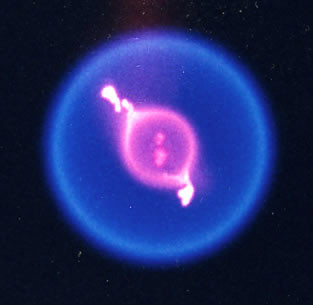
NASA’s Flame Extinguishment Experiment (FLEX) which has run for the past three years and ended in December 2011, has provided insight into how fires behave in a space craft, where there is no up or down. And if we know a bit about how fires behave in space then we can have a better idea of how to fight such fires which is useful in small spaces like the kind found in the International Space Station.

Researchers performed over 200 experiments igniting a drop of heptane or methanol. The bubble of fuel becomes a spherically symmetric flame (as you can see in the video below), that shrinks as it burns fuel.

Fire in space burns at a lower temperature and rate—nearly 100 times slower—and with less oxygen than in normal gravity. So materials used to extinguish fires in space must be in higher concentrations. The International Space Station has CO2 fire extinguishers and the researchers tested how flames burn in the presence of different concentrations of CO2. Perhaps most useful for the space station, the FLEX experiments determined an index for completely fire-safe air. Meaning, the limit where there is not enough oxygen in the air for fuel to ignite. The team found this limiting oxygen index for methanol and heptane.

But there are other very strange phenomena that the team continues to try and explain. When the flame around a fuel droplet dies out, even if fuel is still available, the droplet should stop shrinking. This is how combustion typically works. But there were instances during the FLEX studies where heptane droplets continued to shrink at the same rate as they did when surrounded in flame. The lead researcher Forman Williams—who has been studying fires since for 50 years—has never seen anything like this. It’s as if the heptane continues to burn with no fire. A good enough reason to keep studying. FLEX-2 started this year and will continue through 2012.

Start your week smarter with our weekly e-mail newsletter. It's your cheat sheet for good ideas. Get it.

Christie Nicholson

About Christie Nicholson

Christie Nicholson is a contributing editor for SmartPlanet.

Christie Nicholson

Christie Nicholson

Contributing Editor

Christie Nicholson produces and hosts Scientific American's podcasts 60-Second Mind and 60-Second Science and is an on-air contributor for Slate, Babelgum, Scientific American, Discovery Channel and Science Channel. She has spoken at MIT/Stanford VLAB, SXSW Interactive, the National Science Foundation, the National Research Council, the Space Studies Board and Brookhaven National Laboratory. She holds degrees from the Columbia University Graduate School of Journalism and Dalhousie University in Canada. She is based in New York.

Follow her on Twitter.

Christie Nicholson

Christie Nicholson

Christie Nicholson does not hold any investments in the technology companies she covers.

She writes for SmartPlanet and is not an employee of CBS.

If you liked this, don't miss...
2
Comments

Join the conversation!

Follow via:
RSS
0 Votes
+ -
Perhaps faulty observations are at hand.
It's as if the story of Moses and the burning bush got screwed up. The bush burned but was not consumed by the fire. According to the experiment described in this article, there were instances where the heptane droplet was "consumed" but did not burn. I would be more confident in the fellow's assertion that it did not burn if the observation/recording was made using an infra-red camera to confirm the absence of an exothermic reaction consuming the fuel or something as simple as dispersal of the heptane via evaporation, accelerated by heating. Personally, I think the best way to fight a fire in space is not to have a fire ignite in the first place. Any possibility of fire should be designed out of the systems that share an atmosphere breathed by humans. Absent this approach, perhaps everybody getting into a pod or pods, then opening a hatch (very small just for this purpose) and evacuating the craft of noxious fumes as well as oxygen and cooling down the interior considerably would be helpful. When a fire occured on a Russion space station several years ago, metal parts liquified and were floating around inside the capsule. Initial attempts to kill the fire with a CO2 extinguisher resembled a physics experiment as both men holding the extinguisher suddenly turned into a rocket and flew through the burning craft. They remembered their high-school physics and remembered to hold onto something (part of the craft) during their second try, which succeeded in killing the fire, while simultaneously adding to the toxic mixture of gases floating around the capsule. As luck would have it, their gas mask filters held out just long enough for the air filtration system to clean the air enough to survive. Personally, I think that all space travel should be mandated as non-smoking flights.
Posted by PSFTGURU@...
Updated - 1st Feb 2012
0 Votes
+ -
Perhaps just faulty editing.
It's as if Christie Nicholson was channeling Boonsri Dickinson's mastery of English!!
Posted by davecohn@...
1st Feb 2012
Join the conversation
Formatting +
BB Codes - Note: HTML is not supported in forums
  • [b] Bold [/b]
  • [i] Italic [/i]
  • [u] Underline [/u]
  • [s] Strikethrough [/s]
  • [q] "Quote" [/q]
  • [ol][*] 1. Ordered List [/ol]
  • [ul][*] · Unordered List [/ul]
  • [pre] Preformat [/pre]
  • [quote] "Blockquote" [/quote]

Join the SmartPlanet community and join the conversation! Signing up is fast and free. Don't wait -- we want to hear your opinion!