Follow this blog:
RSS

New technology may help electric cars charge up quicker

By | January 4, 2011, 5:52 PM PST

Credit: Nissan

Credit: Nissan

As Americans began to embrace hybrid cars, some experts predicted that all-electric vehicles would eventually rule.

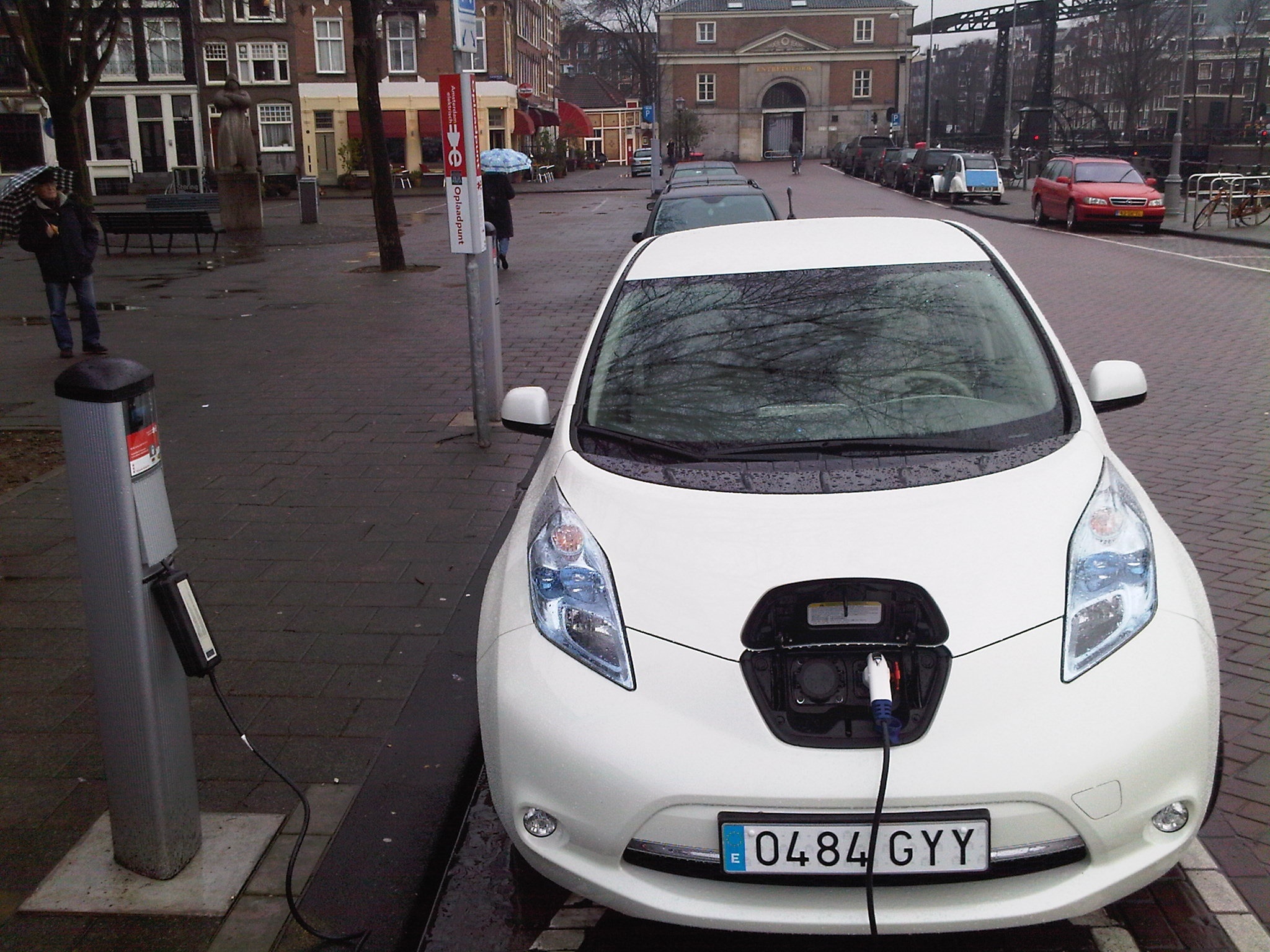
Lately though, that future was starting to appear further and further down a seemingly distant road. Yes, the first fully-electric mass-produced vehicle did finally arrive when the Nissan Leaf rolled off the assembly line back in December. But if you’re hoping the car offers the same ease of use and versatility of the typical family sedan, don’t hold your breath.

Recharging a Leaf can take up to 20 hours when plugged into a 110/120 volt, 15-amp outlet, according to Nissan’s product website. You can get it fully juiced up in eight hours if you find a charging station that offers Level 2 charging. Anyone who’s ever delayed leaving the house because their smartphone still needed to be recharged can imagine how inconvenient this can be.

Scientists are aware of the problem. That’s why a team of researchers at the Rensselaer Polytechnic Institute in New York are working on a new battery material that would allow for much faster recharging than what’s possible with today’s battery technology.

“Charging my laptop or cell phone in a few minutes, rather than an hour, sounds pretty good to me,” Nikhil Koratkar, a professor at Rensselaer, said in a statement. “Moreover, this technology could potentially be ramped up to suit the demanding needs of batteries for electric automobiles.”

The trick to faster charges involves the battery’s anode structure. This electrode structure inside standard Li-ion batteries literally expands as the battery charges and shrinks when it is being discharged. If the anode experiences these changes too quickly, intense stress can build up, causing the battery to overheat and fail. That’s why the batteries in portable gadgets like cell phones and laptops are designed to charge closer to a snail’s pace to prevent stress-induced damage.

The new material, dubbed “nanoscoops,” has greater structural flexibility and can handle the stress of extremely rapid charging.

However, the material is too lightweight for practical use and the team hopes to figure out a way to scale up the material’s mass to where the technology can help power electronics and automobiles.

Start your week smarter with our weekly e-mail newsletter. It's your cheat sheet for good ideas. Get it.

Tuan C. Nguyen

About Tuan C. Nguyen

Tuan C. Nguyen was a contributing editor for SmartPlanet from 2011 to 2013.

Tuan C. Nguyen

Tuan C. Nguyen

Contributing Editor

Tuan C. Nguyen is a freelance science journalist based in New York City. He has written for the U.S. News and World Report, Fox News, MSNBC, ABC News, AOL, Yahoo! News and LiveScience. Formerly, he was reporter and producer for the technology section of ABCNews.com. He holds degrees from the University of California Los Angeles and the City University of New York's Graduate School of Journalism.

Follow him on Twitter.

Tuan C. Nguyen

Tuan C. Nguyen

Tuan C. Nguyen does not hold any investments in the technology companies he covers.

He writes for SmartPlanet and is not an employee of CBS.

If you liked this, don't miss...
11
Comments

Join the conversation!

Follow via:
RSS
+1 Vote
+ -
RE: New technology may help electric cars charge up quicker
Until you can pour energy into an electric car at a rate comparable with pouring in hydrocarbon fuel, it will fail to compete for the long haul market.

The solution is replaceable leased batteries - then you can move energy at the required rate. But that needs a standard form fit and function solution across the industry before world-wide adoption can happen, and in our current litigious patent-ridden competitive climate that just won't happen.

Our business leaders will need to mature up first.
Posted by PassingWind
5th Jan 2011
+1 Vote
+ -
Battery powered motors need only 1/3 rd the energy of gasoline engines.
So you will need to be able to pour in the energy at 33% the rate of gasoline to achieve range parity at the pump. Though with all of the electric propulsion advantages and a full tank to start each morning (with out the need to visit a gas station), would even this rate be necessary to reach a level playing field? Time will tell.
Posted by jeffhre
20th Jul 2011
+1 Vote
+ -
RE: New technology may help electric cars charge up quicker
Shai Agassi's company Better Place allows leased battery replacement in about a minute at battery swapping stations going in this year in several place around the world like Israel, Denmark and Australia. You drive over the replacer and the big battery is swapped from underneath.
My son has a good idea. Use many much smaller batteries, say flashlight battery size, and the batteries would be in a loop or sequence in the car. Then the "filling station" would consist of pushing out the most discharged batteries into a receiver (to be recharged) and pushing in fully charged batteries. You'd replace just the number of batteries you'd need to get to the next socket or recharging station (home or office).
These replacers could be must more ubiquitous (like gas stations) and standardized batteries could fit all cars (like gas).
Posted by skipdykoski@...
5th Jan 2011
+1 Vote
+ -
Quicker Charge Up
I like your son's idea. Tesla could apply something like it, if it could be engineered into their battery packs at reasonable cost.

Better Place treats the batteries and charging like gasoline and locks you in at long term rates. I'd like to see a business model where batteries, cables, chargers/EVSE's adapters etc were treated like gasoline. And electricity is a nominal owner maintenance expense, like oil changes for an ICE vehicle.
Posted by jeffhre
20th Jul 2011
+1 Vote
+ -
Government is the solution
Regulation and tax incentives are the carrot/stick needed to make this happen. Business leaders have one single goal: maximize profit no matter the environmental cost. That's their job. If they do anything else, they can be sued by shareholders. So the big bad evil government is the actula solution. Regulate and incentivize and you level the playing field.
Posted by doctordawg
5th Jan 2011
+1 Vote
+ -
RE: New technology may help electric cars charge up quicker
very nice to hear this story.
the electric car will become popular in the future.
http://www.chinaeu.de/
Posted by chinaeu
23rd Feb 2011
+1 Vote
+ -
RE: New technology may help electric cars charge up quicker
I live in 'Sunny' Queensland, Australia (where it's currently raining . . .)

This sort of quick-charging battery would allow me to charge a battery at home, using solar ( - or hydro ! ), which would then quickly recharge my car battery later.

Therefore my carbon footprint and fuel costs would both be zero.

(After having bought and installed the equipment.)

Alternatively, having interchangeable battery packs would allow me to recharge a battery pack using Solar whilst I drove using another.

The furure's out there, and the future's cheap ! - ish.
Posted by tomsdaddy@...
11th Mar 2011
+1 Vote
+ -
RE: New technology may help electric cars charge up quicker
I have some agreement with all the above. Electrical power is the future. Hydrocarbon fuels must go away if for no other reason than that we have many other uses for them than burning them up.
Batteries, and generating the electricity to charge them, are the last stumbling blocks. While even the filthiest coal burning power plant in the country can produce a calorie of energy much more efficiently and cleanly than a car engine can, it's still not the real solution.
(An aside here, please. People tend to forget that while an all electric car emits zero pollution, it has to get it's electricity from somewhere, and that somewhere these days is usually nuclear or hydrocarbon fueled plants.)
I agree about charging times. I admit I just will not wait 30 to 45 minutes to recharge a car to go about 85 miles, when I can pump enough gas to go 250 miles in about 5 minutes. What are we supposed to do for that 30 to 45 minutes at the recharge station? Will they provide entertainment? What if you really need to be somewhere quickly? How about hammocks so we can take a nap.
So I will, as I have for twenty plus years, suggest capacitors instead of batteries. They have at least one distinct advantage - they charge very quickly.
Any electrical engineers out there who would please comment on this?
Posted by John T. Hill III
19th Mar 2011
+1 Vote
+ -
electric carss
electric car is really a great help to our environment ....
Posted by lackneramanda
Updated - 13th Jul 2011
+1 Vote
+ -
Not really
We have active volcanoes above and below the oceans surface pumping out lots and lots of heat.
Bacteria that breaks down organic compounds, Cows and other ruminant farm animal produce methane which is 20-50 X more effective as a greenhouse gas than CO2 is also produced in prodigious quantities from frozen methane ice deap in the oceans that is distubed and liberates the methane gas into the atmosphere.
It seems to me that these natural forces are orders of magnitude greater than the highly publicised human footprint.

Although I agree that we should not add to the problem. Let's put it in perspective.
Posted by TonyTrenton
Updated - 30th Jul 2011
+1 Vote
+ -
What about using both!
Fast charge a capacitor to then charge the batteries.
What is the power density relative to the weight between batteries & capacitors?
Posted by TonyTrenton
30th Jul 2011
Join the conversation
Formatting +
BB Codes - Note: HTML is not supported in forums
  • [b] Bold [/b]
  • [i] Italic [/i]
  • [u] Underline [/u]
  • [s] Strikethrough [/s]
  • [q] "Quote" [/q]
  • [ol][*] 1. Ordered List [/ol]
  • [ul][*] · Unordered List [/ul]
  • [pre] Preformat [/pre]
  • [quote] "Blockquote" [/quote]

Join the SmartPlanet community and join the conversation! Signing up is fast and free. Don't wait -- we want to hear your opinion!