Follow this blog:
RSS

Making time stand still without moving the planets

By | December 30, 2011, 8:51 AM PST

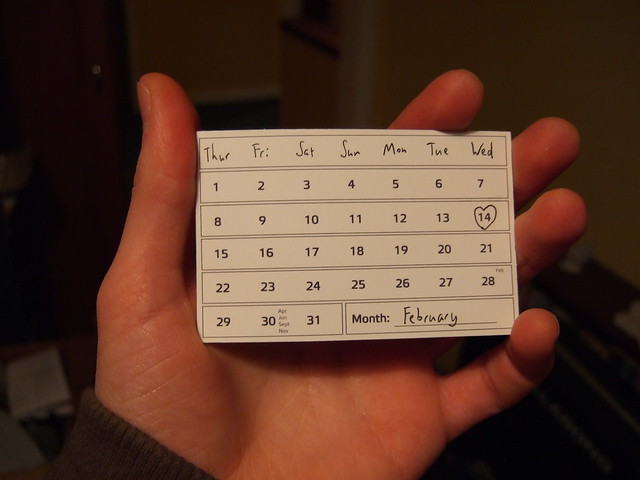
Calendar Card - February

An economist and an astrophysicist have found one way to make time more consistent, on repeat. We are not talking about the movie Groundhog Day. These scientists have created a new calendar where each new 12 month period is identical to the one before. And remains that way in perpetuity.

The Hanke-Henry Permanent Calendar, named after its creators Richard Conn Henry (the astrophysicist) and Steve H. Hanke (the economist), would have Christmas fall on a Sunday and it would also fall on a Sunday in 2012, 2013, and 2014 and so on. So 30 days hath September, April, June and November can be tossed out of your memory. In the new calendar, September, March, June and December would have 31 days, and the rest would have 30.

But honestly, why do this? The Gregorian calendar, which we’ve been using since 1582—when Pope Gregory altered a calendar that was instituted in 46 BC by Julius Caesar—is working pretty well.

The scientists explain in a press release:

“Our plan offers a stable calendar that is absolutely identical from year to year and which allows the permanent, rational planning of annual activities, from school to work holidays,” said Henry. “Think about how much time and effort are expended each year in redesigning the calendar of every single organization in the world and it becomes obvious that our calendar would make life much simpler and would have noteworthy benefits.”

Yes having birthdays and holidays fall on the same day every year might make it easier to remember them. Especially for those who travel internationally. But really? All that work just to remember holidays?

Well apparently it can be economically helpful as well. At least calculating interest on mortgages would become a lot easier. Hanke explains:

“Our calendar would simplify financial calculations and eliminate what we call the ‘rip off’ factor,’” said Hanke. “Determining how much interest accrues on mortgages, bonds, forward rate agreements, swaps and others, day counts are required. Our current calendar is full of anomalies that have led to the establishment of a wide range of conventions that attempt to simplify interest calculations. Our proposed permanent calendar has a predictable 91-day quarterly pattern of two months of 30 days and a third month of 31 days, which does away with the need for artificial day count conventions.”

Of course Hanke and Henry are not the first to attempt a new calendar. But they do think theirs offers new advantages. All of the major calendar reforms have involved breaking the seven-day cycle of the week. And this is a real issue because it violates the Fourth Commandment, “Remember the sabbath day, to keep it holy.” Hanke and Henry don’t break the cycle.

But here’s the real challenge in designing a new calendar. The fact that Earth years are 365.2422 days long. How does one deal with those extra bits of days? Well the Hanke-Henry calendar drops leap years altogether and adds an extra week at the end of December every five or six years. And this, they say, brings their calendar in sync with the seasons as the Earth circles the sun.

But Hanke and Henry want to go every further and boldly recommend we abolish time zones and adopt Universal Time (Greenwich Mean Time) in order to synchronize global dates and times. That way business meetings, school calendars would be the same year after year. The authors argue in a paper published earlier this month in Globe Asia, “Today’s cacophony of time zones, daylight savings times and calendar fluctuations, year after year, would be over. The economy — that’s all of us — would receive a permanent ‘harmonization’ dividend.”

[via Eurekalert]

[Photo Joe Lanman]

Start your week smarter with our weekly e-mail newsletter. It's your cheat sheet for good ideas. Get it.

Christie Nicholson

About Christie Nicholson

Christie Nicholson is a contributing editor for SmartPlanet.

Christie Nicholson

Christie Nicholson

Contributing Editor

Christie Nicholson produces and hosts Scientific American's podcasts 60-Second Mind and 60-Second Science and is an on-air contributor for Slate, Babelgum, Scientific American, Discovery Channel and Science Channel. She has spoken at MIT/Stanford VLAB, SXSW Interactive, the National Science Foundation, the National Research Council, the Space Studies Board and Brookhaven National Laboratory. She holds degrees from the Columbia University Graduate School of Journalism and Dalhousie University in Canada. She is based in New York.

Follow her on Twitter.

Christie Nicholson

Christie Nicholson

Christie Nicholson does not hold any investments in the technology companies she covers.

She writes for SmartPlanet and is not an employee of CBS.

If you liked this, don't miss...
3
Comments

Join the conversation!

Follow via:
RSS
0 Votes
+ -
Interesting proposal.
At this point it sounds like it is being driven by laziness justified by an economics argument. The randomness of todays system is too much for the sheep in todays society to handle.

I was told years ago by a teacher that a good judge of a persons ability to adjust to a changing situation is if they can tell you what the date will be a week from today. It is amazing how many people cannot figure out that simple fact even in the middle of the month. (January 6th 2012 for those running for a calendar)

Back to the question at hand, I do not see this kind of calendar being widely accepted until space travel is more common place. Once large numbers of people are in space at any given time, at orbital stations or a lunar colony, a plantery standard time becomes more important to properly sync communications with earth.

The hardest part of such a change will be going to work at 11 pm when the sun is high in the sky. That will take some adjusting for many people.
Posted by Hates Idiots
30th Dec 2011
0 Votes
+ -
Time to rethink Time
I think "time" is funny, but somewhat adequate for us earthlings.

Between leap years and leap days, eg leaping over the last friday of the year by samoa, time is really in-precise and cannot be used for space travel.

Further, the calendar that the world uses today is off by 300 years, because a roman emperor around 300 a.d. decided to reset it to 0.

Perhaps, its time to rethink and re-do the method for measuring time - now that we have super computers, instead of sticks and stones, and imaginary gods.
Posted by databaseben
30th Dec 2011
0 Votes
+ -
Base month calender on the lunar cycle
If you have thirteen months of twenty-eight days, and one new years day (two new years days every four) then the months would cycle with the moon. The day the full moon would appear on the same day of each month and progress through the years by one day (two on the fourth year) until the cycle repeated after the 21st year. It would throw out all the uneven months, and really give some significance to the new year as it would be it's own day (not even a day of the week). New years day would be its own identity - it would not be one of the seven days of the week, which means if you started the year with a Monday, Sunday would be the last day of the year, you would have New Years Day, then the following day would be Monday. The days of the week would always correspond to the same numerical day of the month.
Posted by t.harkins
Updated - 20th Dec
Join the conversation
Formatting +
BB Codes - Note: HTML is not supported in forums
  • [b] Bold [/b]
  • [i] Italic [/i]
  • [u] Underline [/u]
  • [s] Strikethrough [/s]
  • [q] "Quote" [/q]
  • [ol][*] 1. Ordered List [/ol]
  • [ul][*] · Unordered List [/ul]
  • [pre] Preformat [/pre]
  • [quote] "Blockquote" [/quote]

Join the SmartPlanet community and join the conversation! Signing up is fast and free. Don't wait -- we want to hear your opinion!