Follow this blog:
RSS

Incandescent bulb efficiency improves, but falls short of CFLs, LEDs

By | July 8, 2009, 9:33 AM PDT

With new conservation standards set to take effect in 2012 and President Obama announcing last week he wants to ratchet that up further, I thought we are seeing the last of watt-guzzling incandescent light bulbs.

Apparently, lighting giant Philips has other ideas. It’s new Halogena Energy Savers incandescent bulbs promise an average energy savings of 30%, last up to two years and “contain no mercury.” In short, its 40 and 70 watt bulbs replace 60 and traditional 100 watt bulbs (technically, Philips claims a savings of 22-47 percent).

While the savings is substantially less than compact fluorescent lights (CFLs) and LEDs both which cut electricity consumption by 80% or more over incandescents, they are safer. Breaking a CFL could cost you thousands to clean up the mercury and generate angst over toxicity in the home.

We have CFLs in our home and handle them with the utmost care. We remove them and re-install incandescent bulbs when we rent out a second home. Beyond the Brandy Bridges story two years ago, I haven’t heard much about CFLs breaking and the DOE now seems to bless cleaning them up yourself as long as you follow its disposal instructions. End of life disposal remains an issue and you just know many make their way into land fills and incinerators.
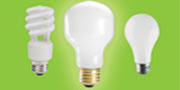
Halogena (middle) versus CFLs and traditional bulbs

Halogena (middle) versus CFLs and traditional bulbs

In my research, LED lighting offers the best alternative to CFLs except for the expense. They generally cost more than $20 and rocket up from there depending on the application. One Evolux S bulb pumps out 900 lumens at 13 watts, but starts at about $70 (shop around online for sure….differences in price can be substantial).

The bulb is billed as a 100-watt bulb replacement, but only produces just over half as many lumens as a traditional incandescent, but its makers says it will last for up to 50,000 hours which for me in my late fifties feels like forever.

As for Philips’ Halogena line of incandescent bulbs, I don’t see the appeal unless you can’t stand the light produced by CFLs and LEDs which can be starkly white. Yes, they dim while CFLs and LEDs generally don’t and are mercury-less.  They cost about $5-$10 and at the moment are available only from Amazon.com and Home Depot.

[Last Sunday's New York Times does a good job of explaining how Halogena recaptures heat given off by traditional incandescents and coverts it back to light.]

I don’t notice the difference in CFL light and nor does my wife who originally objected to losing the soft light of incandescents when we started a mass bulb replacement two years ago.  Being something of a miser, the economics of CFLs (and eventually LEDs) to me are a no-brainer. My electric bill dropped $30 a month using CFLs which easily paid for themselves in the first year - as long as I don’t break one. Going green feels good, too.

And if you can believe it, President Obama last week actually held a press conference on light bulbs. He said lighting consumes 7 per cent of all our electricity or the output of 14 coal fired plants. Energy efficient bulbs could save consumers $4 billion a year, he said. Some $346 million of the stimulus money is earmarked for energy efficiency in the home.

Start your week smarter with our weekly e-mail newsletter. It's your cheat sheet for good ideas. Get it.

John Dodge

About John Dodge

John Dodge was a contributing editor for SmartPlanet from 2009 to 2010.

John Dodge

John Dodge

Contributing Editor

John Dodge has written for the Wall Street Journal, Boston Globe, PC Week (now eWeek), EDN, Design News, Electronic Business, Bio-IT World, Health-IT World, Lowell Sun, Haverhill Gazette and Newburyport Daily News. He is based in Massachusetts.

Follow him on Twitter.

John Dodge

John Dodge

John Dodge prides himself on completely independent journalism. His opinions, observations and reporting are not influenced by any financial holdings. He holds no shares in computer, electronics, software or Internet companies. He also has no business affiliations with organizations except with those for which he creates content as a freelancer.

He writes for SmartPlanet and is not an employee of CBS.

6
Comments

Join the conversation!

Follow via:
RSS
+1 Vote
+ -
RE: Incandescent bulb efficiency improves, but falls short of CFLs, LEDs
You should leave the CFL's in the house when you rent it out John. The amount of mercury that could accidentally be released into the environment is miniscule in comparison to the amount of mercury released from coal and natural gas power plants when providing the extra energy needed to power the highly inefficient incandescents.
Interesting tidbit about the Halogena energy saver line by Philips. While they're still legal it does make some sense to make a more efficient non-mercury bulb for all those people out there who's only excuse for not making the switch is that they are afraid of the mercury but LEDs are still too expensive.
Also, home and specialty LEDS are right around the corner and they will have dimming capabilities.
Keep up the good work John!
Posted by MitchRing
8th Jul 2009
+1 Vote
+ -
RE: Online Makeovers for Baby
We have been living in Montana for the past 5 years and I am not supri sexshop to find it #3 on the "worst" list. Considering a sexy shopmove to Idaho to escapthe high cost of living a low income in MT. There may not be a sales tax here but they get you if you own property!
Posted by filhomarques
23rd Jul 2011
+1 Vote
+ -
Great - But doesn't justify banning ordinary light bulbs!
Certainly it's fun to try out new lights...
and even better if you save on doing it!

But of course it doesn't justify banning ordinary light bulbs:
Americans choose to buy ordinary light bulbs around 9 times out of 10.
Banning what Americans want gives the supposed savings - no point in banning an impopular product!

If new LED lights -or improved incandescents- are good,
people will buy them - no need to ban ordinary light bulbs (little point).
If they are not good, people will not buy them - no need to ban ordinary light bulbs (no point).
The arrival of the transistor didn't mean that more energy using radio tubes had to be banned... they were bought less anyway.

All lights have their advantages.
The ordinary simple light bulb has for many people a pleasing appearance, it responds quickly with bright broad spectrum light, is easy to use with dimmers and other equipment, can come in small sizes, and has safely been used for over 100 years.

100 W+ equivalent brightness is a particular issue - difficult and expensive with both fluorescents and LEDS - yet such incandescent bulbs are apparently first in line for banning (as in the EU)!

There are also problems in achieving small size bright bulbs with fluorescents and LEDS, while halogens, related to ordinary bulbs -like the Philips type you mention- are only slightly more efficient, and will gradually be phased out too given the proposed efficiency limits.

In any case:
Since when does America need to save on electricity?
There is no energy shortage, there are plenty of local energy sources, Middle East oil is not used for electricity generation.
Consumers pay for any power stations, just as they do for factories and shops generally.
Certainly it is good to let people know how they can save energy and money - but why force them to do it?


Anyone say emissions?
OK: Does your light bulb give out any gases?
Power stations might not either:
In Washington state practically all electricity is emission-free, while around half of it is in states like New York and California.
Why should emission-free Seattle, New York and Los Angeles households there be denied the use of lighting they obviously want to use?
Low emission households will increase everywhere, since emissions will be reduced anyway through the planned use of coal/gas processing technology or energy substitution.

Also, the savings amounts can be questioned:
For a referenced list of reasons against light bulb bans, see
http://www.ceolas.net/#li1ax onwards
Posted by lighthouse10
13th Jul 2009
+1 Vote
+ -
RE: Incandescent bulb efficiency improves, but falls short of CFLs, LEDs
Agree the opinion that LED lighting offers the best alternative to CFLs except for the expense.http://www.fosintl.com/
Posted by Meican
15th May 2010
+1 Vote
+ -
I have just one question for all you people. What are you doing to ...
remove flicker from the led lights and all the other because there are people who cannot use anything but the incandescent light bulbs. One such example is my roommate. Once the incandescent bulbs are illegal He is planning on starting a lawsuit because he doesn't want to live in a dark house. Many people cannot use any kind of lighting that flickers which means that electric companies are going to have to either produce dc current not converted from ac to dc but strictly dc current for those people or they are going to have to stick with incandescent bulbs. So what is being done for all of those people. The have a right to have lighting in their house.
Posted by dougogd@...
26th Jul 2010
+1 Vote
+ -
wakee
Very significant article for us ,I think the representation of this article is actually superb one. This is my first visit to your si
Posted by tariq456
18th Oct 2011
Join the conversation
Formatting +
BB Codes - Note: HTML is not supported in forums
  • [b] Bold [/b]
  • [i] Italic [/i]
  • [u] Underline [/u]
  • [s] Strikethrough [/s]
  • [q] "Quote" [/q]
  • [ol][*] 1. Ordered List [/ol]
  • [ul][*] · Unordered List [/ul]
  • [pre] Preformat [/pre]
  • [quote] "Blockquote" [/quote]

Join the SmartPlanet community and join the conversation! Signing up is fast and free. Don't wait -- we want to hear your opinion!