Caltech's cheaper solar cell promises to double efficiency

Caltech researchers claim they have developed a solar cell that is twice as efficient as conventional solar wafers and that could be much cheaper to make.
Using silicon wire arrays, the Caltech researchers claim they can trap up to 85 per cent of the collectible sunlight and convert 90-100 per cent of it into electrons, aka electricity. Conventional photovoltaic cells convert about 40 per cent of the light they absorb into electricity.
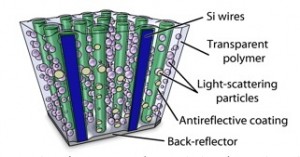
The new technology is explained in a Feb. 14 article in Nature Materials.
Researcher Harry Atwater, Howard Hughes Professor, professor of applied physics and materials science, and director of Caltech's Resnick Institute, explained the new type of cell in a Caltech press statement.
"Many materials can absorb light quite well but not generate electricity—like, for instance, black paint. What's most important in a solar cell is whether that absorption leads to the creation of charge carriers. High absorption plus good conversion makes for a high-quality solar cell. It's an important advance."
The silicon wires, 30-100 microns in length and 1 micron in diameter, absorb some of the light while the rest scatters across the cell's surface. The researchers originally hypothesized a much denser concentration of wires would be required, but found the sweet spot was when they covered a mere 2-10 per cent of the cell surface.
"By developing light-trapping techniques for relatively sparse wire arrays, not only did we achieve suitable absorption, we also demonstrated effective optical concentration—an exciting prospect for further enhancing the efficiency of silicon-wire-array solar cells," Atwater said in the press statement.
That only the wires are silicon means the cell is 98 per cent made from a cheap polymer and only two per cent from silicon, which should make them much cheaper to produce than today's silicon-heavy solar wafers.
They are also flexible, meaning they can be produced as thin films and packaged in rolls. Now the researchers will increase the the size of the wire array cell which to date has only been a centimeter.
"We're scaling up to make cells that will be hundreds of square centimters - the size of a normal solar cell."
Follow me on twitter.
This post was originally published on Smartplanet.com