Follow this blog:
RSS

The future of construction: Meet BIM (or else)

By | February 13, 2013, 3:00 AM PST

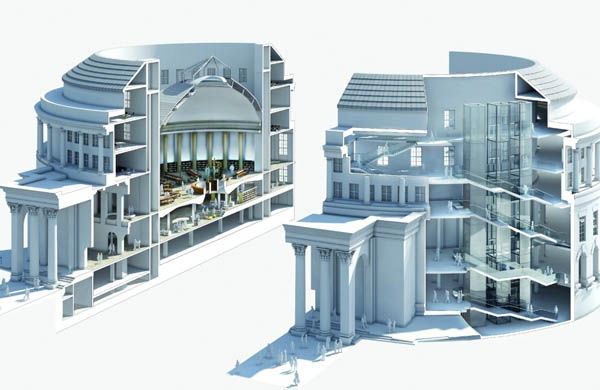
A view into the U.K. library's BIM model, which saved time and cost while also showing the public its proposed designs. (Manchester U.K. City Council)

“Ultimately, we are going to have to work slightly differently.”

That’s the understatement of the decade, made by a cost consultant working on the renovation of the Central Library in Manchester, England. As reported in Building magazine, the associate from Davis Langdon didn’t use BIM — building information modeling — like everyone else on the project. Instead, he requested drawings from the architects and marked them up, the old-fashioned way.

In the case of Central Library, as in tens of thousands of other projects worldwide since, BIM was shown to be a pricey retooling that ultimately paid off by shaving time and costs.

Unlike plain-vanilla CAD, BIM software creates a three-dimensional (3D) model full of smart objects embedded with information. BIM makes it easier to integrate architecture with engineering work, avoid “clashes” of building elements, instantly output lists of materials and labor, and automate valuable tasks like simulating the effects of sunlight an interior space.

As for the cost consultant? BIM is about to eat his lunch, I’m afraid.

The fact is, BIM can do much of the estimator’s work. In addition to its built-in database about practically every material and product, BIM software can track the cost consequences of every design change in real time — live, as they say — and even take the client on a “walkthrough” of the revised design via full-color, 3D animation.

Sound good? In fact, recent changes in the construction kingdom portend a full industry shift to BIM. Soon it will be in every architect’s toolbox, as these six key trends suggest:

1. BIM has become national policy.

The British design and building industry is particularly well aware of BIM’s big implications, according to expert Phil Bernstein, an architect and technologist with Autodesk, which acquired the BIM platform Revit exactly 11 years ago this month.

“BIM is a central theme in the U.K. government construction strategy designed to reduce carbon and costs as a part of overall economic development,” Bernstein said.

Perhaps this should be filed in the “We’ll-Try-Anything” category of escaping a deep economic mess. But David Philp, the country’s cabinet-level head of BIM implementation, contends that technologies like BIM will render many of today’s construction jobs “unrecognizable” by 2050. Another leading Brit, Keith Howells of the big engineering firm Mott Macdonald, equated BIM with the Excel spreadsheet, warning, “If you’re not using BIM in five years time, you’ll probably be out of business.”

David Philp, England's cabinet-level BIM advocate. (Courtesy HM Government / BIS)

David Philp is England's cabinet-level BIM czar. (Courtesy HM Government/BIS)

2. Like Excel, BIM is good business.

A new analysis from McGraw-Hill Construction, The Business Value of BIM in North America*, shows that BIM adoption in that region expanded from 17 percent in 2007 to 71 percent in 2012, “demonstrating impressive growth despite the recent economic pressures.”

It is likely that some contraction in design and build firms helped fatten up those numbers. But still … don’t you wish you had invested in BIM when those housing bubbles popped?

Construction is an international market, of course, and companies such as GraphisoftBentley and Autodesk see even faster BIM growth coming in China, Japan and Brazil — exceeding the 70 percent adoption rate in America.

3. Builders use BIM more than architects.

Here’s another strange fact from the McGraw-Hill study: The adoption rate of BIM among builders actually exceeds that of architects.

This phenomenon was first reported last fall, when research showed that 74 percent of contractors roll with BIM, with architects trailing at about 70 percent.

This is important news: Architects will need BIM skills to work with some builders, making it a prerequisite for certain projects. But it also suggests a potential loss of leadership by the design team as contractors take control of “the model” — for good or for bad.

More than mere pictures of building products, these BIM objects have embedded data and can be dropped right into a building project's BIM model. (Courtesy Bilco)

More than mere pictures of building products, these BIM objects have embedded data and can be dropped right into a building project

4. The cloud is BIM’s next big thing.

What’s next for the technology itself? The shift from desktop to the cloud and mobile will transform BIM and upend the world of architecture once again. Among the changes that you can expect: Cloud computing will support BIM with detailed analytical tools, zapping answers to directly to client meetings and construction sites in real time.

“When BIM data is cloud-based, it becomes accessible for CPU-intensive analytical processes that can leverage the representation to create simulations,” Bernstein explained. “Imagine an energy analysis routine running virtually in a parallel with a designer’s copy of Revit, giving her real-time feedback on her scheme as it unfolds?”

With that idea in mind, BIM software developer Graphisoft last week released the public beta version of its EcoDesigner STAR, which places energy analysis in the heart of the architect’s familiar BIM work environment.

Down the line, projects teams will use smartphones and tablet computers to query huge BIM models — a “significant shift from traditional desktop-based workflows,” Bernstein said. That “likely portends an age where that same information drives computer-controlled fabrication equipment that creates buildings that are assembled, not stick-built.”

A fabrication model for a new building in Dubai. (Courtesy HOK)

A fabrication model for a new building in Dubai. (Courtesy HOK)

5. BIM can protect us from superstorms.

For decades, low-bid contracting has been the law of the land, required for all federal and state building projects. With the rise of BIM, Bernstein and others have argued that construction deals can now be based instead on project outcomes.

“With today’s building technologies, project teams can simulate the behavior of proposed designs and test digital prototypes for resilience before they are ever constructed,”Bernstein wrote for Fast Company, explaining how BIM could inspire designs that reduce storm-related building damage.

The influence could extend beyond durability and resiliency. Compliance with safety rules, toxicity levels, and even energy regulations could be outcome-based, taking construction contracts to a high level of specificity.

“Architects are taking more and more responsibility for the energy performance of their designs,” said Laszlo Vertesi, vice president of development for Graphisoft, in explaining the benefit of EcoDesigner STAR. The product enables architects to use ArchiCAD’s BIM directly as a building energy model, or BEM, replete with performance reports to meet the scrutiny of agency officials and green building advocates.

From BIM model to big building: HOK's Baku Flame Tower in Azerbaijan, designed and built with BIM. (Courtesy HOK)

From BIM model to big building: HOK

6. Owners might demand it.

I’ve been hearing this since the advent of BIM technology over a decade ago, but it has never happened. Yet.

Experts such as Patrick MacLeamy, CEO of HOK and chairman of buildingSMART International, point out that top building owners and developers are starting to ask for BIM models as part of their project deals, another factor that is forcing broader adoption.

“Over the next 10 years, building owners will demand ever-increasing usage of BIM as a precondition, ushering in a new era of accuracy, quality and sophistication for the building industry,” MacLeamy predicted.

BIM vendors like Vertesi and Bernstein agree. “Mid-term, expect growing engagement by building owners to use models as data assets for facilities management,” Bernstein said. “This creates opportunity for designers and builders to provide those datasets as part of the delivery of buildings, and owners an opportunity to use more than old prints of drawings and guesswork to run their valuable assets.”

Mental note for that U.K. cost consultant, perhaps?

*Disclosure: I do some freelance writing for McGraw-Hill Construction’s continuing education group.

Start your week smarter with our weekly e-mail newsletter. It's your cheat sheet for good ideas. Get it.

Chris Sullivan

About Chris Sullivan

C.C. Sullivan is SmartPlanet's architecture columnist.

Chris Sullivan

Chris Sullivan

Columnist, Architecture

C.C. Sullivan is principal of a marketing and advertising agency by the same name focused on the shelter, construction and architectural markets. Formerly, he was chief editor of the magazines Architecture and Building Design & Construction, and launched the Home of the Year awards with Metropolitan Home. He holds a degree from Yale University and previously worked for the architects Tai Soo Kim, Emery Roth & Sons, and Angel Fernandez Alba (Madrid).

Follow him on Twitter.

Chris Sullivan

Chris Sullivan

In addition to working as a journalist, C.C. Sullivan owns a marketing consulting business by the same name and is a partner in SullivanMumford LLC. (A list of clients can be found here and here.) In the unusual event that his writing mentions a company or organization for which he currently provides or previously provided any editorial or marketing services, he will disclose that fact. He will also do the same should he cover any companies in which he holds stocks or other investments.

He writes for SmartPlanet, but is not an employee of CBS.

If you liked this, don't miss...
6
Comments

Join the conversation!

Follow via:
RSS
0 Votes
+ -
Should welcome the change.
Though BIM seems very expensive to me..... it wont take much time to become the norm of the industry just as CAD. It would also be very useful in case of construction project monitoring too if the sync it with MS project or something like that... its huge, but it can be that the software shall itself present a list of activities and form networks ! It would be huge !
Posted by S. Shah
14th Feb
0 Votes
+ -
BIMReview
If anyone would like a free demonstration of the best British BIM software on the market then email me ( d dot jackson @ acecadsoftware dot com) Maybe you just have some questions about what impact this may have on your business... drop me a line, i'm happy to help!
Posted by David Jackson101
15th Feb
0 Votes
+ -
Welcome to the fold
I've been saying it for years, Chris wink
Posted by jyoders19
18th Feb
0 Votes
+ -
MIB
This is the future
Posted by markce456
21st Feb
+1 Vote
+ -
So what's new?
I've been involved with BIM for the last 26 years, since the days of Acropolis, Gable and then Archicad. I have been tolerating the self important, self righteous ... people who have been using 2D drafting programs over that time, and all of the stupidity and outrageous folly that has been generated by uncoordinated drafting.
Admittedly, I think that BIM has only been really viable on PC hardware since 1996, but there has been a total lack of ability at senior management level to grasp what they are doing, or could be doing other than automating the drawing board. A singular lack of imagination and insight that has been a result of the way that architects are trained over the years that those managers were being trained, and a strange, class ridden sort of approach to design that had the "designer" and the Cad-monkey at the heart of it.
The one thing about BIM is that it requires a closer engagement of the designer in the execution of designs. The real advantage of BIM, angry rhetoric aside, is the coordination both within an architect's practice and with the design team as a whole. The amount of waste of material involved in these areas, and the waste of time and money is almost beyond calculation. For these reasons, I would nominated Autocad for crimes against humanity!
Posted by cepmk
12th Mar
0 Votes
+ -
I differ on the views about Davis Langdon decision not to use BIM
I would differ regarding the views about Davis Langdon unwillingness to use BIM for costing. Their decision not to use BIM may be justified. I dont think it means they dont see value in BIM. Unlike designers, the use of BIM for quantity extraction is not as straightforward as many people think. The accuracy of quantities extracted from BIM depends a lot on how the BIM model is developed. From costing perspective it is Garbage in, garbage out. For reliable and efficient quantity extraction from BIM, a cost consultant must closely collaborate with the designers to provide designers with their requirements. This is because Designers often set up BIM with a different goal in mind. So a BIM may look very good but may be useless for meaningful and accurate quantity take off and costing. For instance, in a building, there may be painting on ceilings at 4 m high and some other painting on ceiling at 2.5 m high. Now the cost per square metres in both cases would be significantly different since panting at 4.5 m high requires some form of scaffolding. Unfortunately when architects set up models, they dont do it in a way that split both ceilings into 2 different groups for accurate costing. The same applies to having columns run from floor 1 all the way to the last floor in a multi storey building versus having the column run from top of one floor to underside of the next floor. Here the automated quantity extracted for slabs and columns in both cases would be different. These are just 2 examples. There are many more of such in a building. So for a cost consultant to efficiently use BIM for quantity extraction, the model have to be set up in a way that support costing principles, some of which can have significant cost impact if violated. So it is risky for a cost consultants to automate quantity extraction from such model for the purpose of pricing. That is why on BIM project there is need for early involved of cost consultant during the design process. I am not sure how this project was procured but it appeared that there was no contract requirement for BIM - that itself limit the extent to which the parties can collaborate early. Again whether the designer is ready to go all the way out to allow their approach to design controlled by a cost consultant is another question entirely. So i would not immediately pass a judgment in Davis Langdon for not using the BIM for their services on this project. We have to look more at the contextual issues surrounding the project. For designers its straightforward - for the cost consultant its not so straight forward as it may appear. There has to be an enabling environment to get them the desired efficiency. For many years many architects have use Revit even when nobody on the project knew. They just convert to CAD but they get value in it because they can cut sections and plans etc easily from Revit model. Same with structural engineers, services engineers etc. For the cost consultants its different. The depend on a model not built for what they do. So until there is some harmonization in the building of BIM and the way costing is done, we would continue to see cost consultants do some basic BIM based estimating combined with the traditional 2D estimating because it just wont make sense for them to do complete BIM-based automated quantity extraction, especially from efficiency perspective. So the incentive is not there yet but its increasing as more and more project use BIM. Unfortunately if costing goes wrong cost consultants will have to take the liability for their costing even though it was based on designers model. So if BIM is not in the contract they have no safety net and that also diminish the incentive. If BIM is written in contract and protocol for working is formalized then they have some safety net. It also provide an enabling project environment that allows for early collaboration. I think the impact of BIM for different professional group is different and so the adoption process would also not be the same.
Posted by CalebBIM
12th Mar
Join the conversation
Formatting +
BB Codes - Note: HTML is not supported in forums
  • [b] Bold [/b]
  • [i] Italic [/i]
  • [u] Underline [/u]
  • [s] Strikethrough [/s]
  • [q] "Quote" [/q]
  • [ol][*] 1. Ordered List [/ol]
  • [ul][*] · Unordered List [/ul]
  • [pre] Preformat [/pre]
  • [quote] "Blockquote" [/quote]

Join the SmartPlanet community and join the conversation! Signing up is fast and free. Don't wait -- we want to hear your opinion!