Follow this blog:
RSS

The galactic train wreck of dark matter

By | March 6, 2012, 3:00 AM PST

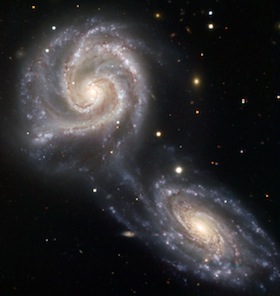
Spiral galaxies NGC 5426 and NGC 5427 in collision. (Credit: ESO)

Spiral galaxies NGC 5426 and NGC 5427 in collision. (Credit: ESO)

When physicists want to understand the deep constituents of fundamental particles, they have the luxury of smashing them together in super-powerful accelerators like the Large Hadron Collider. The subatomic shrapnel that flies out of those collisions can be highly informative about whether the physicists’ theories match reality. Alas, astrophysicists hoping to learn more about the makeup of galaxies don’t have quite the same latitude: galaxies are notoriously hard to push around on command.

Sometimes, however, nature does scientists a favor and delivers the experiment they could never do on their own. Recently, through the Hubble Space Telescope and other instruments, astronomers have been able to check the wreckage of accidental collisions between distant clusters of galaxies for hints about one of the greatest unsolved mysteries in science: dark matter.

To their frustration and surprise, however, the new data may only leave dark matter as more mysterious than ever. Not only do results from a Hubble survey of the galaxy cluster Abell 520 announced this past week contradict physicists’ theories about how dark matter should behave, but they also directly conflict with observations of a similar collision from five years ago.

Dark matter deduced

Galaxies were expected to rotate like water going down a drain. (Credit: Gordon Wrigley)

Galaxies were expected to rotate like water going down a drain. (Credit: Gordon Wrigley)

Back in the 1930s, the astronomer Fritz Zwicky of the California Institute of Technology first noticed something odd about the rotations of galaxies: they were moving as though they had about six times as much mass as all their stars could account for. He and other astronomers would have expected the stars to orbit the centers of their galaxies more or less like particles loosely swirling around a drain. Instead, the stars seemed to revolve in a more rigid formation, like specks on a spinning disk.

Astronomers’ best explanation was that the galaxies’ missing mass must exist as some form of invisible “dark matter” that didn’t reflect light or interact with conventional matter in any way except gravitationally.

Instead, galaxies rotate more like spinning disks because of dark matter. (Credit: Timothy Vollmer)

Instead, galaxies rotate more like spinning disks because of dark matter. (Credit: Timothy Vollmer)

The scientists have batted around various ideas about the nature of dark matter and the current favorite is that it consists of what they call weakly interacting massive particles, or WIMPs. Vast, football shaped halos of WIMPs may extend out beyond the swirling spirals and other configurations of stars in galaxies.

The irony, then, was that everything in the universe visible to us as ordinary matter (or baryonic matter, in the jargon of physics) — all the stars, planets, moons, chairs, trees, and so on — was an exception on a cosmic scale. It represented only 5 percent of all the mass in the university[typo: ha!] universe, whereas dark matter was 25 percent. (The remaining 70 percent is tied up in dark energy, a repulsive force that makes the universe expand and is not to be confused with dark matter.)

For obvious reasons, astronomers have desperately wanted to observe dark matter directly to verify their theories, to little or no avail. Huge subterranean instruments in Italy and Minnesota constructed to detect WIMPs passing through the earth have sometimes reported seeing signals that might betray them, but the general consensus among physicists at the moment is that dark matter has still only ever been seen on a cosmic scale by inferring its presence from its gravitational effects. Dark matter appeared too elusive and too hard to strip away from galaxies’ baryonic matter to see on its own.

Putting galactic collisions to work

Astronomers realized, however, that collisions between clusters of galaxies — which move at millions of miles an hour and are the largest structures in the universe — might succeed in stripping dark matter away from ordinary matter and leaving it relatively exposed (even if it would still be invisible). Even in an ever-expanding universe, the lumpy distribution of galaxies throughout the heavens guarantees that sometimes their trajectories will intersect. When that happens, gravity will make the stars, gas clouds and other baryonic masses in each galaxy cluster mutually interact. They may not actually slam together like cars in a demolition derby (galaxy clusters are mostly empty space, after al) but they can slow one another’s motions and disrupt the galaxies’ shapes.

Not so the galaxies’ dark matter halos, however. Because the dark matter does not interact with much of anything, the slippery, invisible halos should pass right through one another even while their visible matter accompaniments scrape together and tear free.

In 2006 astronomers thought they had discovered proof of their ideas about dark matter. Researchers at the Kavli Institute for Particle Astrophysics and Cosmology turned the Hubble Space Telescope, the Magellan and Very Large Telescopes in Chile, and the orbiting Chandra X-ray Observatory toward the Bullet Cluster, which marks a collision between two galaxies three billion light-years away. As predicted, the mass in the cluster resolved into four clumps: two small ones made of luminous matter in close proximity flanked by two much heavier clumps speeding away from the collision that lacked any visible stars.

Image of Bullet Cluster. Dark matter (blue) has separated from the luminous normal matter (red). (Credit: Chandra X-ray Observatory)

Image of Bullet Cluster. Dark matter (blue) has separated from the luminous normal matter (red). (Credit: Chandra X-ray Observatory)

Astronomers’ sense of vindication lasted only about a year, however. By 2007, astronomers at the University of Victoria in Canada had attempted a similar examination of another gigantic galaxy cluster called Abell 520, about 2.4 billion light-years away. Their results were jarringly different from those for the Bullet Cluster. In fact, they showed very nearly the exact opposite pattern: small, disrupted clumps of luminous baryonic matter were sailing away from the collision site, but most of the mass was still sitting at the center in a relatively starless void.

“]Composite image of Abell 520. The blue-green area pinpoints the location of the dark matter clump. (Credit: NASA, ESA, CFHT, CXO, M. J. Jee, and A. Mahdavi]

Composite image of Abell 520. The blue-green area marks the "dark core" where the dark matter clumps. The reddish areas show less massive clumps of luminous matter. (Credit: NASA, ESA, CFHT, CXO, M. J. Jee, and A. Mahdavi

With some hope that further observations might somehow eliminate the discrepancy, astronomers began examining Abell 520 again in more detail with the Hubble Space Telescope and other instruments. James Jee of the University of California in Davis and his colleagues in California and Canada published the results of those studies last week in The Astrophysical Journal. Disconcertingly, they only confirmed the earlier observations.

As NASA’s press release on the research notes:

“This result is a puzzle,” said astronomer James Jee of the University of California in Davis [...]. “Dark matter is not behaving as predicted, and it’s not obviously clear what is going on. It is difficult to explain this Hubble observation with the current theories of galaxy formation and dark matter.”

Unsettling explanations

What explanations could there be for the differences between how the dark matter has behaved in Abell 520 and in the Bullet Cluster? Several possibilities exist, as Jee and his colleagues have enumerated, but each is rather less savory than the next.

One obvious way to wish away the Abell 520 observations is simply to say that they might be wrong or incomplete. Perhaps the “dark core” of the collision contains more galaxies than the Hubble detected because for some reason, those galaxies contain unusually few stars. The special pleading and odd coincidences involved in making that explanation stand up seem rather far-fetched, however.

Similarly, astronomers could be wrong about the dynamics of the galaxy cluster collisions. The Bullet Cluster was the product of a merger between just two galaxy systems; if Abell 520 emerged from the merger of three, then maybe that difference is enough to explain the discrepancy between the two. Further computer simulations may help to illuminate the problem but it is not immediately clear why a three-cluster collision would end up with so much dark matter at its center.

Physicists also can’t rule out the possibility that dark matter exists in different forms, one of which is “stickier” than the other. That solution might seem like the easiest to embrace: why not simply tack on one more property to such a mysterious substance? The problem is that for the stickiness to exist, then at least some dark matter must be capable of interactions other than the weak ones ascribed to hypothetical WIMPs. And if that is so, it might undermine the standard model of cosmology — a change so disruptive that it would pose more questions than it solved.

The most unsettling of all explanations would be that dark matter doesn’t behave as expected because dark matter doesn’t exist. For almost 30 years, a small minority of physicists inspired by Mordehai Milgrom of the Weizmann Institute have argued that it was wrong to deduce dark matter’s existence from gravitational anomalies in galactic rotations. The more straightforward possibility, they say, is that gravity behaves a little differently on the scale of a galaxy than it does here on earth. They favor a reformulation of gravitational theory called modified Newtonian dynamics (MOND) that tweaks the equations established by Isaac Newton and Albert Einstein.

MOND, too, might disrupt more of physics than it saves, but even putting that objection aside, Abell 520 may not offer much support for the theory. Astrophysicist Arif Babul of the University of Victoria, who was involved in both the previous study and the current one, has been quoted by New Scientist as saying that he and his colleagues tried to fit the observational data into a MOND framework before they wrote up their 2007 paper and couldn’t do it.

So the mystery of dark matter seems to be as profound as ever. Collisions between galactic clusters were supposed to help bring the invisible to light. Instead, they seem to be making a train wreck of the available theories.

Start your week smarter with our weekly e-mail newsletter. It's your cheat sheet for good ideas. Get it.

John Rennie

About John Rennie

John Rennie was a columnist for SmartPlanet from 2011 to 2012.

John Rennie

John Rennie

Columnist, Science

John Rennie is the former editor-in-chief of Scientific American. He has written for IEEE Spectrum, New York Times and The Economist and has appeared on the History Channel, Discovery Channel, NPR and Minnesota Public Radio. He has spoken at the World Business Forum, Massachusetts Institute of Technology, Wharton School of Business, University of Tennessee and Middlebury College and is an adjunct instructor at New York University, editor at large for Txchnologist.com and contributing editor to ecomagination.com. He is based in New York.

Follow him on Twitter.

John Rennie

John Rennie

John Rennie works as a freelance reporter, writer, editor, and lecturer for a variety of publications and organizations, including the websites Txchnologist.com and ecomagination.com, both of which are sponsored by GE. He is also an adjunct instructor in journalism for New York University. (Lists of his affiliations and clients can be found here.) In the unusual event that his writing mentions a company or organization for which he currently provides or previously provided any editorial or marketing services, he will disclose that fact. He will also do the same should he cover any companies in which he holds stocks or other investments.

He writes for SmartPlanet, but is not an employee of CBS.

If you liked this, don't miss...
17
Comments

Join the conversation!

Follow via:
RSS
0 Votes
+ -
Very surprised.
That's one big university!
Posted by ardavidson
6th Mar 2012
0 Votes
+ -
Exactly
Exactly my thoughts! LOL
Posted by wfelter2000@...
6th Mar 2012
0 Votes
+ -
Great article
I'm beginning to wonder about dark matter, too.

"gravity behaves a little differently on the scale of a galaxy than it does here on earth"

Isn't that exactly the observation of dark energy? The unexpected acceleration of the Universe?
Posted by omb00900@...
6th Mar 2012
+2 Votes
+ -
E = mc^2
Does energy have it's own gravity? E = mc^2 shows the equivalence of matter and energy. So could dark matter actually an effect of gravity produced by energy? I've never seen an answer to that.
Posted by riverat1
6th Mar 2012
0 Votes
+ -
Check this out...
Tom Murphy's page about the basics of lunar ranging might be testing if gravity and general relativity is ever so "slightly off" by determining the position of the lunar orbit to within just two millimeters by using a 3.5 meter telescope, a laser and the reflectors left on the moon.
It's quite a read!
Posted by fireofenergy
6th Mar 2012
0 Votes
+ -
Murphy's page
Thanks for the suggestion. I look forward to a good read.
Posted by IMWeira
7th Mar 2012
0 Votes
+ -
Exactly what I have been wondering long time
I asked this question to a general relativity professor once. His answer was yes I think. Now space is filled with all kinds or radiation, but I would think that by far the most of it is the cosmic microwave background. So what is the effect being in the middle of an infinite sphere of material?
Exactly zero. So if there is any gravitation due to ambient radiation, the effect of it should cancel itself out.
Posted by perpetualrabbit
7th Mar 2012
0 Votes
+ -
Good piece
Thanks for this discussion of dark matter that anyone can understand.
Posted by hoodedswan
6th Mar 2012
+2 Votes
+ -
Quark Soup?
The theory of the Big Bang states that the universe started with a small object that rapidly expanded into the universe, the event was extremely hot and it took a long time for matter to form. There nothing in the theory that states that all matter has formed and it is possible that dark matter is a cloud of sub atomic particles that are still too energetic to become atoms.
Posted by sboverie
6th Mar 2012
0 Votes
+ -
Sorry, but that's bs...
"There nothing in the theory that states that all matter has formed and it is possible that dark matter is a cloud of sub atomic particles that are still too energetic to become atoms. "

Nothing... except the salient point that temperatures sufficient to preserve that state of being no longer exist, ANYWHERE, since at most a billion or so years after the postulated Big Bang OR Inflation.
Posted by Lightning Joe
8th Apr 2012
0 Votes
+ -
Alternative possibilities
Good article, I wonder if different forms of collisions wree considered. I..e two objects that have a head on collision would result in a much different pattern than two objects on an angular intersection. If enough dark matter is present, it would make sense that an angular collision would result in a core of dark matter, throwing the lighter baryonic matter outward. In a head on the light stuff would again be beholden to the heavier dark matter as inertia would tend to throw the heaviest stuff the farthest and the light stuff would end up swirling around in the center.

Just my thoughts, I also wanted to add for Riverrat1 that E=Mc^2 is the formula with the assumption that the matter is at rest. The webpage: http://www.science20.com/hammock_physicist/whats_wrong_emc2 is written well and truly expresses the concept as it, and this page explains why massless particles travel at the speed of light.
Posted by spoonology@...
6th Mar 2012
0 Votes
+ -
Dark Matter
Perhaps something happened between 3 billion and 2.4 billion years ago that changed the way this dark matter interacts. Or perhaps the perspective of observation of these 2 different collisions was different. Or, on the other hand, there is no dark matter but holes in spacetime like Swiss cheese. Regardless, I agree with the above comments, that University is massive and really old too.
Posted by Arctic Char
6th Mar 2012
0 Votes
+ -
Occams razor
You can find the dark matter in the shadows that radiate from black holes. It's all there.
Posted by Dukhalion
7th Mar 2012
0 Votes
+ -
Dark Matter
Sounds like our rocket scientists are ah, in the dark about this matter. Lots of theory, wobbly proofs, plenty of room to grow and learn. Isn't that grand!
Posted by IMWeira
7th Mar 2012
0 Votes
+ -
Sure
I suppose you had all the answers from day one, Mr. Hindsight.
Posted by belli_bettens@...
16th Mar 2012
0 Votes
+ -
Dark Matter/Dark Energy
I admit I am following the KISS Principle because that is just me.
But exactly what we talk about how the Universe STARTED, it was ENERGY.
Matter was formed when a very massive particle field we called the Higgs formed
and made PURE Energy into matter? WOW Five Percent of ENERGY was made
into matter (which for all intents and purposes is ENERGY according to Einstein).
So to an uneducated person as myself would Theorize that the rest of the Universe
is still ENERGY? Now I reach a quandry which is gravitational lensing, since could it
not just be called Energy Lensing since Gravity is stated to be related only to matter
but matter is only a different form of Energy. There may/are many forms of matter for
all the elements, now it makes me wonder how many different forms of energy exist!
I understand that working with the tangible form of energy is necessary, however is it
not more-so necessary to understand the different forms of ENERGY?

Confused
Posted by rjangelino@...
29th Mar 2012
0 Votes
+ -
Occam's razor is STILL against "Dark Matter."
I'd suggest instead, that astronomers re-examine their models.

For some reason, the gravity fields inside of galaxies is not "conforming" to their ideas, which were nailed into place in a far different zone of space -- that of planetary systems.

In a planetary system, almost ALL of the mass is embodied in the center sun. This system would indeed behave as they expect, with the inner planets orbiting the sun faster. But in a galaxy, almost ALL of the matter is contained in the disk of stars, NOT in the center of the disk.

Such a system COULD NOT act the same way; the way they say they "expected" it to. Simply put, stars closer to the core would be affected by MORE gravity from OUTSIDE of the core zone, and would thus be LESS likely to orbit faster. This effect would necessarily diminish as one moved outward in the disk; but at the further reaches, stars would react more as we'd expect them to, from our current understanding of gravitational dynamics.

This would be so, even if there WERE a super-massive black hole at the center.

To MY way of thinking, this could be ALL of the difference they are seeing in rotation speeds vs. distance from the center.

The ONLY reason I might doubt this sensible analysis, is because I can hardly believe that they made such an elementary mistake in the first place; much less based a "whole new conception of reality" on it. I am quite ready to be proven wrong, but so far no one seems to have dealt with this point.

Am I wrong?
Posted by Lightning Joe
8th Apr 2012
Join the conversation
Formatting +
BB Codes - Note: HTML is not supported in forums
  • [b] Bold [/b]
  • [i] Italic [/i]
  • [u] Underline [/u]
  • [s] Strikethrough [/s]
  • [q] "Quote" [/q]
  • [ol][*] 1. Ordered List [/ol]
  • [ul][*] · Unordered List [/ul]
  • [pre] Preformat [/pre]
  • [quote] "Blockquote" [/quote]

Join the SmartPlanet community and join the conversation! Signing up is fast and free. Don't wait -- we want to hear your opinion!