Follow this blog:
RSS

Mind games on global warming

By | December 6, 2011, 3:00 AM PST

Is our climate problem really all in our heads?

I don’t mean the question in the way that global warming deniers might: that climate change is an illusion or hoax. The science overwhelmingly shows that the world is heating up rapidly and, according to a study out just this week in Nature Geoscience, three-quarters of that warming is directly due to human activities. Rather, do we as a human species have some kind of psychological block that bars us from confronting the issue forthrightly?

Evidence of the frustrating lack of progress on climate issues abounds. A new analysis by the Global Carbon Project finds that in 2010, with the recession’s end, worldwide emissions of carbon dioxide (CO2) jumped by 5.9 percent, the largest absolute increase since the Industrial Revolution. The International Energy Agency’s latest World Energy Outlook warns that mankind is just five years away from locking in 2 degrees Celsius of warming and on a track that would eventually add 6 degrees C. The major reinsurer Munich Re considers the odds that warming will be held to just 2 degrees C. are “extremely slim.” Rumors preceding this week’s international climate talks in Durban, South Africa, suggested that industrial nations have largely abandoned interest in negotiating significant restrictions on CO2 that would kick in before 2020.
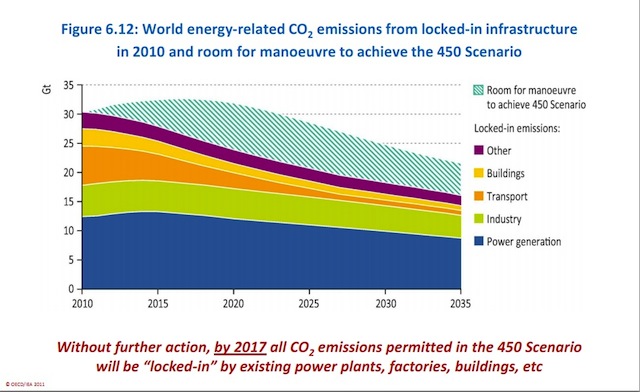
Credit: World Energy Outlook/Int'l. Energy Agency

Credit: World Energy Outlook/Int

Obvious practical reasons for the resistance to addressing climate problems aren’t in short supply. Altering our energy and transportation infrastructures to release fewer greenhouse gases will involves massive public and private investments. There’s also plenty of legitimate debate about what measures to take on climate. Do we need to build more nuclear power plants? Are carbon taxes better than carbon cap-and-trade systems? How do we balance poor nations’ immediate needs for plentiful, cheap energy with goals for curbing the energy sector’s environmental impact? All good questions.

But in recent years, some academics and observers of the climate debate have advised that the real obstacles are unconscious psychological factors that thwart efforts to engage with the issues. They’ve further argued that many of the arguments and strategies used to address climate change are therefore misguided or even counterproductive.

Are they right? To a degree, surely yes. But the relevance of their psychological insight is overstated in my opinion, and it provides too many easy excuses for those looking to avoid the urgent, difficult steps that the problem seems to call for.

Believe what you want

First, let’s consider the nature of the psychological factors that have been mentioned. An abundant literature in psychology and behavioral economics, perhaps crowned by contributions from 2002 Nobel laureate Daniel Kahneman of Princeton University, has established that we Homo sapiens are disappointingly irrational in our evaluations of risks. We are particularly poor at sizing up situations that involve slowly mounting consequences (particularly if they will befall other people first) or low likelihoods of catastrophic outcomes. These, of course, are precisely the dimensions of the climate problem.

Credit: Hatchibombotar, via Flickr

Credit: Hatchibombotar, via Flickr

Motivated reasoning is another phenomenon psychologists have identified: people rationally justify what they want to believe and recoil from what’s threatening or unwelcome. The idea that people are skeptical of climate change because they lack sufficient information about it is crucially wrongheaded, warn those researchers — and efforts to hammer home the scary consequences of global warming will only harden the opposition. For example, a forthcoming paper by Robb Willer and his colleagues at the University of California, Berkeley, in the January issue of Psychological Science finds that people are more likely to disagree with gloomy presentations of climate science than with more hopeful ones.

But a more sweeping suggestion, buttressed by studies like one last August in Communication Research by P. Sol Hart of the American University and Eric C. Nisbet of Ohio State University, is that climate change suffers from a “cultural cognition” problem. Cultural cognition is an idea pioneered by Dan Kahan at Yale University and others that people’s beliefs and perceptions are overwhelmingly shaped by sets of values picked up from the groups to which they belong by birth or by choice.

All of us may believe that we listen to evidence, weigh it rationally, and then draw our conclusions. But in reality, at every point in that process, our values discount or emphasize aspects of that process unevenly. Consequently, the cultural cognition theorists say, people’s positions on issues such as climate (as well as abortion, gun control, the teaching of evolution and so on) act as markers for their social identity.

At first blush, that insight may sound obvious. It isn’t really news that our families and societies shape our thinking. What’s profound about the cultural cognition argument is the claim that, in a sense, people with different values live in different realities: they never even experience the basic facts of certain problems the same way.

All these arguments seem to build a case that climate change is an issue so emotionally freighted against dispassionate evaluation that any policy that demands wrenching, immediate change is all but impossible. Psychological critics therefore often urge that the climate lobby should forsake divisive, demanding head-on action on CO2 and instead reframe the climate in terms of values with a broader consensus. Skip the annoying CO2 restrictions and go for beneficial energy reforms alone (even if that means letting the chips on future warming fall where they may).

Get real

Perhaps I’m just showing my own cultural roots by saying this, but although I completely accept that cultural cognition and motivated reasoning strongly influence our attitudes about climate, I don’t accept a simple, fatalistic reading of the research to prove that we can’t do better. Drafting realistic climate policy is always going to be hard and controversial, but I don’t think it has to be futile.

Surely, people don’t routinely want to recognize other kinds of highly inconvenient crises, too: epidemics, storms, bankruptcies. And yet they come to grips with their reality. Governments manage to fight unpopular wars and bail out unpopular banks. Civil rights struggles discomfit big segments of American society with committed cultural aversions to recognizing the rights of African-Americans, women, gays, and others. Somehow we’ve made progress on those fronts, too. Why not climate?

Personally, I’ve also always been annoyed by the characterization of climate scientists and their message as hopeless or pessimistic. Scenarios of rising sea levels, future droughts, extreme weather and so on that come out of climate models aren’t cheery. But many of the scientists who spoke out early and loudly on the dangers — such as James E. Hansen of NASA and the late Stephen Schneider — also emphasized that these worst-case outcomes could be avoided with reasonable, affordable investments in renewable energy and CO2 reduction. Their message was that we could do something about the problem. If people see climate science as negative, then that’s an impression others put on it, not something intrinsic to it.

The psychological arguments alone also don’t clearly explain why outspoken anti-scientific opposition to climate protection is such an oddly Anglo-American phenomenon. The G.O.P. seems to be the only major conservative political party in the world that takes a strenuously anti-science stance on climate. Conservative principles don’t seem to be irreconcilable with sound climate policy elsewhere.

Moreover, public opinion in the U.S. at least seems fickle on the issue—more so than I would imagine core values or aversion to negativity would dictate. A recent Pew Research Center survey finds increasing belief that global warming is a serious problem, even among Republicans. Andrew Revkin, the former New York Times environmental reporter who still writes its Dot Earth blog, has described such shifts in public response as “water sloshing in a shallow pan.” But the poll data show that a well-timed political push can take advantage of popular support for leverage.

Politics, not psychology

The truth is, however, the masses aren’t the ones setting climate policy. Politicians are, and quite frankly, I’m not patient with arguments that cultural cognition or motivated reasoning gives them an excuse to duck the objective facts. Rather, the voting records of the U.S. Congress often seem to suggest that protecting the economic interests of the fossil fuel industry have loomed larger in their priorities.

Our species’ irrational side adds to the genuine, inescapable complexities of forging sound climate policies. But I suspect the more immediate obstacle to climate progress isn’t cultural cognition so much as it is political cowardice.

Start your week smarter with our weekly e-mail newsletter. It's your cheat sheet for good ideas. Get it.

John Rennie

About John Rennie

John Rennie was a columnist for SmartPlanet from 2011 to 2012.

John Rennie

John Rennie

Columnist, Science

John Rennie is the former editor-in-chief of Scientific American. He has written for IEEE Spectrum, New York Times and The Economist and has appeared on the History Channel, Discovery Channel, NPR and Minnesota Public Radio. He has spoken at the World Business Forum, Massachusetts Institute of Technology, Wharton School of Business, University of Tennessee and Middlebury College and is an adjunct instructor at New York University, editor at large for Txchnologist.com and contributing editor to ecomagination.com. He is based in New York.

Follow him on Twitter.

John Rennie

John Rennie

John Rennie works as a freelance reporter, writer, editor, and lecturer for a variety of publications and organizations, including the websites Txchnologist.com and ecomagination.com, both of which are sponsored by GE. He is also an adjunct instructor in journalism for New York University. (Lists of his affiliations and clients can be found here.) In the unusual event that his writing mentions a company or organization for which he currently provides or previously provided any editorial or marketing services, he will disclose that fact. He will also do the same should he cover any companies in which he holds stocks or other investments.

He writes for SmartPlanet, but is not an employee of CBS.

If you liked this, don't miss...
20
Comments

Join the conversation!

Follow via:
RSS
+6 Votes
+ -
Climate change is always ongoing
I really don't understand all the hype, and politicians trying to force the expenditure of billions of $ on expensive alternate energies is just plain wrongheaded. Climate has always changed, mankind's contribution to it is observable, but not overwhelming, and I'd submit that a warm climate is easier to deal with than a cold one. Nevertheless, it is true that fossil fuel use comes with a host of environmental contaminants and ruins vast areas. If politicians were really interested in cutting CO2 emissions (Not a pollutant, no matter what the EPA believes), they would be pushing for replacing coal-fired power plants with nuclear plants, which is the only base-load energy source that is not fossil-fuel based. Given that this is not occurring, then the only conclusion is that the politicos really don't care to do anything about our long-term energy solutions. Therefore, the best remaining solution is to let a free market in energy determine how to meet our energy requirements.
Posted by Starman35
6th Dec 2011
0 Votes
+ -
RE: Coal Plants
However, Satellite research showed how much the coal plants have been cleaned up - and they've been cleaned up to the tune of 77% less sulphur pollution if I remember correctly. So in the future, it may not be a factor at all.
Posted by GregGold
6th Dec 2011
-2 Votes
+ -
Oh I almost forgot!
Yes of course Nuclear energy! how could we have missed that solution .You must be a genius! Yea lets ask the Japanese and the Russians about that! Because it is so safe and clean! Give me a break is the the light bulb upstairs on at all Jheez! Don't even want to hear the crap about how that would never happen here or did we forget 3 mile island!Oh and where do you propose we stash all of that irradiated spent fuel! I guess we could put it in your back yard! Look on the bright side when the ice age comes at least you will be warm and glowing! LOL LOL LOL Lol Some people never learn!
Posted by ibdirtpoe@...
6th Dec 2011
+3 Votes
+ -
You lost me in the 1st Paragraph
"I don???t mean the question in the way that global warming deniers might: that climate change is an illusion or hoax. The science overwhelmingly shows that the world is heating up rapidly and, according to a study out just this week in Nature Geoscience, three-quarters of that warming is directly due to human activities."

Seriously? Let's think about what Starman35 said. Every time we hear about climate change "those people" don't talk about simple things but rather start off with "we need a tax or credits ..." Then we hear about them cooking the books and catching them saying things like "we can't let the public hear about this, because it doesn't fit our agenda" and other things like that. So you betcha we are a bunch of skeptics. If someone wants to come talk to me about fixing climate change, or are we back to calling it "global warming", for free (=$0.00) then you have my attention. When the first thing you do is call me stupid for asking the question and tell me the solution involves me first giving you money I am not interested.
Posted by rpwillia0@...
6th Dec 2011
0 Votes
+ -
How can you reverse climate change for free, r?
I, too am skeptical when someone comes down the pike saying that the world as we know it will end, but if you fill my hand with cash, I'll fix it. But, really, if we all agree that global warming was happening, and that if we stopped using high carbon fuels like coal and fossil fuels, then we could turn it around, would you do it? If so, how are you going to do it without money, and lots of it?

I'm pretty skeptical about the politicians being able to keep their hands off money collected thru something like a carbon tax, but as I understand it, all the carbon tax does is collect the tax and give it straight back to the people to use for what they see fit. If you want to use it to install insulation and a rooftop collector, then you can; if you want to use it to buy a bigger SUV, go for it, and good luck paying for the gas. Over time, most people will wise up and use the refunded monies to finance the shift to low carbon energy sources.
Posted by klassman6
6th Dec 2011
+1 Vote
+ -
RE: reverse for free
It won't happen...look at who started the carbon trading scam...Gore. In the UK, guess who is raking in the Pounds Sterling? The guys who've accomplished nothing but trading credits. It's like the commodity futures, except the religion of human caused climate change (facts be damned) hasn't figured it out yet.
Posted by GregGold
6th Dec 2011
0 Votes
+ -
Cap and trade IS questionable...
Carbon sequestration is too difficult to quantify. For instance, a landscape can be a carbon sink in wet years and a carbon emitter during dry years. The cap and trade system depends on an accounting system that raises the eyebrows on most everyone, while the carbon tax, if refunded directly to the consumer, is much cleaner and could end up being a powerful finance tool for a low carbon energy society.
Posted by klassman6
6th Dec 2011
0 Votes
+ -
Pennywise, pound foolish.
You are just reading the things they want you to read and not investigating the context in which it was said. You're not stupid, just uninformed. If you think you can fix global warming for free you are dreaming and the longer we wait to get started on fixing it the more costly it will be.
Posted by riverat1
6th Dec 2011
+3 Votes
+ -
climate
First: Just as soon as the supposed 'knowledgeable' persons, whose first reaction is that we all watch Fox News because we don't agree with you. As well as the innane name calling which shows the closed mind of the person making the comment, all at the same time claiming that they know the truth, shows nothing but ingnorance.
Second: Science has always been skeptical. Sure you can prove some stuff, but when it comes to something as unknowable as the whole world reaction to human interaction puported as FACT, well, that has the idea of maybe we're not quite as sure as we think. Examples of this is Medicine. While the meds provided to the population is helping a percentage of people, it also hurts others. That is also the SCIENCE.
Third: 'Climate Change', 'Global warming', The Earth is heating up. The Earth is cooling down. New oil is found. New gas is found. Solar flares are detrimental. Gamma rays will kill everything if we are in it's way. Death stars. Floods of huge magnitudes. Earthquakes and Volcanoes. Meteors. Comets. Magnetic shifts. OH! MY
Fourth: Don't worry. Be Happy!
Posted by Solution1
6th Dec 2011
+1 Vote
+ -
Complex problem
Classic problem solving is that you admit there is a problem, define the problem as well as possible and then decide to tackle the problem. The article shows several different viewpoints but what it should show is that there are a lot of people who disagree that there is a problem. Climate change has occurred several times in Earth's history, there have been several mass extinction episodes during that history.

If people can agree that climate change can happen naturally, then what kind of changes would show that the current climate change is only natural and which changes would show that this is different and why it is different. A consesus has not happened because there are some groups who need more evidence and there are some who have made up their minds that climate change is not a problem.

I would have to agree that the biggest obstacle is political cowardice and that this applies to more than one party and even more than one nation. The congress critters are doing what their constituents pay them to do, support the status quo anything else is beyond their abilities.

So, it comes down to a Dirty Harry phrase; "Do you feel lucky?" Maybe there is nothing bad that will happen if we continue to add tons of CO2 and then maybe there is still one bullet left.
Posted by sboverie
6th Dec 2011
+4 Votes
+ -
Gee, you just figured this out?
Of course humans are slow to accept bad news. Just look at our looming budget crisis, the reluctance to accept that anything needs to be done to solve Social Security and Medicare beyond taxing the rich more, the total waste of devoting food to ethanol, etc. On a personal level, just look at any smoker. Often these blind spots are held by the same people who advocate massive changes to solve global warming. In fact, there's evidence that our brains are wired to discount bad news as a survival strategy.

But it doesn't help to call the opposition "deniers" and worse names. It doesn't help to tell people that only you know what's best for them. It doesn't help that there's a history of environmental collapse predictions from at least the '60s (Club of Rome, anyone?) that just never came true.

People may not want to face bad news, but even worse they just don't like being pushed around.
Posted by zackers
6th Dec 2011
+2 Votes
+ -
And if you think we pollute too much now...
...just wait until we all go bankrupt and start wondering where our next meal is going to come from. Poverty has never been good for the environment.
Posted by JohnMcGrew@...
7th Dec 2011
0 Votes
+ -
RE: Trigger
Empty cylinder "click"..
Posted by GregGold
6th Dec 2011
0 Votes
+ -
Shroedinger's Cat
Paradox where two opposite facts can exist side by side and equally true until the observer sees the effects.
Posted by sboverie
6th Dec 2011
0 Votes
+ -
I don't care
I'll be dead sometime in the next 50-60 years...what do I care?
Posted by tech_ed@...
6th Dec 2011
0 Votes
+ -
Do you care ...
about your children and others who will follow you? Anyway if you live another 50 years you will certainly see and be seriously affected by the effects of global warming.
Posted by riverat1
6th Dec 2011
+1 Vote
+ -
Yes, I care very much.
I fear that they will end up living in perma-poverty in a toxic post-industrial world (like much of Eastern Europe) where societies are struggling just to stay alive, no longer having any capability to mitigate their current environmental situation. And it will all happen because instead of fighting real environmental problems, we will have shot our wad fighting near-imaginary ones.
Posted by JohnMcGrew@...
Updated - 7th Dec 2011
+1 Vote
+ -
The stupidity. It is amazing.
The same people in my life who rant about global warming think nothing of throwing away a CFL, and it's mercury, in their household trash.

I have 3 friends I will not visit at home anymore until a haz mat team cleans their house.

They are psychotic about CO2 but 3 miligrams of mercury from a dropped CFL smashed on their living room floor is no big deal.

They break out the wet/dry shop vac as I run for the door.

If they had a child I would report them to child services, but thank god they are not reproducing.
Posted by Hates Idiots
Updated - 7th Dec 2011
+1 Vote
+ -
I've always been amused by the same government...
...that has tirelessly fought to free our homes of mercury-filled light switches and thermometers now mandates that we refill our homes with highly fragile CFLBs; devices that under any other scenario would require a hazmat team to be cleaned up legally.
Posted by JohnMcGrew@...
9th Dec 2011
+1 Vote
+ -
Good piece; Comments tell their own story
The original piece above is valuable. Good insight on the psychological and political factors. If nothing else, most of the dozen or so comments above, just illustrate or validate some of Rennie's points. While the data about significant warming is now clear -- even to previous skeptics like Richard Muller and Bjorn Lomborg, and the physics of CO2 as a warming agent were identified in 1826 by Fourier, and predicted to warm the planet 70 years later by Svante Arrhenius, we are still confined by the human and emotional issues. Worth pondering. It is also worth noting that the extremely long lag times for climate to change, ice sheets to melt, sea level to rise make this something unprecedented in human history. Less than 1 percent of 1 percent of the population even realizes that sea level fluctuates almost 400 feet regularly in Earth's history, aside from the new heights that will occur as the ice sheets melt beyond their normal range. Our awareness is poor. Much harder to recognize than even the debt crisis, or social security. And considering climate change as just another environmental crisis belies its profoundness. This is a game changer. The 3rd generation will care, for sure. Interesting time to be alive and consider who we are, and what our options are. Really good as we enjoy holiday time with families and consider the year, and years ahead.
Posted by johnenglander
9th Dec 2011
Join the conversation
Formatting +
BB Codes - Note: HTML is not supported in forums
  • [b] Bold [/b]
  • [i] Italic [/i]
  • [u] Underline [/u]
  • [s] Strikethrough [/s]
  • [q] "Quote" [/q]
  • [ol][*] 1. Ordered List [/ol]
  • [ul][*] · Unordered List [/ul]
  • [pre] Preformat [/pre]
  • [quote] "Blockquote" [/quote]

Join the SmartPlanet community and join the conversation! Signing up is fast and free. Don't wait -- we want to hear your opinion!