Follow this blog:
RSS

Climate disasters: quibbling over causes

By | November 15, 2011, 3:00 AM PST

If you want to better understand whether global warming really causes droughts, hurricanes, and other extreme weather, don’t think about meteorology. Think about unemployment.

Between 2008, when the housing market imploded and the stock market tumbled, and late 2009, the U.S. civilian seasonally adjusted unemployment rate shot up from under 6.0 percent to double digits. It hung around 9.6 percent for most of 2010, and has since slid slightly down to about 9.1 percent. Asked for a three-word explanation for why so many people are out of work, virtually everyone would say “the bad economy.”

But wait — is the economy really to blame? If we look at any individual lost job, is it truly certain that the housing market and credit crunch woes sufficiently explain why that worker was let go? Maybe if he had worked harder and done more to prove his worth, he would have kept his job. And in the case of big layoffs, aren’t those job losses really more directly attributable to poor management, which might have done more to buffer a company against economic fluctuations?

And so on. Zooming in on individual events, one can always come up with reasons to doubt that a macro trend is responsible. In many cases, those specific factors may even be the more immediate or direct causes. But in aggregate, it’s absurd to deny that the larger economic factors are a primary cause of joblessness. If nothing else, the trend creates conditions in which the missteps at the individual or corporate level are more likely to lead to disaster.

Global warming’s connection to extreme weather events has always been as diffuse as the economy’s tie to unemployment. The difference is that no one has tried to pretend that the economy is irrelevant.

Pointing fingers

For many years, the standard, balanced, responsible line on climate and extreme weather has been a modified version of “it’s hard to say.” No one event could be attributed with certainty to climate change, but patterns of weather events in keeping with those larger changes were to be expected.

Some scientists, clearly frustrated with the problem of conveying the urgency on climate they feel to the public, have become less restrained. James E. Hansen of the NASA Goddard Institute for Space Studies and two colleagues posted a paper online on Nov. 10, “Climate Variability and Climate Change: The New Climate Dice,” that emphatically argues many recent events fall into “a new category of extreme climate outliers” for which warming is the only plausible explanation.

Kevin E. Trenberth of the National Center for Atmospheric Research has even published a provocative proposal in Wiley Interdisciplinary Reviews: Climate Change that recognizing new, unusual weather patterns as human in origin should be now science’s  default (or null) hypothesis. (Two accompanying papers by Judith Curry of the Georgia Institute of Technology and Myles Allen of the Univerity of Oxford argued to the contrary, though they have their disagreements, too. Journalist James Hrynshyn has a concise summary of their views on his “Class M” blog.)

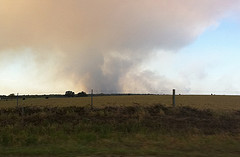
Wildfires in drought-stricken Texas, 2011. (Photo: accent on eclectic/Flickr)

Wildfires in drought-stricken Texas, 2011. (Photo: accent on eclectic/Flickr)

Pinning down the cause for an event is difficult, and not just because the physical dynamics of something like a weather event are enormously complex. Nonlinear systems like the one that produces earth’s weather are famously plagued with chaotic “butterfly effects,” in which long chains of escalating perturbations can sometimes allow whispers of air in one hemisphere to stir hurricanes in another.

Definitively assigning blame to any one factor is therefore always open to argument. Certainty seems even more remote given that our understanding and knowledge of the weather system is always incomplete, so one can always question the importance of unobserved factors. Moreover, the philosopher David Hume argued for the impossibility of perfectly determining the cause of any effect on the basis of experience. One can always object that some unseen, unregistered factor might be the true cause.

My point is not that determining the cause of weather disasters (or anything else) is impossible or hopeless. Rather, it’s that identifying a specific cause beyond doubt is impossible. Holding out for perfect proofs that global warming is causing droughts, floods, or storms — rather than probabilistic ones based on models — is unreasonable. It becomes a strategy for climate change deniers and climate action delayers to extend debate by simply refusing to concede.

Those skeptical of climate science frequently want proof that global warming’s influence on events is dispositive — that is, so clear that it can be distinguished from other sources of normal weather variation. They want proof that an event tied to global warming might not be simply an example of normal weather variation. They might as well be asking for proof that only the economy can be blamed for someone’s job loss.

Ultimately, though, asking whether global warming caused specific past or current weather disasters is the wrong question. The better question is, will global warming cause more such droughts, floods, hurricanes, and so on in the future? The answers aren’t uniform for all kinds of weather events, but in many cases, a strong case exists that particular regions will see more such problems.

Bad choices, not bad weather

Some of those who dispute the connection between global warming and weather disasters don’t quarrel with warming’s role in the weather — only in the disaster. Roger A. Pielke, Jr., of the Cooperative Institute for Research in Environmental Sciences, is perhaps the most prominent advocate for the argument that the expanding human population and economic development are far more directly responsible than changes in the climate. He has shown, for example, that imprudent societal decisions encouraging more construction in areas highly vulnerable to hurricane damage have driven up the economic losses from the storms far more than any increase in their number or severity has.

Damage in Bethel, VT., after Hurricane Irene, 2011. (Photo: U.S. Fish and Wildlife Service)

Damage in Bethel, VT., after Hurricane Irene, 2011. (Photo: U.S. Fish and Wildlife Service)

It’s an excellent insight in many ways, and it suggests actions that planners would be foolish not to take in any case. But I take issue with how the argument is often used: to dismiss focusing on climate change as an appropriate or efficient goal for policy. Why bother with the painful business of carbon emissions reduction, after all, when we can blunt any effect of climate changes by making better development decisions?

The problem with that attitude is that it ignores climate’s still significant effect. Better development policies might indeed reduce the economic consequences of more severe storms, shifts in rainfall, rising sea levels and so on — in fact, policy makers will have to make sure that they do. Climate change will foreclose options the policy makers might have otherwise had. Where storms causing coastal flooding will be more severe or commonplace, for example, some kinds of coastal development now allowed will likely be forbidden.

Critics of climate policy reform often argue that spending on carbon emissions control will come at the expense of other, better things that money could be spent on. But they neglect to mention that living in a rapidly changing climate may impose considerable opportunity costs, too.

Moreover, a strategy based on boosting society’s resilience to climate change, or reducing its vulnerability to it, might make sense if we know precisely how much and how quickly the climate will shift. We still don’t, however. Given that recent global carbon emissions have been exceeding what was once considered to be a worst-case scenario, and that the increase in global temperatures could be 5 degrees Celsius or more, the costs and difficulties of adapting to the climate are mounting. And if the climate should change faster or differently than these adapters have planned, the toll could be heavy.

Global warming’s role in causing individual, specific disasters isn’t yet as great as the bad economy’s is in destroying people’s livelihoods. Yet the unrelenting rise in carbon dioxide levels from human activities is only increasing global warming’s influence. If we wait until global warming would be the major, undeniable determinant of weather-related damage before trying seriously to curb it, it will be too late.

Photo: Hurricane Katrina, courtesy NASA Goddard Space Flight Center

Start your week smarter with our weekly e-mail newsletter. It's your cheat sheet for good ideas. Get it.

John Rennie

About John Rennie

John Rennie was a columnist for SmartPlanet from 2011 to 2012.

John Rennie

John Rennie

Columnist, Science

John Rennie is the former editor-in-chief of Scientific American. He has written for IEEE Spectrum, New York Times and The Economist and has appeared on the History Channel, Discovery Channel, NPR and Minnesota Public Radio. He has spoken at the World Business Forum, Massachusetts Institute of Technology, Wharton School of Business, University of Tennessee and Middlebury College and is an adjunct instructor at New York University, editor at large for Txchnologist.com and contributing editor to ecomagination.com. He is based in New York.

Follow him on Twitter.

John Rennie

John Rennie

John Rennie works as a freelance reporter, writer, editor, and lecturer for a variety of publications and organizations, including the websites Txchnologist.com and ecomagination.com, both of which are sponsored by GE. He is also an adjunct instructor in journalism for New York University. (Lists of his affiliations and clients can be found here.) In the unusual event that his writing mentions a company or organization for which he currently provides or previously provided any editorial or marketing services, he will disclose that fact. He will also do the same should he cover any companies in which he holds stocks or other investments.

He writes for SmartPlanet, but is not an employee of CBS.

If you liked this, don't miss...
14
Comments

Join the conversation!

Follow via:
RSS
+1 Vote
+ -
Sigh! Yest another baseless argument
The statement "Some scientists, clearly frustrated with the problem of conveying the urgency on climate they feel to the public, have become less restrained." says it all. No one believes the media and many scientists any more because there always seems to be an agenda behind the revelation. Just present the facts and let us make the conclusion and stop providing the conclusion followed by an accusation that we just don't get it, with some facts all the way at the end.
Posted by rpwillia0@...
15th Nov 2011
+5 Votes
+ -
Scientists (and the media) can present the facts...
But if you're not intelligent enough to understand them, you'll simply end up as another lemon juice bandit, led by the bias of others.
Posted by gork platter
15th Nov 2011
+1 Vote
+ -
Bad weather happens.
To blame recent bad weather on global warming is not only baseless, but narrow minded. Some of the worst weather in history has been caused by legitamate global cooling.

Global cooling events related to the end of the Little Ice Age triggered a CAT 5 hurricane that hit the early North American colonies in 1635.

2 CAT 1 hurricanes went extra-tropical and caused October blizzards in New England in 1815 after a major volcano eruption earlier in the year. 1816 is globally known as the year without a summer when it snowed in Boston in June and killing frosts hit the US and Europe in late May and again in early September. The global crop devastation caused food shortages in many areas that winter. Surprisingly 2 places on the planet saw warming that year. Ireland and Russia.

The list of bad weather to hit the world throughout history is extensive. Most people look at the last 40 years as a large sample when in reality it is a blip on the planetary clock.

The most over used word in weather circles today is unprecedented.

The stupidest expression said is when people say something is the worst event of its kind this century. Well duh. That is an easy statement to throw out since we are barely a decade into the century.
Posted by Hates Idiots
15th Nov 2011
+1 Vote
+ -
Re: Bad weather happens.
Yes, bad weather happens and global warming is not the cause. However global warming can exacerbate the extremes of bad weather. It can make the heat waves a few degrees hotter than they otherwise would be, the droughts a bit dryer than they otherwise would be, the monsoons heavier than they otherwise would be, even snowfall a bit heavier than it otherwise would be. No single weather event is attributable to global warming/climate change however a statistical shift in the details of various weather events over time is the very definition of climate change.
Posted by riverat1
Updated - 16th Nov 2011
+1 Vote
+ -
A simple rule to remember for understanding "climate science" today.
"Weather" is not "climate", unless something bad happens. Then it's because of "climate change".
Posted by JohnMcGrew@...
17th Nov 2011
0 Votes
+ -
Climate is a derivative of weather
Climate is the time based derivative of weather. Too many people on both sides of the issue jump on some weather event as being definitive of climate change or lack thereof. I haven't been totally innocent of that myself but I try. To paraphrase what I said above a statistical shift in weather over enough time is the definition of climate change.
Posted by riverat1
17th Nov 2011
+2 Votes
+ -
Could not agree more on most of it
Good points. Unemployment is caused by the bad economy and all sorts of undesirable conditions (e.g. desertification, rising seas) are caused by global warming. Both bad economy and global warming are easily demonstrated to be real.and undesirable.
The debates start is when some claim to know what causes a bad economy or what to do to fix it. We have studied economies much much longer than global warming and we are still largely inept at proving specific causes in any one economic cycle or how to fix them. Climate is more complex by orders of magnitude and we have studied it far shorter. That it is real is beyond argument. However unless contradictory facts (e.g. in 1922 the Norwegian ice pack had disappeared and then returned while carbon was increasing all along) it is difficult to convince that we know causes let alone cures.
The unfortunate part of the debate is not that remedial action is not taken (many question if we know what that is), but that we should be focusing on how to cope with events that will require coping.
Funds wasted trying to reverse unproven causalities within a system that is real but not completely understand, would be better spent to improve the coping ability of those populations most drastically affected. Resistance to the remediation waste paralyzes efforts toward coping strategies to the detriment of the most affected. The UN could focus on where/how to relocate Seychelles residents instead of trying to lower rising seas.
Posted by marcomessina
15th Nov 2011
+1 Vote
+ -
Greed
"Unemployment is caused by the bad economy and all sorts of undesirable conditions (e.g. desertification, rising seas) are caused by global warming."
Actually, Unemployment is a direct by-product of the greed of the corporate executives. Not content to generate income over the long term, C?Os looking for that quick buck dump thousands or workers just to bring the company's profits up so that they can make their bonus. Then when it is determined that the executives have utterly destroyed the company, they are let go with hundreds of millions of dollars in golden parachutes...
No, the weather is not the problem, it's corporate greed!
Posted by tech_ed@...
15th Nov 2011
+3 Votes
+ -
Climate science is physical
Climate science is complex although I'm not prepared to say it is more complex than economics. However climate science is a physical science in ways that economics can't even approach. I don't think it's reasonable to compare the two. Climate science is more like quantum mechanics.

Regarding remedial action, it's almost always cheaper to avoid having to take it than to respond after the fact.
Posted by riverat1
Updated - 15th Nov 2011
0 Votes
+ -
Seychelles residents
They need to be relocated because their granite micro-continent is slowly sinking out from under them. It does not help that the massive coral die off around the islands is directly caused by polluted runoff from the islands. The growing corals have formed a protective breakwater for millennia, but no more.

Blasting coral and granite for use in construction projects may save them money on importing concrete, but they have also fractured the very foundations of the island leading to salt water penetration into what had long been coastal freshwater wells.

Mother nature and poor development practices are killing those people. Not climate change.
Posted by Hates Idiots
15th Nov 2011
+3 Votes
+ -
There is an easy way ...
Simply look at the all time record breakers. If the randomness of the climate is unchanging, all time record breakers will get farther apart as each one sets a higher hurdle for the next.

If all-time record breaking is on the increase, climate randomness is on the march.

It would be nice to know what causes it, especially if it means we can reverse it if we want to, but ...

Whatever the cause, we really do need to acknowledge it and have a plan to cope with it. Living in denial means we are helpless victims, no smarter than headless chickens.
Posted by PassingWind
Updated - 15th Nov 2011
0 Votes
+ -
No, No, NO
Not Global Warming...Climate Change. It regularly does this, and has since the earth was formed. Why is that so hard for the vocal few to understand?
Posted by 16Tons
15th Nov 2011
-1 Votes
+ -
Long term vs short term
Global warming is, as best as can be determined, a gradual change and, therefore, a problem that demands a long term commitment to achieve an outcome that will only be apparent in the future. Politics in the USA seldom looks further than the next presidential election. Large corporations dominate the economy & the importance they place on things is in proportion to which earning reports they will impact. Both are bad enough in isolation but those corporations.also routinely influence the political process & shape public opinion for their own benefit. Toss in anti-intellectual, pro-business bias on the part of a significant fraction of the clergy & the current situation (and the resulting future catastrophe) is hardly surprising.
Posted by hoodedswan
15th Nov 2011
+1 Vote
+ -
A Carbon-Bubble - who knew?
I'm down with the idea that the current economic doldrums is being caused by greed and the creation of economic bubbles. So what I'm getting from this discussion is that we are at the peak of a three-hundred year carbon bubble, aka the Industrial Revolution. We love our carbon and all the things it brings, electricity, heat, plastic, etc...and so we have bloated up the planet with excessive carbon, and now the effects of that reckless behavior are coming to pass.
I think it's a fantastic analogy with a lot of truth in it. It clearly shows how our over-consumptive culture is at the root of both issues, and how the bubble analogy, which people are very familiar with now, also applies to our behavior re the environment. I'd like to see the story go viral so that people can really grasp what is going on in terms they can immediately see. One big problem science has in communicating about climate change/AGW is that people feel it's very abstract. This analogy - the Carbon Bubble - has great power to change that whole conversation.
Posted by yogi-one
21st Nov 2011
Join the conversation
Formatting +
BB Codes - Note: HTML is not supported in forums
  • [b] Bold [/b]
  • [i] Italic [/i]
  • [u] Underline [/u]
  • [s] Strikethrough [/s]
  • [q] "Quote" [/q]
  • [ol][*] 1. Ordered List [/ol]
  • [ul][*] · Unordered List [/ul]
  • [pre] Preformat [/pre]
  • [quote] "Blockquote" [/quote]

Join the SmartPlanet community and join the conversation! Signing up is fast and free. Don't wait -- we want to hear your opinion!