Cannery Tow? A mobile canning system for craft beer

The beer industry is in the midst of two important shifts changing how the libation is made and sold. One is the surge in U.S. beer breweries: there are more today than at any time in the past 125 years, and 97 percent of them are micro- or "craft" breweries. Heck, even the White House is trying its hand.
The second shift amounts to a sea change in how beer – especially beer made by craft brewers – is being packaged. Goodbye bottles, hello cans.
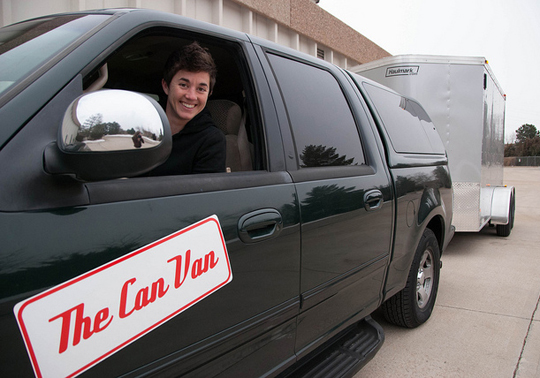
A Northern California startup called The Can Van is targeting both trends. It offers small and very small breweries – often called nanobreweries – a way to transition from bottling beer to canning beer. As its name suggests, The Can Van literally brings the canning line to the customer through its mobile canning system (pictured in the next photo below).
The idea was born in a place where people tend to devote quite a lot of thought to beer: graduate school.
Chief executive officer Jenn Coyle and chief operations officer Lindsey Herrema met while pursuing degrees in San Francisco's Presidio Graduate School Sustainable MBA program. A mobile beer-canning concept was the subject of a school project on which they and three classmates collaborated.
"We researched the brewing industry and wanted to find a business with an environmental impact and small local business impact, and we love beer – we were already home brewers. After graduating, we just kept going with it," says Coyle. The Can Van's maiden voyage was in January 2012.
Fermenting change
When the current craft beer movement bubbled up in the late 1980s, small brewers started selling their product on draft -- through bars and restaurants -- and direct to consumers in bottles. Bottling beer is relatively easy for startups to organize because it can be done on a small scale, even by hand, one at a time. Bottles were generally considered the best way to package small quantities (single servings, as opposed to kegs or growlers) of beer.
Cans were long pooh-poohed by beer aficionados, who said they gave the brew a metallic tinge.
That attitude has changed dramatically in recent years. Proponents say the thin plastic liner inside the can keeps the beer free of a metallic aftertaste. True beer snobs insist on pouring the beer into a glass before drinking it, which eliminates any chance of getting a metallic taste from the mouth of the can. Add to that argument the fact that cans are easier to take on the road – for everything from camping to tailgating to beach parties. Plus, beaches and parks often prohibit glass beverages.
But what is really winning craft beer can converts is the quality argument.
Compared to glass bottles, cans better preserve the taste of beer due to two main factors: air and light. Air exposure can impact beer's taste and unlike with bottles, no air can enter a sealed can. Light exposure also harms beer's quality, which is why beer bottles are generally colored brown or green. Cans completely eliminate light.
There are also environmental advantages. While both glass and cans are recyclable, cans are recycled at a much higher rate than glass bottles. Their impact at the top of the supply chain is debatable, given the energy and resources required to produce aluminum.
Because cans weigh significantly less than glass, less fuel is needed to ship canned beer compared to the same quantity of bottled beer. And more canned beer can be stacked onto a single pallet.
Can-do attitude
After studying the attributes of canning, Dale Katechis started packaging the beer he brewed at Colorado-based brewery Oskar Blues in cans back in 2002. People laughed at him, but he stuck to his guns and persevered. He's not alone. Today, there are 188 different craft breweries in the United States selling their beer in cans, according to CraftCans.com, and many more are making plans to start canning.
Among the craft brewers who have made the switch are two of the largest: New Belgium and Sierra Nevada.
"I think when Sierra Nevada and New Belgium committed to cans, that was when the tide shifted," says J.E. Paino, founder of Northern California craft brewery Ruhstaller, one of The Can Van's first customers. "These guys are really leaders in our industry – they set the tone."
Committing to canning, however, is not something all craft breweries can afford.
Depending on the desired production speed, a canning line can cost from $200,000 to $500,000, Paino estimates. Often, cans are only printed at large volumes -- the point of entry to order pre-printed cans is around 210,000, he says, and that costs around $30,000.
Of the 188 craft beermakers canning their beer, 143 have made this investment and canning in-house, says CraftCans.com. Twenty-nine others are contracting production to breweries with canning lines, and the rest are looking to mobile canning services, such as The Can Van.
"We've made it so that it's plug and play," Coyle explains. The canning line is rolled out of a customized trailer and brought into the brewery – this might be a sizable enterprise or nothing more than the garage of a nanobrewery. The conveyor is powered through a regular 110-volt wall outlet, a hose is linked in for water, and an air compressor is powered up via a 220-volt outlet.
To avoid the high costs and huge volumes required with pre-printed cans, labels are printed and adhered to plain silver cans.
Paino notes that while the utility and convenience of a mobile canning service for small batches is a no-brainer, the learning curve of the "craft" of canning beer was steep for Coyle and Herrema, who "didn't successfully can more than 10 cans until the third attempt," he says. "They came, set up shop, failed, and then repeated until they got it right. So they suffered, but they made it happen."
Focused on the little guys
Although there is no widely accepted definition for a nanobrewery, you can think of them as very small microbreweries emerging in garages and basements rather than in rented commercial kitchens. Often, a nanobrewer is really just a step up from "home brewer" -- someone who has invested around five figures in the effort rather than a few hundred dollars and who aspires one day to open a microbrewery.
"Nanobrewers are the perfect example of the sort of brewer that we wanted to help when we decided to start The Can Van. They are small and growing, have little to no space for equipment, and limited capital available for large investments," Coyle says.
Dan Woodske, proprietor of Beaver Brewing of Beaver Falls, PA, and the author of a guide to opening a nanobrewery thinks most nanobrewers are too small for even very small-scale canning to make sense. Most beer from nanobrewers is sold on draft -- in kegs or growlers -- or very small batches of bottles, he says.
Still, Coyle may be smart to focus on the nanobrewing trend. Among very talented brewers, demand for their product may encourage them to commit to scaling up - and cans now offer a very legitimate alternative.
"There is a definite trend going toward cans," Woodske says. "If I was doing larger qualities, I would do cans."
Images: courtesy of The Can Van
This post was originally published on Smartplanet.com