Follow this blog:
RSS

Will appealing to human emotions save the environment?

By | January 31, 2011, 2:00 AM PST

J Nichols

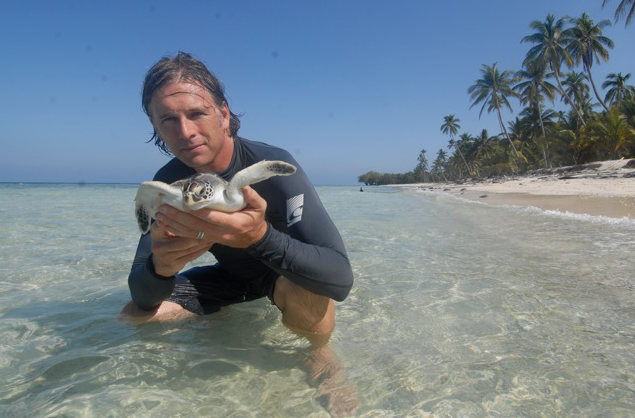
J. Nichols working on a sea turtle conservation project in Anambas, Indonesia. The community has protected 500,000 baby green and hawksbill turtles thus far.

Conservationist Wallace J. Nichols, known for his work protecting sea turtles and the ocean, argues that environmental problems should be addressed using neuroscience and empathy, in addition to the existing facts, figures and statistics. He says people make decisions based on various emotions (product marketers certainly can attest to this), but environmentalists don’t really speak to those emotions in their work. “We should be using words like happiness and love,” he says. “Not in the hippie way but in the neuroscience way.”

Nichols is a research associate at the California Academy of Sciences; founder of Grupo Tortuguero, a grassroots effort that focuses on restoring Pacific sea turtles; and co-director of Ocean Revolution, which mentors the next generation of ocean conservation leaders. We talked recently between his research trips to El Salvador and Baja. Excerpts of our conversation are below.

I’ve read about your work with turtles. What are you working on today?

My work with ocean stuff started with sea turtles when I was a kid. A lot of people have big ideas when they’re kids, but what will you do when you’re an adult? So I thought I could be a marine biologist. But as far as I knew, Jacques Cousteau already had the job, and nobody really encouraged me to follow my dreams.

I did my PhD work on sea turtles in Baja and studied their genetics and migration. In the meantime they were being caught in nets and killed and eaten and going extinct. So I started getting involved in the human dimension and started learning about the science of persuasion by talking to fishermen about what motivated them. So in parallel to the science, there is the social change work, and that’s where things have continued.

So I’m a scientist but also a conservationist/activist/community organizer/communicator, which now extends beyond sea turtles to all the issues around the sea turtles —plastic pollution in the ocean, over fishing, coastal development. I started an effort called Live Blue, which puts a positive spin on ocean conservation and an ocean lifestyle, instead of just a list of things you shouldn’t do, shouldn’t eat, shouldn’t think, shouldn’t wear, shouldn’t buy.

J. Wallace’s Blue Marble project features people around the globe sharing a million recycled glass marbles, reflecting the fact that from one million miles away, our planet looks like a small blue marble.

Let’s go back to what you called the “human dimension” and the dialogues with Baja fishermen around conservation. What’s the hardest part of that work?

Institutionally, we’re not set up to even talk about it, to begin a real conversation about human emotions and how important they are to all of this. So we end up talking about economics and biodiversity, but not emotion. And most of the people I know are making most of their decisions based somewhat, if not mostly, on emotions–and we act like that’s not the case. And it leads to failure.

Interestingly, marketing of product is all emotional: Coke uses happiness to sell sugar water; Subaru uses love to sell cars. We in the conservation world use facts to sell well-being, and it doesn’t work that well. And we wonder why people aren’t paying attention to our facts, statistics and reports. So there’s this disconnect: People make decisions based on a whole lot of different emotions, but we don’t really address them in our work. We should be using words like happiness and love—not in the hippie way, but in the neuroscience way.

The field of cognitive neuroscience, the science of well-being, of empathy—it’s all happening now. I’ve said for a long time if I could do grad school again, I’d do a degree in neuroscience and do a degree in neuro-conservation, which doesn’t exist yet.

What would that study involve?

An application of cognitive neuroscience to solve leading problems in the environment. Just like neuroscience is currently merging with marketing and economics.

So in a perfect world, how would this role of neuro-conservation play out? How would it factor into our education and the conversation about the environment?

Our institutions would be incorporating full knowledge about the benefits of the social, physiological and health benefits of a healthy environment Our public health institutions would be considering the public health benefits of access to the coast as city planning/coastal planning is carried out.

If stress causes disease, which we know it does, and disease reduces well-being, which we know it does, a reduction of stress reduces disease. And if sitting on the beach and looking to the ocean reduces stress, which we know it does, then sitting on the beach is a public health tool. A very inexpensive one, less expensive than drugs—prescription or otherwise. It sounds far out, and people look at you like you’re, well, Californian—but it’s really not. It’s science-based. If you find something that’s free or inexpensive that reduces stress and it’s available to the public, you would think that promoting it would be good.

So in a perfect world, this type of thinking leads to more integrated, enlightened public policy and conversation. People could say, “I’m feeling stressed, I’m going to sit on the beach. I understand what it does to my brain because I learned that in school. I know why the color blue and the sound of waves makes me feel good.”

Hand-in-hand with this is a K-12 neuroscience curriculum, so when you graduate from high school you know you have a brain and how it works, how it’s influenced and how the environment and food affect your brain.

We understand if we have a sore throat, we have a cold coming on , and there’s some things you can do like get in bed or drink more liquids. We have a general understating of our health issues, but we don’t yet have an understanding of our brain. It has the potential to be somewhat revolutionary.

As it is, we don’t really teach our kids much about how their brains work, so that leaves us vulnerable to those who do understand it. So we’re sold sugar water with the promise of happiness and the color of red. And it seems to work. People buy it.

J. Nichols and his daughter Gracye in Indonesia. They will return this summer.

What three things need to happen to move this concept forward?

  1. Teaching a K-12 neuroscience curriculum at every school. We have almost none of it now. That’s as important as some environmental education. I might even put a neuroscience curriculum in front of environmental ed in terms of importance.
  2. Institutionalizing it in some way so there are people on staff in our higher education institutions, government agencies and leading organizations who understand the mind-nature connection.
  3. Using that language in all of our efforts to promote environmental and human health, much like marketing is currently done with products. We’d spend less time trying to convince people of the emotional connection based on research.

The key thing is, I’m not suggesting that we jettison rational thinking. The idea is that we can think rationally about our emotions. We can think critically and creatively about how to understand our emotional lives.

I have a student who is beginning to work on the premium that is put on real estate, based on view of the ocean. For example, you have two penthouse apartments in San Francisco. One faces the city, one faces the ocean. The ocean view would sell for half a million dollars more. If you added up all those premiums, that extra value for a box with a view–it’s in the billions of dollars, for just one city. And globally it’s probably trillions of dollars.

People aren’t really talking about it. It’s just this understanding that the water makes it more valuable?

Right, they’re not talking about it. It’s frustrating. I applied for a Pew fellowship and wrote the best proposal ever of my life, and they were like, “too creative” and I’m like, “Not really… just connecting the dots.”

Where is your next trip?

I am going to Baja at the end of the month for the 13th annual meeting of Grupo Tortuguero [Turtle Group], a model grassroots project we created. It’s grown to be quite big, spread over 3,000 to 4,000 miles of coastline.

We’ll never be able to pay people enough to stop doing something they like to do—like hunting and eating turtles. So the motivation can’t be only financial. If we’re asking them to give something up, we need to offer something good, and this meeting needs to be more than a meeting. It has this meeting/family reunion/big party/mental download/learning opportunity feel to it, and there are awards that are given to different communities. Humans are motivated for a whole bunch of reasons–it turns out love of family, pride, doing the right thing, solving problems and learning new things are all really important.

It’s a different approach [to turtle conservation], with the understanding that the resources will never exist for the enforcement on the water that would be needed. Rather than wait for the government to allocate resources and wait for corruption to go away, we took a different approach. When the government sees the program is successful, they get on board.

Some of the fishermen I’m working with in Mexico, I’d say, if they were born where I was born, they’d be the marine biologists, and if I were born there, I’d be the curious fisherman and would help the turtle guy track turtles.

So have they stopped eating turtles?

Yeah, a lot of them. The conversation often goes, “In our home we eat 10 turtles a year.” So you say, “Could you eat eight?” And then they say, “Yeah, we could do that.” Then they come back the next year and say, “We only ate six this year.” And you say, “That’s better than 10.” And they say, “Next year we’re going to eat none.”

That’s not to say poaching is gone. But enough so that the population is on the rise. The science is ongoing, and we’re seeing a positive trend.

Photos: Neil Osborne

Start your week smarter with our weekly e-mail newsletter. It's your cheat sheet for good ideas. Get it.

Melanie D.G. Kaplan

About Melanie D.G. Kaplan

Melanie D.G. Kaplan is a contributing writer for SmartPlanet.

Melanie D.G. Kaplan

Melanie D.G. Kaplan

Contributing Writer

Melanie D.G. Kaplan is a regular contributor to The Washington Post and Nomad Edition's Good Dog and has written for The New York Times, National Geographic Traveler and People. She holds degrees from Syracuse University and Columbia University's Graduate School of Journalism. She is based in Washington, D.C.

Follow her on Twitter.

Melanie D.G. Kaplan

Melanie D.G. Kaplan

In addition to working as a journalist, Melanie keeps the dog food fund flush with occasional consulting jobs. In the unusual event that her writing mentions a company or organization for which she has provided editorial services, she will disclose that fact. She will do the same should she cover any companies in which she holds investments.

She writes for SmartPlanet and is not an employee of CBS.

If you liked this, don't miss...
24
Comments

Join the conversation!

Follow via:
RSS
0 Votes
+ -
Man-bear-pig cannot stand on facts alone.
So switch to brain washing our kids.

Disgusting.
Posted by Hates Idiots
31st Jan 2011
0 Votes
+ -
RE: Will appealing to human emotions save the environment?
If you want to save the environment, don't appeal to people's emotions.

Appeal to thier pocket books.
Posted by keitha73
31st Jan 2011
0 Votes
+ -
RE: Will appealing to human emotions save the environment?
The environment is like being left a trust fund from a wealthy relative. If you are dumb you will drink and spend your way down through the principal until there is nothing left. Or, if you are smart you will leave a percentage of the principal alone and live off of the interest that it generates. Based on what has happened to the cod off Canada and the oysters in the Chesapeake bay-to name just two, we have been dumb.
Posted by cfaranetta
31st Jan 2011
0 Votes
+ -
RE: Will appealing to human emotions save the environment?
The reason don't pay attention to conservation "facts" is that a large part of the population has figured out they're only half-facts, cherry-picked facts - leaving out anything which might be contradictive to the "position". Just like climate change - removing most of the rural data points so that the temperature shows a higher mean...

When conservationists use ALL the data and it's not cherry-picked pap, then people will begin to pay attention.

As for making the decisions via emotions rather than based fully on facts....that's exactly why we're in the mess we're in economically and socially. Can't do the right thing because it's not politically correct...might hurt someone's feelings.

And that too is disgusting.....
Posted by GregGold
31st Jan 2011
0 Votes
+ -
The greatest difference between mankind and the animals...
...is that mankind is able to act using intellect over emotions.

So I am always suspect of those who suggest that we act more like
the animals by using emotions over intellect. Clearly, their
intellectual arguments are inadequate.
Posted by JohnMcGrew@...
31st Jan 2011
0 Votes
+ -
Neuroscience
It is not clear how neuroscience will help people. The article states that neuroscience is used as a marketing tool. If the children in school are taught to look for emotional manipulation then they can scrape that propaganda out of their decision process. It is hard to teach children how to think without telling them what to think.
Posted by sboverie
31st Jan 2011
0 Votes
+ -
RE: Will appealing to human emotions save the environment?
No, appealing to their emotions isn't the required science and I say that with great respect for the environment work being done.

The UN and all of its members are working on complex problems but academia is actually blind to temperature. We calculate for it as students and professionals, we don't get to see it. Although all the laws are in place, we are limited by lack of sight of temperature or verification.

Here is the prime example on climate change discussion. We don't want man to heat the atmosphere with what we do on the planet and have laws to building sustainably. Building codes tell us to watch out for solar radiation and that is why buildings in Europe are white washed. North America and beyond weren't that smart because we let a coat of paint or lack of shade cause our buildings to be radiated. On January 23, 2010 it was 39 degrees F reported at the weather station yet radiated buildings were as hot as 159 deg. F without emissions produced. This was the rule in every state or province. Here is what it looks like in the infrared spectrum. Http://www.thermoguy.com/urbanheat.html

Paint or shade your investment or it is illegal and super heating the atmosphere contributing to climate change while governments react to symptoms because of lack of sight.
Posted by Thermoguy
31st Jan 2011
0 Votes
+ -
To add to his point.
Budget cuts and just plain sloppy science within the US Weather Bureau has led to the mounting of automated weather stations in poor locations where heat sinks like buildings and highways wreak havoc on the temperatures monitored.

If people comment that the official temperatures in a particular city in Massachusetts are up over historic norms I remind them that the federal science station that had been recording temperatures for over 100 years closed 20 years ago because of budget cuts.

It was replaced by a remote weather station mounted on a strip of barren land between a 6-lane highway and a hotel parking lot.

On a sunny 70-degree day the pavement in both places can hit over 100 degrees. That station will often report temperatures in the 100s on nice spring days, and over 40 on near zero winter days. Yet the unadjusted temperatures measured at that remote station are considered the official temperature by the US government.

The local meteorologists have all learned which remote weather stations to ignore because of bad readings caused by poor placement. All of them depend on readings from home weather stations owned by private citizens. These properly installed systems provide forecasters with accurate readings across much of northern Massachusetts and southern NH.
Posted by Hates Idiots
31st Jan 2011
0 Votes
+ -
RE: Will appealing to human emotions save the environment?
@GregGold said it for me. Thanks.
Posted by czarinatx
31st Jan 2011
0 Votes
+ -
RE: Will appealing to human emotions save the environment?
The fact is that if people based their votes on a rational basis rather than an emotional basis then 90% of politicians would lose their jobs. If people were rational then they wouldn't be looking for any excuse to denigrate honest scientists and we would be well on the way to ending CO2 emissions from human industrial processes. If people were rational the US would have a national health plan that insured universal coverage and we would pay half of what we do per person for health care. If people were rational then nobody who didn't have a hormonal excuse would be overweight. I could go on. People base their decisions largely on emotional reasons despite considering themselves oh so rational. I'm not immune to that problem myself.
Posted by riverat1
31st Jan 2011
0 Votes
+ -
Or perhaps if people were "rational"...
...they'd know better than to trust politicians and scientists who
behave like politicians.
Posted by JohnMcGrew@...
1st Feb 2011
0 Votes
+ -
Appealing to emotions is called...
marketing. And yes, that is what is needed. That's not all that is needed - we also need facts and truth. People behave largely as they are conditioned to behave. To change their decisions, mostly made by emotion, you have to make them want and believe in that change.

Though being rational is important, people make decisions based on how it makes them feel. They may say that they're making a rational choice, but still that "rational" decision makes them feel they're doing the right thing, so it still comes down to emotion.

Neuroscience is a way of understanding what makes people feel the way they do. Successful businesses exploit it for profit, so it's silly not use it socially to promote well-being and improve things for everybody at the same time.
Posted by Get-Smart
1st Feb 2011
0 Votes
+ -
RE: Will appealing to human emotions save the environment?
Gee Wally, what are you going to do with a million blue marbles? I suggest recycle as eco-ben-wa balls. If you want to be really clever you can breed the turtles like they do shrimp and catfish. Because Chinamen prepare quite a few dishes utilizing turtle, you could improve the US-China trade imbalance and save the turtles simultaneously all the while making money to fund your research so you would not have to rely on the Pew foundation.You got any good recipes for turtle soup?
Posted by james.jerome
1st Feb 2011
0 Votes
+ -
RE: Will appealing to human emotions save the environment?
Using Reason + Emotion to solve our most pressing problems isn't
brain washing. Especially if it's explained in process.

Read up on the subject. I recommend Sam Harris' new book, The
Moral Landscape.
Posted by wallacejnichols
1st Feb 2011
0 Votes
+ -
RE: Will appealing to human emotions save the environment?
Get-Smart in #12 put it well.
Posted by riverat1
1st Feb 2011
0 Votes
+ -
RE: Will appealing to human emotions save the environment?
Wow! Some of these folks need a day at the beach. It is surprising to find so many folks apparently fearful of even exploring shifts in change from the status quo. J continues to lead successful efforts to protect and restore sea turtles by every means possible and to support those who choose to continue to use traditional conservation efforts to do the same. But he has also moved into investigations about how to do more and better to protect the environment that the health and security of humans depend on. Attacks on those efforts to expand our understanding of ourselves and our interactions with one another seem to me to be perilously unwise.
Posted by DCGadfly
1st Feb 2011
0 Votes
+ -
RE: Will appealing to human emotions save the environment?
Wallace is right. People will protect what they love. That's why David Helvarg of Blue Frontier Campaign tells people to go to the beach.

That's what Futerra concluded in their Branding Biodiversity research -- "presenting the awe and fascination and yes, love, of nature is more effective at stirring positive action and inspiring people than any other methods, especially doom and gloom."

That's why Eco Ocean says Share the Love & Save the World.

http://deepblueblogx.blogspot.com/2010/12/share-love-save-world.html
Posted by mmisn@...
1st Feb 2011
0 Votes
+ -
RE: Will appealing to human emotions save the environment?
After reading some of the comments, it's clear that some readers
are in need of an update on their understanding of cognitive
neuroscience research. Check out some of the latest work on the
science of emotions in your local public library or Google Scholar.
Fascinating stuff.
Posted by wallacejnichols
1st Feb 2011
0 Votes
+ -
@ #12, #15 and #16..
When a government engages in such marketing it is called propaganda.

Where do you draw the line with what the government deems appropriate to market?

As far as businesses go, it is the governments responsibility under the Commerce Clause to protect citizens from false or misleading advertising.

Who protects us when it is a government agency doing the false advertising?

A great example is the lawsuit brought against a UK school system over the use of An Inconvenient Truth in science classes. The movie was being taught as fact.

The lawsuit successfully proven that the movie had 9 major factual errors and was not legitimate science, but in fact propaganda.

A judge with a history of liberal decisions ordered that the movie could only be shown in social studies classes as an example of propaganda. The movie also had to be shown with a disclaimer.
Posted by Hates Idiots
2nd Feb 2011
0 Votes
+ -
RE: Will appealing to human emotions save the environment?
HI, #19

When anyone engages in marketing it's propaganda.

Regarding the judgment on the lawsuit brought over showing An Inconvenient Truth in UK schools, here is a summary of the judgment:

Justice Burton's written judgment was released on 10 October 2007. He found that it was clear that the film "is substantially founded upon scientific research and fact, albeit that the science is used, in the hands of a talented politician and communicator, to make a political statement and to support a political programme." The necessary amendments made to the related guidance notes make it clear what the mainstream view is, insofar as the film departs from it. The notes also explain that there are views of skeptics who do not accept the consensus reached by the Intergovernmental Panel on Climate Change. Given these amendments, the judge considered that the film was put in a context in which a balanced presentation of opposing views was offered and where it could be shown to students in compliance with the law. Given a proper context, the requirement for a balanced presentation did not warrant that equal weight be given to alternative views of a mainstream view.

The judge concluded "I have no doubt that Dr Stott, the Defendant's expert, is right when he says that: 'Al Gore's presentation of the causes and likely effects of climate change in the film was broadly accurate.'" On the basis of testimony from Dr. Robert M. Carter and the arguments put forth by the claimant's lawyers, the judge also pointed to nine of the statements that Dimmock's counsel had described as "errors" as inaccuracies; i.e, that were not representative of the mainstream. He also found that some of these statements arose in the context of supporting Al Gore's political thesis. The judge required that the guidance notes should address these statements.

That doesn't sound much to me like the way you described it. Sounds to me like the judge is saying the movie is substantially legitimate science with a few errors. What kind of propaganda are you pedaling Hates Idiots?

More details on the lawsuit here: http://en.wikipedia.org/wiki/Dimmock_v_Secretary_of_State_for_Education_and_Skills
Posted by riverat1
2nd Feb 2011
0 Votes
+ -
RE: Will appealing to human emotions save the environment?
Propaganda, Brain Washing, and Al Gore

NO matter what kind of socialist liberal global warming person you are and NO matter what you do it will NOT affect the environment. Global warming and "save the environment is just another way for you people to 'control the masses"
Pure Genius? I say pure crap
Posted by verd@...
3rd Feb 2011
0 Votes
+ -
Nice edit.
You left out the part of the ruling that detailed the 9 major inaccuracies in the movie.

Try posting the entire ruling. As I earlier stated, the judge has a long history of liberal rulings, and his ruling displays a sympathetic tone, but the bottom line is simple. It was found to be propaganda and banned from being taught as science.
Posted by Hates Idiots
3rd Feb 2011
0 Votes
+ -
Follow the link.
#22,

That's why I included the link to the Wikipedia article. There's a limit to how long a post in a place like this is before it becomes TL;DR.

You focus on 9 supposed errors, some of them debatable, but ignore the thousands of facts the movie got right. That's like giving someone a 0 on a test because they missed 9 out of 1000 answers.

As an example of one of the errors, Gore said in the movie that if Greenland's ice sheet were to melt it would lead to 20 feet of sea level rise. That is a true statement. What Gore didn't specify is the time frame that it could happen in which is several centuries. People aren't used to thinking in such time frames so they assumed he meant it would happen in 100 years or so.

Another example is that coral reefs are being bleached by the effects of global warming and other factors. The judge seemed to think that Gore overstated the global warming aspect and underplayed the other factors. The judge didn't find that global warming played no role in coral bleaching events. BTW, 2010 was a record year for sea temperatures and coral bleaching which tends to bear out Gore's implications.

I don't think the movie was ever being taught as straight science to begin with and the only thing ruling did was add some material to the guidance notes to specifically address the 9 supposed errors. Hardly a refutation of the whole movie.
Posted by riverat1
3rd Feb 2011
0 Votes
+ -
If you try to convince me by appealing to my emotions....
I will suspect that you are "full of it."

It's about time we started respecting human beings by treating them as rational creatures. This should begin in grade school, where people should be taught to think.

Too many people think with their gut instead of their head. They've been taught that their feelings constitute a valid argument. Because they are incapable of thinking logically, they are victimized by anyone with a good sob story.
Posted by sissy sue
10th Feb 2011
Join the conversation
Formatting +
BB Codes - Note: HTML is not supported in forums
  • [b] Bold [/b]
  • [i] Italic [/i]
  • [u] Underline [/u]
  • [s] Strikethrough [/s]
  • [q] "Quote" [/q]
  • [ol][*] 1. Ordered List [/ol]
  • [ul][*] · Unordered List [/ul]
  • [pre] Preformat [/pre]
  • [quote] "Blockquote" [/quote]

Join the SmartPlanet community and join the conversation! Signing up is fast and free. Don't wait -- we want to hear your opinion!