Follow this blog:
RSS

Through engineering, a new look at the brain

By | September 6, 2011, 2:00 AM PDT

When engineers don’t understand something, they take it apart. In a process called reverse engineering, they try to figure out the insides in order to comprehend the whole.

This is exactly what Madrid-born physician-turned neuroscientist Rafael Yuste is doing with the brain, in an attempt to figure out some of the mysteries of human behavior and disease. Yuste is a biological sciences professor and co-director of the Kavli Institute for Brain Science at Columbia University. Using living brain slices from mice, he focuses on solving the puzzles of the largest part of a mammal’s brain: the cerebral cortex.

I recently talked with Yuste about his work. He said brain scientists haven’t made a lot of progress in understanding how the human brain works in the last century, but he is optimistic about a breakthrough. Excerpts of our conversation are below.

Why did you begin studying the brain?

As a grammar school student in Spain, I read a book called Microbe Hunters about the history of bacteriology, and I was captivated by the idea of being a scientist and helping solve problems that help mankind. I went to medical school, and I quickly realized that the most fascinating questions for medicine and biology were understanding the brain.
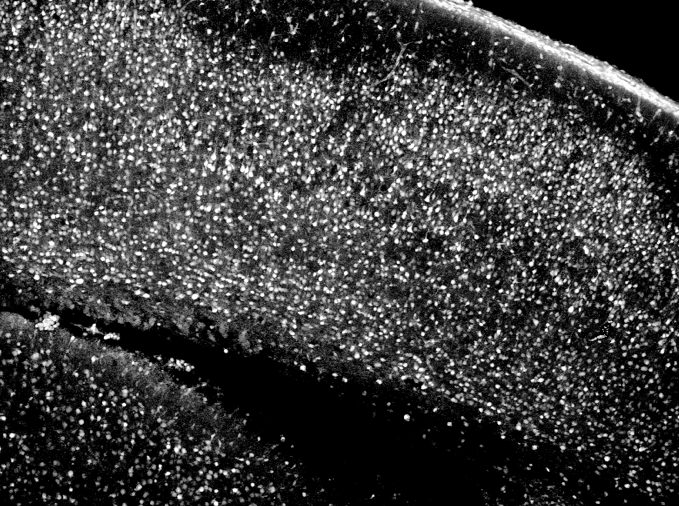
A brain slice of the cerebral cortex of a mouse, showing about 4,000 neurons. This picture shows a segment that is about 10 millimeters wide by 2 millimeters tall.

What do we still not understand about how the brain functions?

I think we’re still missing the whole picture. We’re still at the same stage we were 100 years ago, although we’ve collected much more data. Any established science has a general theoretical framework with which to understand the data. This is unfortunately still missing from neuroscience. We don’t have a general theory that explains what the circuits in the brain actually do. We have a lot of little theories but not a general one. The cortex is the largest part of the brain and is the site of all cognitive functions. That’s what makes us human.

What do we need to know to understand?

You could always argue, “When do you understand something?” The criteria for understanding something could be different for different people. But I think, for example, we understand an organ in the human body if we are able to fix its problems. Or you understand how a car works if you know enough about its mechanics to fix it when it breaks. If you apply that test to the brain, I’d say we cannot fix the problems. Schizophrenia, obsessive-compulsive diseases, Parkinson’s, Alzheimer’s–we’re at the very early stages.

You’ve compared the cortex to a circuit built out of modules. Can you explain that?

We don’t have a general theory; we’re walking in the darkness. So we make use of other fields around us that can provide us with some ideas of what to do. It’s natural to think of [the brain] as a circuit because it’s built out of components that send electrical signals to communicate. Electrical engineering is a very successful discipline, so we look there for inspiration. You can imagine in the cortex there could be a circuit, and if that’s the case, then we need to reverse engineer it.

This is exactly what engineers do from unknown devices—they take it apart, draw the circuit diagram and make an educated guess as to what the device does. People like me are trying to do the same thing with the neocortex.

You’re studying mice. Are their brains as mysterious as ours?

I don’t think we understand the brain of any animal. The assumption is that the cerebral cortex works the same, whether it is a mouse, giraffe or human. Our ultimate goal is to figure out how the human brain works so we can cure these diseases; and out of curiosity. In studying mice, we have an experimental model. We can keep slices of the mouse’s brain alive for about 12 hours in a special chamber. We have the circuit on a dish and can study the slides with optical and electrical techniques.

What other disciplines help you figure out the brain?

I think the biggest problem with neuroscience—the reason why we still haven’t figured the brain out—is the complexity of the circuits in the brain. There’s billions of neurons connected in very mysterious ways. It’s not easy to try to take it apart. What has happened in neuroscience is that new methods have been invented to tackle these formidable challenges. These methods are coming largely from the physical sciences—physics, chemistry and engineering. Engineering people in my lab have backgrounds that are interdisciplinary.

The hope is that these new methods would break this impasse and enable the gathering of data about these complicated circuits that would lead to the resolution of this basic problem.

What progress would you expect in your lifetime?

I’m optimistic. I think we’re almost there, as a field, and that there’s going to be a moment in neuroscience–that I hope will happen very soon–that will be a breakthrough, in which someone, somewhere will articulate a general theory that will be a little analogous to the moment in genetics when the DNA double helix model was proposed. It was very simple theory for how genetics works, and that was the foundation of molecular biology. I hope we’ll have something like this for the brain.

This is what I’m dreaming of—the moment when we’ll have this breakthrough of having a basic model of how these cerebral cortex circuits work. Once we have that, I’d expect a lot of the data we have floating around will fit into place.

How are your days spent?

I run a lab of 10 scientists. We work long hours and weekends, and I supervise and direct the group. I normally get to work very early, spend a couple hours answering emails and doing paperwork and then spend the rest of the morning in one-on-one meetings with people in the lab. In the afternoon I normally block time off to work on writing papers or writing grants. People like me travel a lot to meet colleagues and give talks.

I don’t do experiments anymore, but I supervise people who are doing experiments every day. Some days I feel like I’m their technician because I order their supplies and am brought in to solve their problems.

Even for an issue as critical as solving the human brain, do you still have to fight for funding?

I’ve been fortunate so far. I’ve been able to realize my dream and do the kind of science I want to do. When I started as a neuroscientist, my mentor in England told me to do good experiments and don’t worry about the rest. Somehow I think if you do good work and good science, the funding appears miraculously. We have to work to get it, but it does come.

I’m pretty convinced this is true, at least in science. I had to leave a fairly cozy life as a doctor in Spain. I came to the U.S. to start anew, with a couple suitcases, and I never regretted it. I would encourage young people to do the same. Don’t be too worried about your finances, and don’t be tied down too much to your roots. You only live once.

Start your week smarter with our weekly e-mail newsletter. It's your cheat sheet for good ideas. Get it.

Melanie D.G. Kaplan

About Melanie D.G. Kaplan

Melanie D.G. Kaplan is a contributing writer for SmartPlanet.

Melanie D.G. Kaplan

Melanie D.G. Kaplan

Contributing Writer

Melanie D.G. Kaplan is a regular contributor to The Washington Post and WebMD and has written for The New York Times, National Geographic Traveler and People. She holds degrees from Syracuse University and Columbia University's Graduate School of Journalism. She is based in Washington, D.C.

Follow her on Twitter.

Melanie D.G. Kaplan

Melanie D.G. Kaplan

In addition to working as a journalist, Melanie keeps the dog food fund flush with occasional consulting jobs. In the unusual event that her writing mentions a company or organization for which she has provided editorial services, she will disclose that fact. She will do the same should she cover any companies in which she holds investments.

She writes for SmartPlanet and is not an employee of CBS.

If you liked this, don't miss...
7
Comments

Join the conversation!

Follow via:
RSS
+1 Vote
+ -
Wasting the talents of senior scientists?
The fact that a top scientist such as Dr. Yuste has to spend his days running a lab, writing grant proposals, and giving talks makes me wonder about the efficiency of modern science (and engineering).

It's a very common situation. In order to get funding, you have to organize the lab around a scientist with a stellar reputation. That person never gets to do any original work in the lab. At most, he or she just gets to guide others.

While many such labs employ the geniuses of tomorrow, I still have to wonder if maybe we are wasting a lot of top talent.
Posted by zackers
6th Sep 2011
+1 Vote
+ -
Am I missing something here.
If experiments on non-human animals have taught us nothing else, it is that very little if anything is directly transferable. If you want to know how the human brain works, then test on human brains, not the brains of mice. If the goal is to understand the workings of the mouse brain to perfect the ability to know how to fix mouse brains that are somehow "defective" then this is a valid model. Otherwise this is voodoo science that has no practical value for the human species.
Posted by dcr100@...
6th Sep 2011
0 Votes
+ -
You missed a whole paragraph
As Dr. Yuste said: "I don???t think we understand the brain of any animal. The assumption is that the cerebral cortex works the same, whether it is a mouse, giraffe or human. Our ultimate goal is to figure out how the human brain works so we can cure these diseases; and out of curiosity. In studying mice, we have an experimental model."

I don't know what else there is to say. The human brain is extremely complex, we're lucky we have less complex brains such as mice that are still similar to ours. Once we understand mice brains better, then we can move to human brains and apply the same principles.

At present, we have no humane way to study human brains in action at the level we can mouse brains. You can't slice up the brain of a living human. Maybe later we will have better, less invasive ways of following how the human brain works. Or having an understanding of how a mouse or monkey brain works will allow us to do less invasive monitoring of a human brain.
Posted by zackers
7th Sep 2011
-1 Votes
+ -
Didn't Miss the Paragraph
No I didn't miss the paragraph in question. What you fail to realize is that the life of the mouse is just as precious to the mouse as the life of a human is to the human. To experiment on the mouse without its permission is just as wrong morally as it is to experiment on a human. If it is morally OK to do such experiments on the mouse, why is it not so for the human? Human physiology is uniquely human and lessons supposedly learned from experimentation on other animals is marginally transferable to humans at best.

If you want to know exactly how the human brain works, then do your experiments on human brains, not those of mice, chimps, or cats. All life is sacred. To devalue the life of a mouse, is to devalue the life of every living animal. The first step in desensitizing human empathy, is to ignore the worth of any other animal's life. It is limited thinking that is preventing the advancement of human brain physiology, and any amount of experimentation outside the human environment is antithetical to the effort.

The view you express regarding the superiority of the human brain is a common one, and is best described as speciesism. With compassion for other animals, who depend upon our human voices for their protection, we must all look to our moral values for a determination of the righteousness of the taking of another life for the purpose of experimentation. I personally lift up my voice in opposition to such work by this scientist and his crew.
Posted by dcr100@...
7th Sep 2011
+1 Vote
+ -
Well
did the mouse tell you he considered his brain to be sacred, or did you extrapolate from your own experience?
Posted by jtdavies
9th Sep 2011
+1 Vote
+ -
Mouse Didn't Have to
Apparently there are some human brains that are less evolved than those of some mice.
Posted by dcr100@...
24th Sep 2011
+1 Vote
+ -
@dcr100@.
i HAD JUST ABOUT GIVEN UP ALL HOPE OF FINDING ANOTHER EVOLVED HUMAN BEING!Its nice to know their is others who can see man and what he does in a true light! The arrogance and the ignorance of man combined shall be our down fall! I love the attitude of these simpletons that profess mans superiority and some how their is a manifest destiny written throughout the Universe that says we have the right to use abuse destroy and torture other life forms at our pleasure for our needs and purposes! How often man professes his superiority over the so called beast of the field. When in fact it is man who behave like beast and wild rabid animals destroying for their own personal gain and pleasure! I wonder when we have finally destroyed the majority of life on this planet just because it would be a inconvenience and not profitable to respect and save other species!I truly believe Man in their superiority all alone on the planet will show their real colors to each other. Man will then start to cannibalize ,mutilate and torture each other into extinction as we did all of the species before us! I say good riddance to the species of man incapable of evolving and learning from their mistakes! Proof of that alone can be found just by listening to A.M Radio talk shows and the lies and half truths that they regurgitate to the millions of sheep. Who believe everything they are told without question everyday. Yes man is far from superior!The Dinosaurs had a brain the size of a walnut. Yet the managed to live successfully for millions of years! Homo sapiens with their big brains i highly doubt will be able to achieve the same longevity on this planet! Oh and global warming is just a conspiracy right guys! Even though 99.9% of all scientist are in agreement on it! Only scientist that oppose these facts are employed by big oil. Of course the Super genius of the Republican choose to ignore the 99% and worship at the alter of big oils paid lies and misdirections! Yes We are doomed as a species, Unless we can evolve and teach empathy to a certain section of our population who has none and is proud of it! I believe their MOTTO is I got my so who cares about the rest! I believe it is written somewhere in the doctrine of the Republican National Party!
Posted by ibdirtpoe@...
11th Sep 2011
Join the conversation
Formatting +
BB Codes - Note: HTML is not supported in forums
  • [b] Bold [/b]
  • [i] Italic [/i]
  • [u] Underline [/u]
  • [s] Strikethrough [/s]
  • [q] "Quote" [/q]
  • [ol][*] 1. Ordered List [/ol]
  • [ul][*] · Unordered List [/ul]
  • [pre] Preformat [/pre]
  • [quote] "Blockquote" [/quote]

Join the SmartPlanet community and join the conversation! Signing up is fast and free. Don't wait -- we want to hear your opinion!