Ecovative: The new plastic is made from mushrooms

 Poking around in my mom’s attic recently, I was reminded that I still have the shipping box from my Macintosh SE, because the box is gigantic, and it’s great for storage. But the equally colossal pieces of Styrofoam that protected the computer in shipping more than two decades ago are long gone, spending their next thousand-plus years in a landfill.
And this is what drives Eben Bayer crazy.
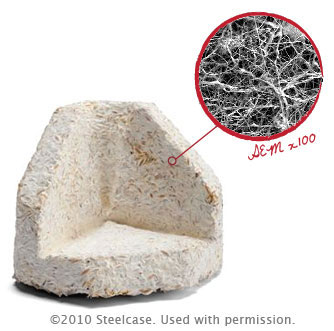
Co-founder and CEO of Ecovative Design, Bayer is on a mission to replace all packaging foam with a new material made from agricultural byproducts and mushrooms. Bayer and his co-founder invented MycoBond, a patent-pending technology that uses a growing organism and byproducts from food production (oat hulls from New York, cotton hulls from Texas and rice hulls from Arkansas) to create a strong composite material. The material is currently being used for shipping and insulating, but in the future you may see it on your TV or in your car. (Click here to see Bayer’s TED Talk last summer.)
I called Bayer Monday at his office in Green Island, NY. Excerpts of our conversation are below.
Where is Green Island? It sounds very peaceful and, well, green.
It’s an island in the Hudson River near Albany. It has a hydroplant about a mile from us, and it’s a nice spot for our company.
You say Styrofoam is one of the biggest culprits in our landfills, taking up 25 percent of the space.
The 25 percent is from an EPA study, and that’s by volume.
In general we have a plastic issue. We talk about Styrofoam because of how it’s used, and that’s in a highly disposable way. You have this polymer that’s made from carcinogenic compounds like benzene, and it will last up to 10,000 years. If you need it to last that long, that’s one thing, but it’s often just used for shipping, and then it’s disposed.
It’s the ultimate example of unsustainability.
If you look at packaging in nature, like a banana peel, it does perfect job of just protecting something for a short time.
 Your approach is to create materials that fit into nature’s recycling system.
We have a plastic that’s alive—a living polymer. Our vision is to replace plastics where ever they don’t make sense, which could even be your computer or TV.
Steelcase—one of the largest office furniture makers in the world--they’ve been really happy with EcoCradle, so we’re deploying it across more of their packing lines.
We’re launching EcoCradle in the computer market. There’s one big client that will be using it (we will be releasing the name in a couple weeks.) We also just started making wine shippers. With wine, our material acts as an insulation.
Finally, we’re starting to do some consumer products—picture frames, bowls for your home. The idea is to think of this as a new kind of plastic.
Are they designed to only last for a certain amount of time?
They last almost indefinitely if you keep them dry and out of nature. You can think of it as being biocompatible with our planet. But if this material gets put in your garden or on the side of the road, it starts breaking down like a seed husk within three months to a year. It’s getting broken into biocompatible stuff. It’ll help improve the soil in your area.
Packaging doesn't need to be a waste material. It can have a positive impact.
 You say mushrooms are nature’s recycling system. Explain that.
In general, most of the things in plants that are hard to recycle, but mushrooms produce the enzymes to do so. In forests there’s a lot of fungi that are breaking down the compounds.
So the mycelium from mushrooms—you use that as a glue to hold together these agricultural byproducts?
That mycelium is sort of like the root structure of a mushroom. Mycelium is comprised of tiny hollow fibers, and the fibers are made up mostly of chitin—which is what’s in lobster shells. It grows on its own [so energy costs are one 10th of the costs to create foam].
What are the challenges of working with this material?
It's like a conventional plastic, but it’s alive. It has a five- day growth period. So we had to build our own infrastructure for it to grow, and a lot of it is educating our customers and clients.
And we have to keep the fungi happy.
What does that involve?
We try to play good music for them.
It’s a matter of having the right temperature, right moisture levels and not too much light.
So when a client places an order, instead of starting to manufacture, you start growing?
We have a lead time of about two weeks, which is a standard manufacturing lead time.
What else might it be used for in the future?
With protective packaging, anything that weighs more 10 pounds. Anyone that uses plastic foam, we’d like to replace it. We’re able to provide that replacement at a cost parity with plastic. We’re environmentally a leader, but we’re also recognized for our price point.
The key is the mycelium—the whole organism and the seed husk becomes the final product. In every other approach, they take not the seed husk but the seed—the more expensive part that people would eat--and they grow the seed and throw away parts of it, so it requires much more energy and creates more waste. We’re using waste materials and using the entire organism.
The future for us is replacing foam.
[Chief scientist and co-founder] Gavin McIntyre just won a half a million dollar proposal to adopt this same platform for automobile interior trim parts and cushions. It’s a New York State Energy Research and Development Authority-funded program.
We’re also doing building materials as well--replacing foam insulation. It would mostly be commercial. The question is what’s the best way to do it.
There’s a lot of places where we can just replace Styrofoam. That’s our first-generation technology. The heart of our innovation is mycelium. We have patents pending in 35 countries on that. We see using it for all sorts of plastic material—like the hard plastic around your TV.
What if these things got wet?
You can get them wet. You really have to put them in your garden, in the environment [for them to start biodegrading].
Do you eat mushrooms?
I do. And Gavin does not.
Related on SmartPlanet:
- Video: The future of packaging
- Trade group makes case for environmentally sound packaging
- Despite SunChips flap, green packaging ideas make progress
- Grow your packaging, and why sustainability is behind Steelcase's big IT overhaul
This post was originally published on Smartplanet.com