Follow this blog:
RSS

Wind, wind everywhere. Who needs any other energy source?

By | September 17, 2012, 4:20 AM PDT

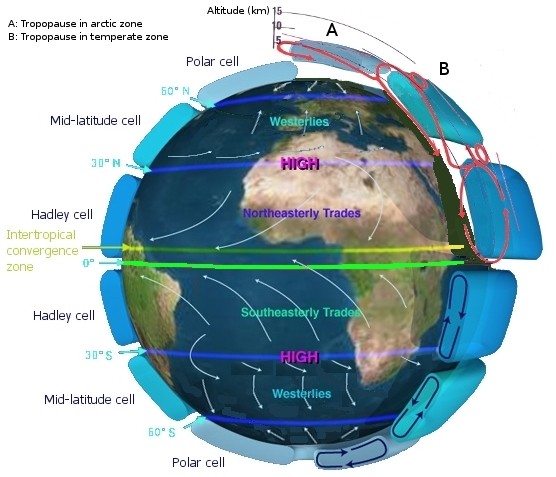
A Winderful World: Global wind currents could provide enough electricity for everyone on the planet, even if each person invites 100 extraterrestrial guests.

There’s enough wind blowing out there to provide more than 100 times the amount of electricity than the world currently uses.

According to a new study by the Carnegie Institution for Science at Stanford University, reported in Nature Climate Change, “surface winds” alone could do the trick by furnishing 400 terawatts of generating capacity. That’s more than 20 times the planet’s current 18 terawatt demand, the study states. (18 TW is a lot higher than “installed capacity” figures that I’m familiar with, but never mind - the point is that there’s enough wind to satiate everyone and legions of others).

Throw in high altitude wind - the sort reachable via kite or some other airborne device rather than through land-based wind towers - and you’re looking at an embarrassment of riches. Those loftier currents blow harder and more steadily. They reside anywhere from a thousand feet or so, up to the miles-high jet stream, and could add another 1800 terawatts, according to Carnegie.

But be careful before littering the skies with turbines. If you mess with nature’s breezes too much  you could actually alter the climate - an ironic possibility given that the point of installing wind turbines in the first place is to cut down on fossil-fuel induced climate change.

That would certainly be the case if you were to build all those 2200 terawatts of wind machines. “At these high rates of extraction, there are pronounced climatic consequences,” the study notes.

However, Carnegie assures us that if we were to simply stop at today’s global power level of 18 terawatts, then “wind turbines are unlikely to substantially affect the Earth’s climate.” One caveat: the turbines would have to be distributed, and not clustered in concentrated areas.

How much would it cost to get those 18 terawatts into the sky? Well, now you’re talking about the true impediment. As the study points out, “It seems that the future of wind energy will be determined by economic, political and technical constraints, rather than global geophysical limits.”

Let’s see how the financial and political winds blow.

Image: NASA via Wikimedia.

A swirl of wind stories on SmartPlanet:

Start your week smarter with our weekly e-mail newsletter. It's your cheat sheet for good ideas. Get it.

Mark Halper

About Mark Halper

Mark Halper is a contributing editor for SmartPlanet.

Mark Halper

Mark Halper

Contributing Editor

Mark Halper has written for TIME, Fortune, Financial Times, the UK's Independent on Sunday, Forbes, New York Times, Wired, Variety and The Guardian. He is based in Bristol, U.K.

Follow him on Twitter.

Mark Halper

Mark Halper

Mark has no financial holdings in the companies he writes about. He occasionally travels at the expense of companies or their press relations agencies in order to report on a company or industry event related to it; Mark will prominently disclose this information when appropriate. This relationship will have no influence on his coverage. Companies he covers do not get to review columns in advance, or select or reject topics.

He writes for SmartPlanet and is not an employee of CBS.

If you liked this, don't miss...
19
Comments

Join the conversation!

Follow via:
RSS
0 Votes
+ -
Same thing with solar
I don't know if it's true, but I've read that the amount of solar energy that reaches the earth in 14 seconds approximates the amount of energy used by humans in a day. That's about 6000 times what we need. However, if a solar panel is only 12.5% efficient, that 6000 is reduced to only 720. Can you imagine the cooling effect if we were to "capture" 0.13% of the solar energy reaching the earth? Of course, the waste mostly goes to heat, so maybe the inefficiency doesn't hurt. Regardless, whether you're taking energy out of the wind or capturing part of the solar energy that reaches the earth, there is an impact. I suppose the trick is to balance it. Perhaps solar farms could be located in such a way as to increase wind speeds nearby, allowing for combination solar/wind farms.
Posted by AlanLaRue
17th Sep
+3 Votes
+ -
This is why we should stop subsidizing wind and solar...
...and instead be funding research into storage technologies that makes harnessing all of this obvious energy practical. How many decades are we behind because we've been subsidizing the wrong thing?

The problem is that everyone understands windmills and solar panels. But few understand how the grid works or difficult it is to store energy and redeploy energy. Windmills and solar panels make for easy photo-ops for politicians, but storage tech does not. Until we convince people that storage is the key, we'll continue to waste trillions of dollars on windmills and panels we can't efficiently use and using carbon-based fuel.
Posted by JohnMcGrew@...
17th Sep
-3 Votes
+ -
Yeah, right ...
...and burn anything we can put our hands on to !.. while trying to get them we kill, we rape, we lie, we poison ourselves and all other creatures living besides us. How unlucky of these creatures to be born in the same century with us. They could have survived millions of years (well, not the meteorites, and all) instead they will go (they go as of now) right down the history books.
Posted by MimarSinan
17th Sep
+2 Votes
+ -
In case you haven't noticed...
...our "renewable energy policy" for the last 40 years has resulted in exactly what you describe. Clearly, that approach has not worked. Other than doing more of the same, exactly what would you suggest?

"Investing" in high cost, low output "alternatives" are not investments or alternatives at all. We need to be investing in solutions that are competitive with what we have today. Why? Because we represent a relatively small part of what future energy consumption will be on this planet, and the Chinese & Indians don't care about their burning and poisoning. If alternatives are not competitive on a cost/benefit basis, they won't be using them any more than we'll no longer be able to afford to.
Posted by JohnMcGrew@...
Updated - 17th Sep
0 Votes
+ -
Eco-friendly transport system
I have taken little pain in creating a login id specifically I felt answering you. You are tune in sense that we Indians are not keen enough and concern about the environ degradation. But take this information that we have a low per capita usage. I got a disturb sleep last night, I am very early to work at office, just been browsing the net to get information on fluid dynamics [on a subject that I am not familiar at all], simply with a motivation to device a Eco-friendly transport system. Do you acknowledge we are concerned with nature ?
Posted by vaanan
17th Sep
+2 Votes
+ -
I am not sure what you are talking about...
...or how it relates to the topic at hand.
Posted by JohnMcGrew@...
18th Sep
+3 Votes
+ -
Interesting drive this weekend.
My travels took me past 6 of the large turbines and one solar farm installed in eastern Massachusetts. The results were mostly positive, but still mixed.

Of the 6 turbines 5 were working. A big improvement on my last trip when only 2 were operational and the rest were down for repairs. The only one still waiting on repairs has a shoddily built foundation that is crumbing and tilting on a 3 year old turbine. They have spent almost a year trying to figure out how to fix it without completely taking down the turbine. At this point disassembly would have fixed it faster. Relocation to another site is now being considered.

The solar farm was interesting. A rash of panel thefts has left the farm working at less than full capacity since opening in August 2012. As of Sunday they had finally replaced all of the missing panels. I was surprised to see a temporary banner advertising the panel manufacturer mounted on some poles at the fence line shown in the article. It was shading the western end of the array at 2 pm on a nice sunny day.

http://www.patriotledger.com/topstories/x326766926/Two-more-Carver-solar-panels-stolen
Posted by Hates Idiots
17th Sep
0 Votes
+ -
Wind energy but maybe more
The movement of air to move wind generators is trivial compared to giant undersea turbines put in the path of ocean currents. Water has much more energy for a given cross section. There are far more possibilities for generating power from ocean currents that are less problematic concerning interactions with the biology of the planet. I'm not speaking of tidal power, that is very intrusive to the natural biology of the inlets that could make use of that. Actually it can be quite disastrous. The ocean current projects would be big money items but worth the effort. Come on now, lets get on it.
Posted by radiodog4@...
17th Sep
+2 Votes
+ -
Ocean Current Turbines Dangerous!!
First, there is the problem of fish kill. Spinning turbine blades are quite fast at or near the tips. We already have enough threatened species of deep ocean fish. Tuna for instance are becoming harder and harder to find.

Second, ocean currents transport quite a lot of heat. The East Coast of the US for instance, and all of Western Europe is warmed by the Gulf Stream. Shut down the Gulf Stream, and Rome Italy will have the same climate as Buffalo New York, or Chicago Illinois. London and Siberia would be about the same temperature.

The same problems exist for Japan, Korea, and the entire West Coast of the US.

What a turbine does is to remove energy of motion from the working fluid. This slows the fluid down.An efficient enough turbine will almost stop the working fluid. Air or water makes no real difference. You just change the turbine design to match the properties of the fluid.

Remember the Water Cycle from High School Science? Rain ultimately comes from the Oceans. Water vapor is carried by winds to the land. Winds at different altitudes are weakly coupled, but, are coupled. Remove enough energy in any area, and you have successfully transformed that area into a desert.

Western Europe is already seeing reduced rainfall as they transform to a wind based electrical system. Right now, that is being blamed on CO2. In 10 years or so, it will probably be blamed on wind turbines.

Atmospheric physicists have calculated how much wind energy can be tapped before the results become severe enough to merit action. the result is about a Gigawatt in any one area, and around 10 Terrawatts globally, that's around twice the energy currently generated by Nuclear Power in the US, as a ceiling for worldwide power, and close to the current worldwide total for Hydroelectric power.

In the US, both California and Texas are close to the gigawatt limit for Wind Power, and both are currently experiencing drought downwind of the Wind farms. Maybe it's just a coincidence?

I wonder if there is a connection?

Every time an energy price hike comes up, these sorts of things are trotted out as wonderful cure alls, but the downsides are never considered. Every power source has downsides.

Wind Power has been used in the US since the 1920s, but was never cost effective if there was utility power available. The problem was always backup. That is still true. Wind Power has to be backed up. usually by burning coal. That means that the Utility that uses large scale wind power has to keep a coal fired power plant running the whole time so that it can be ramped up to full output in a few minutes if the wind stops. Winds don't blow all the time, so that scenario happens usually a couple of time s a week. To make Wind Power economically competitive, Utilities are required to buy the output of the Wind farms, and still they require Federal subsidies of close to 25% of total revenues.

Because of this, Wind and Solar power increases the use of dirty old Coal as a power source.

I suspect that if undersea turbines are ever built, we will find problems with them too. Corrosion comes to mind, as well as inspection and maintenance. It's really quite hard to conduct routine maintenance on something that is 300 meters below sea level. Make it higher, and it will become a navigation hazard. Most commercial power plants have about 10% downtime for maintenance. Wind or Water turbines currently have more downtime than that. But, should approach that level of reliability in time.

Really, the only major workable economic option we have is Nuclear. The real Ecologists have recognized this for close to a Decade now. So do most of the real Engineers. It's the hobby ecological movement that is against Nuclear.

I suspect that we will continue putting off the inevitable conversion to Nuclear generation, and electric transportation until the last minute then use old technology because it's what we know. That would be the worst way to do it.

The Last Minute happens right after a large number of people lose their air conditioning one summer. When that happened in California a decade or so ago, they just shut down all the clean air provisions and pulled their power from anywhere they could. Imagine that happening from Houston to Chicago.

it would be Bye Bye EPA, Shut Up Sierra Club, and streamline any possible replacement. No one will want to wait 10 years to fix things.

Too bad it takes around 10 years to design and build a power plant.
Posted by YetAnotherBob
Updated - 18th Sep
+2 Votes
+ -
It's only a theoretical number
This number only talks about the potential energy available from wind, not how practical it is to produce it. For example, the US uses about 20% of the world's total energy (see https://en.wikipedia.org/wiki/World_energy_consumption ). Scientists involved in another study of wind power (see http://spectrum.ieee.org/green-tech/wind/little-limit-to-the-amount-of-wind-energy ) say that it would require 4 million windmills to produce half of the planet's current total energy requirements. That means the US would need about 800,000 large windmills to produce half of its total power from wind. In 2009, the US installed 5700 windmills (see http://www.awea.org/issues/supply_chain/Anatomy-of-a-Wind-Turbine.cfm ), so at that rate it would take 140 years to build the windmills needed to replace half the US energy requirements *today*.

We could build windmills faster, but there are other restrictions. Building such a large number of windmills requires enormous amounts of concrete (1.7 million cubic yards of concrete for the 5700 windmills built in 2009, enough for more than 7,630 miles of 4-foot wide sidewalk), rebar, as well as other materials. And we have to build an electric grid that could collect the electricity from remote windmills and deliver it to cities.

This is not to say it's impossible. The US currently has around 540,000 active oil wells, and each of them is roughly the same investment as one windmill ($4 million for an oil well vs. $3 to $3.5 million for a windmill, see http://www.petrostrategies.org/Learning_Center/drilling_operations.htm and http://www.windustry.org/resources/how-much-do-wind-turbines-cost ). But it took us 150 years to build that kind of an oil infrastructure, even though there were enormous rewards for companies that did so. Building 800,000 windmills would require well over $2 trillion, plus the costs of building the associated electric infrastructure. We would also need to come up with some kind of energy storage system (completely unknown at this point) for when the wind isn't blowing hard enough to meet our immediate needs, as well as convert most of our cars to electric. It's not something that's going to happen overnight.
Posted by zackers
Updated - 17th Sep
+2 Votes
+ -
Electric Cars
While I like the idea of converting freeways to allow for coast to coast driving with electric cars, the total energy required for current cars, trucks, trains and planes in the US is greater than the total installed electric generation capacity in the US.

I think you have underestimated the total amount of power required. The existing power line infrastructure is just not capable of moving that much power.

Also, you are using old figures. The US currently uses less energy than China does, and only slightly more than India does. Add in Western Europe and Russia, and that gives you around 70% of the worlds energy usage. So, the US currently uses about 15% of the total. But, percentages aren't everything. The total energy usage of the US hasn't dropped. It's just that the rest of the world is using more.

So, in aggregate, it's a worse picture than you present.
Posted by YetAnotherBob
18th Sep
-2 Votes
+ -
Wasting time on Solar and Wind
You say we are wasting our time only because battery technology has not had a breakthrough? Its not like they are not working on storing electricity. If they could a couple lightning bolts discharged into a capacitor like system would power plenty for a long time. Why is it the Nay sayers always post the longest most complex bullS*it lines in the reply sections
Posted by doumor_99
18th Sep
0 Votes
+ -
18 terrawatts
I suspect that number includes not only generated electricity but the energy from fuel used for motive power as well.
Posted by riverat1
18th Sep
+1 Vote
+ -
Practical considerations
fThis article raises way more questions than it answers. The important bit is this: "the future of wind energy will be determined by economic, political and technical constraints, rather than global geophysical limits. That's an important message that we all need to hear.

In the final analysis, the power that gets built is the power that makes economic and environmental sense. Wind and solar have important roles to play, but are unable to reliably provide the majority of our power needs. As wind penetration rises past 10-15% the cost increases and the emissions avoided decline more and more sharply for each additional increment because of the rising costs and emissions associated with the larger and larger amounts of low-utilization standby generation from fossil fueled units that is required. The same concept applies to solar power.

The only technology capable of reliably and economically providing CO2 free power in large amounts will continue to be nuclear power. The new 3rd generation units now under construction at several locations around the globe will be significantly safer and eventually significantly cheaper to build and operate than current plants. Fukushima has thrown people into an emotionally driven rejection of the very technology that we need to embrace, but we need to get past the fear and examine all the evidence before turning away from the best option to avoid the worst effects of climate change.

Beyond 3rd generation units like the AP-1000 (1100 Mw output, equivalent to 750 5 Mw windmills at 30% capacity factor) are 4th generation units that will not only be incapable of melting down but able to run for centuries burning the "waste" from current plants to recover the 99% of energy remaining in it.

This is the path China and India are planning for, but we will be late to the game unless we apply more logic and less emotion to designing our energy future.
Posted by John Hartshorn
18th Sep
0 Votes
+ -
Combination
It will be great if the wind turbines can be covered by solar cells to allow generation of two sources of electricity at one time
Posted by Wilson Yeo
19th Sep
0 Votes
+ -
wind 400 TW
Winds are driven by sun radiation. Earth receives about 1e17 W of it, about 1e16 W is absorbed by atmosphere. If all of this is used for driving of winds with temperature difference of 10K, in perfect Carnot cycle it makes only 3e14 W or 300 TW. In reality, temperature diferences are much lower, solar power is spred over cold and warm places, there are friction, losses in turbines, evaporation, mixing of air, wave-making, photosynthesis, buffering by land and sea, etc. etc. Even 10% of this 300 TW is obviously too much, several percent max is more realistic. So these 400 TW are pure fiction.
Posted by praoss
20th Sep
0 Votes
+ -
Bringing the humanty sitrgul for beter life to a Matur form
Hello All
My subject will be about that the humanity have passed its infancy, childhood and adolescence and now the humanity are in the maturation stage and we must push this mature humanity farther to the full maturation, and to enhance the awareness of unity and the feeling of responsibility .


Part One
Do you think my friends that the global worming was due to the carbon dioxide and alike only? The answer is NO. Why? Because there is a very dramatic factor that we create but we do not understand its effects, and not aware of it. And that is the urbanization of the area where it should be green and this will tern this area that was a carbon dioxide consumer and an oxygen and humidity producer to a new type of desert + carbon dioxide
Posted by A S Zachi
20th Sep
0 Votes
+ -
.............begins at home
A small company in southern California is installing their small turbine on individual homes in rural Mexico. The energy is then stored in a container no larger than an air- conditioner unit then used as needed. The units cost about $2,000.00 and can be easily installed and moved. This eliminates two big costs-transportation and storage. For more informaation look at Sauer Energy.com.....
Posted by valoyc
28th Sep
0 Votes
+ -
home insurance
i know a very good site. which have very good info about home insurance .
a href="http://www.alliance321.com/homeowners-insurance-florida-quotes/">home insurance florida
Posted by ashiksakura
Updated - 25th Nov
Join the conversation
Formatting +
BB Codes - Note: HTML is not supported in forums
  • [b] Bold [/b]
  • [i] Italic [/i]
  • [u] Underline [/u]
  • [s] Strikethrough [/s]
  • [q] "Quote" [/q]
  • [ol][*] 1. Ordered List [/ol]
  • [ul][*] · Unordered List [/ul]
  • [pre] Preformat [/pre]
  • [quote] "Blockquote" [/quote]

Join the SmartPlanet community and join the conversation! Signing up is fast and free. Don't wait -- we want to hear your opinion!