Follow this blog:
RSS

University moves toward powering Florida with the Gulf Stream

By | May 23, 2011, 3:19 PM PDT

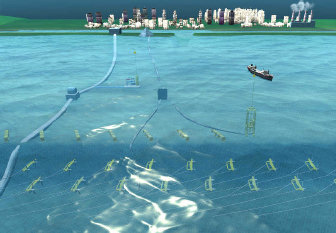
An artist's rendering of offshore turbines harnessing the Gulf Stream to power Florida's cities. Credit: Florida Atlantic University

Florida’s expansive coastline has long drawn surfers and sunbathers, and now, some university researchers are dipping their toes into the surf with an experiment to generate tidal power, regulators announced today.

Florida Atlantic University has applied to the Bureau of Ocean Energy Management, Regulation and Enforcement (BOEMRE) for permission to test a prototype hydrokinetic technology on the Outer Continental Shelf (OCS) approximately nine to 15 nautical miles offshore Fort Lauderdale.

“This is the first lease application BOEMRE has received to test ocean current equipment on the U.S. Outer Continental Shelf,” said BOEMRE Director Michael R. Bromwich in a prepared statement. “Before a leasing decision is made, we are preparing an environmental assessment under the National Environmental Policy Act and are providing an opportunity for public input concerning these activities.”

The assessment will consider the technology’s impact to life on the ocean floor, wildlife, and existing human uses such as commercial fishing. BOEMRE says that it has identified four other areas off of Florida for testing ocean current technology and collecting resource data.

Florida Atlantic University’s (FAC) interest lies in tapping the energy potential of the Gulf Stream, which flows continuously along the state’s eastern coast before shifting its direction toward Europe.

The turbines would utilize 23-foot-diameter rotors and generate up to 100 kilowatts of capacity, according to reports. A buoy and single anchor mooring would hold it in place.

The Gulf Stream’s strong, steady current would provide baseload renewable power akin to a fossil fuel power plant. Solar and wind power sites are generally intermittent with spikes of power being generated during peak hours.

FAC has stated that Florida could meet up to a third of its energy potential by drawing on the Gulf Stream’s 8 billion gallons per minute flow rate across the OCS.

Tidal power is gaining momentum as a clean energy solution overseas: Scots are planning to power distilleries with the tides, and an undersea “kite” will is being deploy off of Northern Ireland this year to produce 500 kilowatts of electricity. Nearly 25 percent of the world’s wave and tidal technologies are located in the United Kingdom.

Domestically, the U.S. Department of Energy granted US$37 million in government grants cover 27 projects intending to generate power from rivers, tides, waves, vortexes, currents and thermal gradients.

In 2010, the DOE designated FAU the Southeast National Marine Renewable Energy Center, one of just a few national centers for ocean energy research and development. FAU’s private sector partners include Verdant Power.

FAU established its program in 2006 with a grant from the state of Florida. It is also exploring the possibility of harnessing ocean thermal energy conversion.

Related on SmartPlanet:

Start your week smarter with our weekly e-mail newsletter. It's your cheat sheet for good ideas. Get it.

David Worthington

About David Worthington

David Worthington is a contributing editor for SmartPlanet.

David Worthington

David Worthington

Contributing Editor

David Worthington has written for BetaNews, eWeek, PC World, Technologizer and ZDNet. Formerly, he was a senior editor at SD Times. He holds a degree from Temple University. He is based in New York.

Follow him on Twitter.

David Worthington

David Worthington

David does not have financial holdings that would influence how or what he covers. Occasionally he consults for other companies; should David cover a topic in which a client is involved, he will disclose this fact in his writing. His views do not represent those of ScaleOut Software.

He writes for SmartPlanet and is not an employee of CBS.

If you liked this, don't miss...
6
Comments

Join the conversation!

Follow via:
RSS
0 Votes
+ -
The obvious question
You offer some interesting details, but many critical ones are left out. While tidal power may well represent a viable economic power source, it's difficult to find any articles that mention tidal powers greatest negative - biofouling maintenance (within current environmental constraints) and how it will affect this technologies overall economics. In general, economic implications and viability seems to be a black hole for Smart Planet contributors - as it is with most other pop media services. Unfortunately, if this is a "smart planet" audience, then you are not serving their interest in sufficient detail by ignoring the economics of ideas.
Posted by dduggerbiocepts
24th May 2011
0 Votes
+ -
Gulf Stream power
I cannot understand why industry is so slow about using wave power or this Gulf Stream power. The are about as green as you can get and shouldn't require much maintenance. So you have an endless source of power that is non polluting with low maintenance. As long as it isn't in a major ship traffic lane, there shouldn't be any other issues. Of course there would have to be a cage around it so it wasn't digesting fish or whales.
Posted by builder50@...
24th May 2011
+1 Vote
+ -
Barnacles!
As dduggerbiocepts suggests, bio-fouling almost surely will be a big problem. As any Florida boat owner can tell you, if you leave something in the water continuously, barnacles, slime, and a whole coral reef will soon be attaching themselves. As the whole point of this type of power plant is preserving the environment, preventing bio-fouling will be an especially sensitive proposition. The best stuff is poisonous to sea life and is already illegal. The current stuff is marginally effective because it just tries to kill less sea life, which is contrary to its primary mission. The future holds promise of better anti-fouling options (more specific poisons, super slippery coatings, electronic or sonic repulsion, etc.), but that is the future, not now. So I expect any in-the-water power generator to require frequent and difficult maintenance, which will not only drive up the cost, but drive down the availability and efficiency of the equipment too.
Posted by Day Dreamer
29th May 2011
+1 Vote
+ -
Incomplete science.
Has anyone studied the down stream impact of that many turbines being put in the Gulf Stream?

Beyond the potential problems faced by migratory fish using the Gulf to ease long distance travel, we have all seen the dire warnings of what would happen if the Gulf Stream slowed because of shifting temperatures and saline levels. Does putting a physical barrier in place have the same effect?

The comparisons between wind power and this kind of wave power are extensive. To start with there is a growing amount of data supporting the negative impact of large wind farms on local bird populations and microclimates. It is easy to see the same impacts in the ocean.
Posted by Hates Idiots
31st May 2011
0 Votes
+ -
Incomplete and/or pseudo science
As day dreamer points out, bio clogging (think barnacles & algae) will be troublesome, as will corrosion - or are they going to make this thing out of gold? What about ship traffic running into it? This idea seems like another "too good to be true" scheme to extract government cash. I'd sure hate to write the environmental impact statement for this, as well as protect it from the occasional hurricane.
Posted by Starman35
17th Jun 2011
0 Votes
+ -
Into the deep
Some key concerns to address head-on:
1. Corrosion: Precedents: Borrowing from civil engineering (dam & bridge builders)
with sumbergible structures (20+) years the use of composites ~ metals
& various polymers (CK/ceramic coatings) have been in use in offshore
platform industry for several decades and material development is
on-going.

2. Submergible floating structures (similar to offshore wind ,above-surface, catenary buoys) reduce shipping and recreation hazards. Constant flowing current may act as cleaner to biofouling. Bio-materials sink thanks to gravity. Suspended systems help reduce the buildup and maintain head clearance for maritime and recreational vessels.
Posted by kurentz
Updated - 14th May 2012
Join the conversation
Formatting +
BB Codes - Note: HTML is not supported in forums
  • [b] Bold [/b]
  • [i] Italic [/i]
  • [u] Underline [/u]
  • [s] Strikethrough [/s]
  • [q] "Quote" [/q]
  • [ol][*] 1. Ordered List [/ol]
  • [ul][*] · Unordered List [/ul]
  • [pre] Preformat [/pre]
  • [quote] "Blockquote" [/quote]

Join the SmartPlanet community and join the conversation! Signing up is fast and free. Don't wait -- we want to hear your opinion!