The Thorium Lord

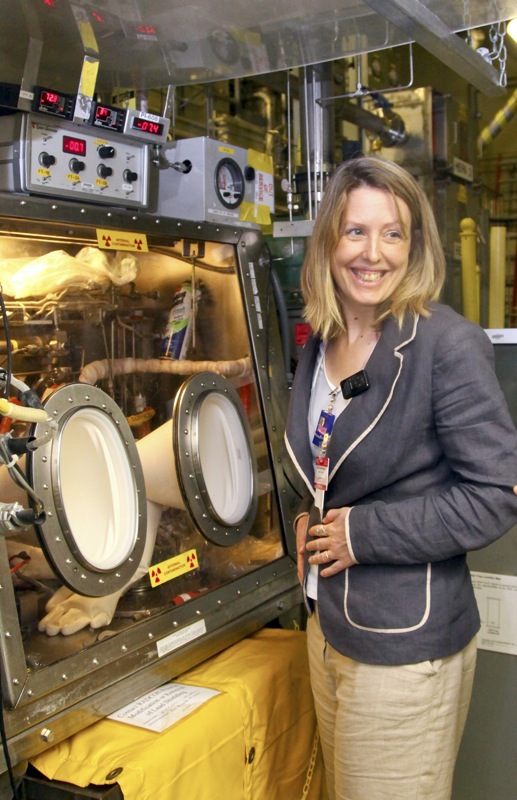
Oh, Worthington believes the scenario alright. She just doesn't accept that it was a conspiracy.
"People like to look for wrong doings in this, but actually I think it was just the political climate and the reality at the time," says the Baroness, a Labour Party member of the House of Lords, the upper chamber of British Parliament. "Obviously nuclear power has been linked to weapons throughout history, and one of the factors of a uranium based fuel cycle is it gives you lots of plutonium which is perfect for bombs and weapons. And that's what we wanted during the Cold War. So that's what got the money."
Indeed, under President Richard Nixon, the U.S. abandoned a safer and more effective fuel that it was developing and that had been very much in the running along with uranium in those early days of America's nuclear energy program.
The safer fuel that did not "get the money"? Thorium - a mildly radioactive substance which, like uranium, is an element on the periodic table. Compared to uranium, its supporters claimed that it did not produce weapons grade waste. Good for peacetime, not so good for two super powers intent on flexing deadly muscles.
What's more, its waste lasted only hundreds of years instead of uranium's tens of thousands. Just as compelling: Tennessee's Oak Ridge National Laboratory had developed a "molten salt" reactor running on liquid thorium that provided failsafe assurance against meltdowns and blowouts, and that could operate more efficiently than solid fuel uranium reactors. To round out the benefits, thorium was plentiful around the world.
Those advantages are still true today, four decades after Nixon. And if Baroness Worthington has her way, thorium - she calls it "the forgotten fuel" - could well break through onto Britain's and the world's energy scene.
FIGHTING INERTIA
Worthington is the UK's leading political voice for thorium nuclear power. In fact, she is one of the main politicians anywhere in the West speaking up for thorium. Her goal is to get Britain to build nuclear reactors that run on thorium, not uranium, and that contribute substantially to the country's ambitious goal of cutting CO2 emissions 60 percent by 2030 and 80 percent by 2050 - targets established by the Climate Change Act of 2008, which Worthington helped draft before she was even a member of the Lords.

While Prime MInister David Cameron himself is trying to secure a strong future for nuclear power in the country, he is focused on uranium reactors for the eight sites where his government has approved new reactors, with no mention of thorium.
"There's a sort of inertia where we currently have a nuclear energy system based on solid fuel uranium reactors that remain the dominant technology," says Worthington, who I spoke with at length on a flight to the 4th Annual Thorium Energy Alliance Conference in Chicago late last month. "But I think there's much more upside now for alternative nuclear reactor designs which are inherently safer and cheaper - and thorium offers that potential."
One of the pillars of her platform is a group she started in February and chairs, called the All Party Parliamentary Group on Thorium Energy. As its name implies, the APPG brings together multi-partisan members from Parliament's House of Lords and lower House of Commons to advance the thorium cause and to educate. It reaches out to government, industry and academia. (It was at an APPG meeting on April 23 that the UK's Department of Energy and Climate Change (DECC) acknowledged that thorium is at least somewhere on its radar. The APPG meets again at the Houses of Parliament this Tuesday the 19th. I'll be there and will report).
Worthington is also the patron to the Weinberg Foundation, a London-based thorium champion formed last September in honor of Oak Ridge's Dr. Alvin Weinberg, the late physicist who led the thorium molten salt team at Oak Ridge in the 60s, who advocated safe nuclear power over weapons-oriented nuclear, and who Nixon basically fired.
UNLIKELY CAMPAIGNER
The 40-year-old Baroness, a Cambridge University English literature graduate, is an unlikely flag waver for thorium. Until a few years ago, she was a card carrying anti-nuke zealot, having waged environmental campaigns of one sort or another since leaving Cambridge in the early 90s, and landing at Friends of the Earth around 2003. Her job there? "I was the climate change campaigner, and I was asked to run an anti-nuclear campaign," she says. "Now, it seems like quite a paradox." (As this story was going to press, things became a little less paradoxical, as blogger Mark Lynas reported that the environmental group is considering ending its decades long opposition to nuclear, and that it supports research into thorium and at least one other of several alternative nuclear technologies).
Worthington eventually parted ways with FOE, but not with her anti-nuke feelings. Determined to help shape environmental policy from within industry, she went to work for Scottish utility Scottish and Southern Energy, where she tried to assert an anti-nuclear position but where, as she tells it, "I would lose every battle I had with them."
Still, she bled anti-nuclear. Then something happened. Or more precisely, someone.
"It was Kirk," Worthington deadpans. In Western thorium circles, "Kirk" means one thing - Kirk Sorensen, an impassioned, steeled and articulate thorium leader - the Captain Kirk of the new thorium brigade, if you will. Sorensen's new company, Flibe Energy in Huntsville, Ala, is picking up where Alvin Weinberg left off, developing a molten salt reactor based on the Oak Ridge design.
"I mean, most people get turned on by Kirk- he's phenomenal," says Worthington. She experienced her Kirk moment in 2009 at a Guardian newspaper energy conference in Manchester, England where she was a judge on a panel looking at 10 new technologies that could save the world from climate change, and he presented his ideas about thorium. "He kind of shocked us all because we had never heard of it," she remembers.
GREEN MACHINES
Fast forward to today. Sorensen and Worthington were one of the many presenters at the May 31 Chicago thorium conference, keynoted by Richard Martin, author of the just released thorium homage, SuperFuel. (I also presented, giving an overview of my Kachan & Co. report on alternative nuclear power).
Worthington considers herself as much a climate change campaigner as ever. "Energy's one of my passions. In the context of climate change, that's what drives me," she says. To her, that means nuclear as well as renewables like solar, wind and others. "The green spectrum contains a lot of different types of people. There are some who are very avidly anti-nuclear for their own reason, and then there are some who are very pro-nuculear. I've shifted from one end of the spectrum to another. I hope that we'll see a whole range of low carbon technologies come along, but I think we'd be foolish to rule out nuclear. But I want the safest and most cost efficient nuclear, which is why I'm interested in thorium."
She is not an advocate of solid fuel uranium nuclear, noting that it's too expensive, has safety issues, and leaves dangerous long-lived waste.
But does thorium stand chance, given the entrenched uranium value chain, the expense of developing it, and general anti-nuclear sentiments?
"I think it should happen, and that's part of what we're doing, lobbying to make it happen," says Worthington, who wants the UK government to commit funds toward thorium research and development, and who is adamant that the funds should go into a liquid thorium - rather than solid thorium - reactor.
CHINA COULD LEAD THE WAY
Worthington is not simply counting on the UK. She opens the possibility that Britain could import the technology from several possible countries - perhaps most notably, from China, which is developing at least two liquid thorium reactors as part of its ambitious plans to rely heavily on nuclear power and less on coal. "They're putting a hell of a lot of store into nuclear, and they want it to be safe, they don't want to have a Fukushima happen on their territory," she says.
China has an extra incentive for developing thorium: The country has already mined a lot of it, by virtue of its world dominant rare earth industry. Rare earth metals - used in everything from weapons to iPods - occur in a mineral called monazite, which is also rich in thorium. China is believed to have stockpiles of thorium left over from rare earth operations.
"It might happen in China first, and then it's something that can get transferred over here. The UK has always been open to anyone who has a licensed reactor desgin and comes and asks to build one in our country. In the past that has been the French (and Japanese). They (the UK) would be happy to sit down witht a Chinese company and run through all the licensing requirements. We'd encourage them to do so."
Sorensen's Flibe could also come over too. And Japan, in the wake of its Fukushima nuclear meltdowns, also has thorium efforts under way, including plans by utility Chubu Electric to investigate thorium power. India is another country developing thorium nuclear power, as it could make use of the vast thorium reserves that occur naturally in its beach sands.
"It's open to anyone. It's a market," says Worthington.
One way or another, she holds out hope that the UK could within the next five years start putting money into developing a test reactor, either on its own or as part of a European initiative. That would then make it feasible, she says, for the country to deploy a licensed, commercial thorium reactor by the mid-2020s.
TAKING THE HEAT
For that to happen, industry will have to get involved, and help finance the development. According to Worthington, several UK and European companies from the aluminum, iron and steel, chemicals and other industries have expressed interest in using small thorium reactors as a source of industrial process heat, rather than as an electrical generator. Nuclear reactors give off heat used to drive turbines that make electricity, but are also potentially excellent sources of heat for high temperature processes- such as extracting oil sands in Canada).
As the Baroness notes, while there are plenty of fossil fuel alternatives that can make electricity, "there's an industrial lack of good low carbon heat supply."
That idea resonates with Flibe's Sorensen, who, a day after I spoke with Worthington, told the Chicago thorium conference that thorium reactors could provide heat not just for industrial processes, but also for water desalination and for turning hydrogen into ammonia for agricultural fertilizer. Also of potentially huge societal benefit, Sorensen noted that a liquid thorium reactor yields byproducts that are highly useful to medical diagnostics and cancer treatments, including molybdenum-99 and Bismuth (I'll get more into this in a separate story).
"The most useful things that these machines might produce might not even be electricity," Soresnen said. "It may be other things. I'm becoming more and more convinced that medicines and desalinated water and process heat are going to end up being more valuable products from the use of liquid fluoride thorium reactors than electricity."
Sorensen also reaffirmed that thorium is plentiful and, in a liquid reactor, efficient, claiming that a grain silo full of thorium would be enough to power North America for a year.
Worthington is hopeful that once the industry gets past significant thorium development costs (Flibe has estimated it will take at least $1 billion to complete development of a modest sized liquid thorium reactor) that it will be able to manufacture relatively low cost thorium reactors on a production line basis.
She does not expect any help from the conventional big nuclear manufacturers like Areva, Toshiba Westinghouse and General Electric Hitachi. "They're not interested," she notes, adding that "they're probably at best neutral" toward thorium.
CHANGE REACTIONS
Worthington knows she is fighting a minority battle against the status quo. But that sort of thing suits this 40-year-old woman in the House of Lords, where the average age is 69, and where 80 percent of the members are men. A Twitterer, she's cut out for change, challenge and doing things differently. She sometimes brings her 18-month old son to work at Parliament, where, she, quips, "he's even voted" - a reference to the Parliamentary tradition by which members register their votes via physically entering one room or another in the Halls. "I've carried him through the voting corridor, but his vote didn't count, sadly."
She also never shied away from a battle or a cause she believes in. In the late 1990s, when she wasn't a politician, she helped write a clause to a piece of legislation called the Countryside and Rights of Way Bill that, in her words, "makes the reckless harassment of dolphins illegal" - in other words, any one taunting a dolphin with jet skis can get arrested. Then came her contribution to the Climate Change Act of 2008 - the one that targets 80 percent carbon reduction by 2050 - which she helped write while working for Scottish and Southern.
It was her tenacity and skill at writing bills that helped get her appointed to the House of Lords in February last year by Labor Party leader Ed Miliband (The 775 members of the Lords are appointed, not elected. Their main role is to advise and suggest changes to proposed House of Commons bills, which the Lords can also delay). "I never really wanted to be a politician," she claims.
Thorium is her newest cause, as she works to reverse the legacy of the Nixon era. Does she ever doubt the alternative nuclear fuel, or has she ever questioned whether all the claims for it are too good to be true?
"Oh yeah, constantly," she says. "It's a constant process of finding out things. Lots of people are trying to knock it down." She receives regular thorium criticism via Twitter and email. "I investigate each time," she says. "I try to talk to as many people as I can to get a range of opinions. I do occasionally think it's too good to be true. Then I bounce back, because nothing's perfect, and the alternatives have all got problems."
She'll certainly work tirelessly for it - tireless work is one of the Baroness' hallmarks. On the flight to Chicago, she was writing a submission of evidence criticizing the government's newly proposed Draft Energy Bill. She blasts it for posing as a boost for renewables while actually focusing on attracting foreign investment for the construction of conventional nuclear plants. "It's an odd piece of legislation," she notes.
In addition to everything else, she founded and runs Sandbag, a non-profit group that promotes climate change policy, including carbon emissions trading schemes.
Not that she's all toil. As we wrapped up our hour long talk, I asked the Baroness, who's married to a Cambridge neuroscientist, what she likes to do when she's not splitting atoms. Her face beamed as she talked about spending time with her "awesome" son.
She also recalled how once, after leaving university, she sailed across the Atlantic, from the Canary Islands to Antigua on a small boat with two friends. It was an excursion on which, she candidly admits, "I was very bored - it was a long time not to be standing on land." The Baroness is now setting sail on the thorium nuclear waves. It's another journey that is likely to take a while. But at least this time, the trip shouldn't be boring.
--
Photos: Worthington at ORNL by Jason Richards via Knoxnews, Frank Munger's Atomic City Underground blog. Kirk Sorensen by GordonMcDowell via Flickr. Friends of the Earth Logo from FOE website. Parliament from Diliff via Wikimedia. Thorium molten salt reactor from ORNL via Wikimedia. Weinberg and Wigner from ORNL via Wikimedia. Marten Eskil Winge's 1872 painting, 'Thor's Battle with the Ettins' from Wikimedia. Worthington headshot from parliament.uk.
Explore SmartPlanet's Thorium Trail:
- Safe nuclear: Japanese utility elaborates on thorium plans
- Japanese utility mulls thorium
- Safe nuclear: UK eyes thorium
- Safe nuclear: Let the thorium debate begin
- Safe nuclear: India’s thorium reactor
- Fukushima’s lesson: ‘Alternative’ nuclear, not ‘no’ nuclear
- Watch replay of nuclear’s future, with dash of rare earth
- Why safe nuclear will rely on rare earth minerals
- Meet the future of nuclear power: 8 guys in China
- How nuclear will make oil greener
- The new face of safe nuclear
An all-in-one guide to alternative nuclear:
This post was originally published on Smartplanet.com