Follow this blog:
RSS

The rise of the albatross: Good news for global warming

By | January 13, 2012, 4:25 AM PST

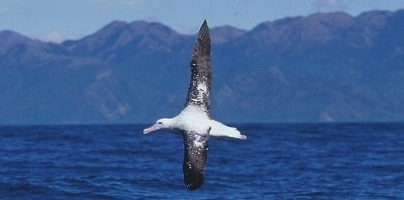
Albatross showing off its highly effective wings. Photo from van Poppel via Wikimedia.

The albatross suffers the world’s worst public relations.  It is arguably nature’s most miraculous flying machine, able to glide for thousands of miles without flapping its wings, which span up to 11 feet.

Yet people know the poor thing as a punishing impediment - something hung around someone’s neck - thanks to Samuel Taylor Coleridge’s Rime of the Ancient Mariner.

The albatross, around the time its reputation took a beating. (Gustave Doré engraving for Rime of the Ancient Mariner, from Wikimedia).

Now, climate change is doing its part to highlight the bird’s marvels. Science reports that global warming is boosting average wind speeds over the Southern Ocean, quickening albatross foraging trips during nesting season to 9.7 days in 2008. In 1970, the same trip took 12.4 days.

The faster journeys have benefitted albatross welfare, fattening them up by more than a kilogram (2.2 pounds) to a more resilient weight, and increasing the survival rate of chicks. That’s good, considering the albatross population has been shrinking.

But global warming that giveth also taketh away. Science warns, “The positive consequences of climate change may be temporary if patterns of wind in the southern westerlies follow predicted climate change scenarios.”

The albatross is used to such fickleness. Before the 18th century seaman shot it with a crossbow, it enjoyed a splendid reputation as an omen of good sailing winds. For now, then, here’s to the feathery creature’s 15 minutes of fame.

Albatross A-B-C’s:

Start your week smarter with our weekly e-mail newsletter. It's your cheat sheet for good ideas. Get it.

Mark Halper

About Mark Halper

Mark Halper is a contributing editor for SmartPlanet.

Mark Halper

Mark Halper

Contributing Editor

Mark Halper has written for TIME, Fortune, Financial Times, the UK's Independent on Sunday, Forbes, New York Times, Wired, Variety and The Guardian. He is based in Bristol, U.K.

Follow him on Twitter.

Mark Halper

Mark Halper

Mark has no financial holdings in the companies he writes about. He occasionally travels at the expense of companies or their press relations agencies in order to report on a company or industry event related to it; Mark will prominently disclose this information when appropriate. This relationship will have no influence on his coverage. Companies he covers do not get to review columns in advance, or select or reject topics.

He writes for SmartPlanet and is not an employee of CBS.

If you liked this, don't miss...
1
Comments

Join the conversation!

Follow via:
RSS
0 Votes
+ -
Ocean acidification too.
If ocean acidification significantly changes the ocean food chain that could be bad news for the albatross. I can't imagine it won't have an effect.
Posted by riverat1
13th Jan 2012
Join the conversation
Formatting +
BB Codes - Note: HTML is not supported in forums
  • [b] Bold [/b]
  • [i] Italic [/i]
  • [u] Underline [/u]
  • [s] Strikethrough [/s]
  • [q] "Quote" [/q]
  • [ol][*] 1. Ordered List [/ol]
  • [ul][*] · Unordered List [/ul]
  • [pre] Preformat [/pre]
  • [quote] "Blockquote" [/quote]

Join the SmartPlanet community and join the conversation! Signing up is fast and free. Don't wait -- we want to hear your opinion!