Follow this blog:
RSS

Politicians grapple over U.S.’s ability to compete with China

By | October 5, 2011, 3:33 PM PDT

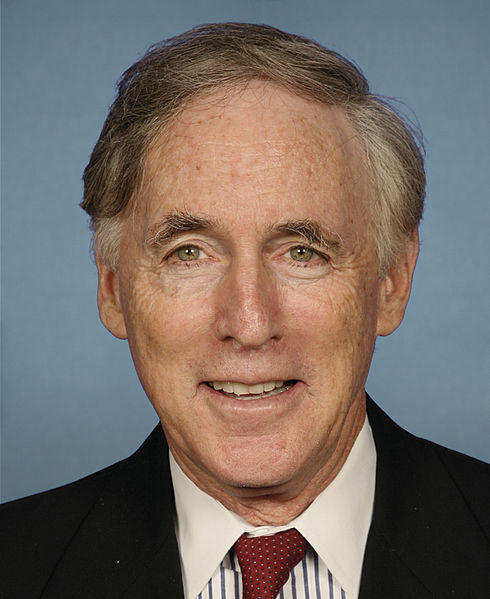
Longtime Congressman Cliff Stearns opposes subsidizing domestic development of solar and wind technologies.

Longtime Congressman Cliff Stearns opposes subsidizing domestic development of solar and wind technologies.

The Obama administration has seized upon comments by House Republican Rep. Cliff Stearns (R-FL), who suggested that the U.S. is incapable of competing against China to produce renewable energy technologies.

“We can’t compete with China to make solar panels and wind turbines,” Stearns told NPR on Monday. The U.S. should instead prioritize its R&D efforts where it is “winning,” he said.

Stearns is the chair of an energy and commerce subcommittee that is overseeing an investigation into the administration’s financing of the failed solar power start-up Solyndra. He has a history of advocating “clean” coal and nuclear power.

The Department of Energy’s media team shopped Stearns’ remarks to Politico, and sought to contrast the administration’s stance that the U.S can win the energy race to “those who want to wave the white flag and surrender,” in an e-mail.

Stearns’ quote was contrasted with Energy Secretary Steven Chu’s remarks Saturday at a domestic solar industry trade show. (Note to the DOE - call next time)

“…They’re here to win the clean energy race. … It’s not enough for our country to invent clean energy technologies — we have to make them and use them too. Invented in America, made in America and sold around the world — that’s how we’ll create good jobs and lead in the 21st century,” Chu said.

The Obama administration has investigated China for allegedly illegally subsidizing its renewable energy industry. In turn, China halted shipments of rare earth minerals that are requisite to manufacture renewable energy technologies to the United States.

Should the U.S. be subsidizing domestic production of solar and wind technologies? What do you think?

Start your week smarter with our weekly e-mail newsletter. It's your cheat sheet for good ideas. Get it.

David Worthington

About David Worthington

David Worthington is a contributing editor for SmartPlanet.

David Worthington

David Worthington

Contributing Editor

David Worthington has written for BetaNews, eWeek, PC World, Technologizer and ZDNet. Formerly, he was a senior editor at SD Times. He holds a degree from Temple University. He is based in New York.

Follow him on Twitter.

David Worthington

David Worthington

David does not have financial holdings that would influence how or what he covers. Occasionally he consults for other companies; should David cover a topic in which a client is involved, he will disclose this fact in his writing. His views do not represent those of ScaleOut Software.

He writes for SmartPlanet and is not an employee of CBS.

If you liked this, don't miss...
8
Comments

Join the conversation!

Follow via:
RSS
0 Votes
+ -
Politicians grapple over U.S.â??s ability to compete with China
There are to many Congressman in office like Streams that shouldn't be there. Another Poiltician selling the U. S. short again.
Posted by Rick4kraft
6th Oct 2011
+1 Vote
+ -
They never seem to learn from history.
They used to say the same thing about Japan in the '80s.
Posted by JohnMcGrew@...
6th Oct 2011
+1 Vote
+ -
Step back
Solar & wind are politically controversial at the moment but will eventually be significant sources of energy. We're a superpower - in many ways, still the superpower - so we retain the ability to manufacture strategically important products domestically. Given that, subsidies may be useful in the short term but should not substitute for market competitiveness in the long term.
Posted by hoodedswan
6th Oct 2011
+2 Votes
+ -
No need to subsidize anything
Just place a price on carbon that is equivalent to it's negative impact on the planet and let the free market do the rest. Get on with it already!
Posted by GreenCollar
6th Oct 2011
+1 Vote
+ -
And what would that price be?
And where would that money go? It's already been tried, and nobody cared. Mainly because nobody could decide on those two questions.
Posted by JohnMcGrew@...
6th Oct 2011
+1 Vote
+ -
"Price on carbon" = value on junk offsets
A "price on carbon" would be only an artificial value set on carbon offsets of dubious validity. Offsets are what you have to buy when you don't want to spend the money to actually reduce your emissions. Carbon offsets could be defined to be anything that has some arguable connection to CO2, like bogus tree plantings in Nigeria, or contributions to progressive causes. Cap-and-trade would give Wall Street another fantasy commodity -- carbon offsets -- to underlie new derivatives, like what caused the last crash. Big bets on offset derivatives would suck the money out of local banks and the manufacturing sector. Use of offsets in lieu of actual emission reductions would discourage innovation and investment in cleantech.

Congressman Stearns has a point: it's so hard to manufacture anything in America now, with the banks not lending except to big borrowers and the EPA on a rampage promulgating standards with no available technology to meet them, and the ever-changing minefield of employee hurt feelings litigation, that Wall Street and Washington have decided that they will just punt US manufacturing and US workers and let the Chinese take the technology risk of cleantech development. I am an inventor in the cleantech space, and I am optimistic about the long term although the Valley of Death is getting pretty dry. The new patent law, which gives a break to microbusinesses, is a good start, and I hope a trend in startup encouragement. Right now it seems like government help is only for the big and well-connected, like Solyndra.
Posted by Wilmot McCutchen
6th Oct 2011
+1 Vote
+ -
Only Germany
The only country that is better at manufacturing products is Germany, not Japan and certainly not China.
Posted by rickmdm
6th Oct 2011
+1 Vote
+ -
subsidizing energy technologies
The United States subsidized the construction of the electrical grid and private electrical generating and electricity sales utility companies that had the right to sell electricity in monopilistic markets for many years and it is only now with the new FERC rule, about 800 pages, that allows power producers to sell power anywhere, and is still being slowly implemented across the US. One way the US government can avoid picking the winner is to do a feed in tariff for both renewables production and energy efficiency to reduce the base load.
Posted by david2727
6th Oct 2011
Join the conversation
Formatting +
BB Codes - Note: HTML is not supported in forums
  • [b] Bold [/b]
  • [i] Italic [/i]
  • [u] Underline [/u]
  • [s] Strikethrough [/s]
  • [q] "Quote" [/q]
  • [ol][*] 1. Ordered List [/ol]
  • [ul][*] · Unordered List [/ul]
  • [pre] Preformat [/pre]
  • [quote] "Blockquote" [/quote]

Join the SmartPlanet community and join the conversation! Signing up is fast and free. Don't wait -- we want to hear your opinion!