Pokeberry power: new solar cells from fibers and fruit

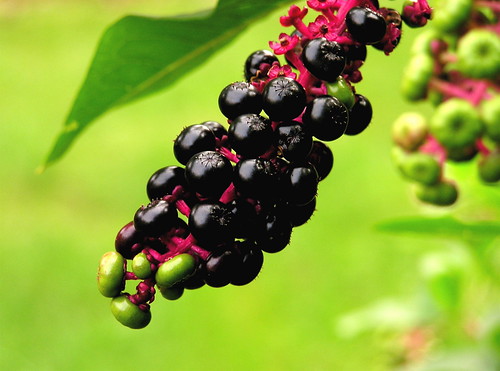 Squeezing juice from a berry might help us squeeze more converted energy from the sun.
Researchers from Wake Forest University's Center for Nanotechnologyand an associated company FiberCell Inc. have developed a new solar cell and coating that they say has double the efficiency as current flat-cell technology.
The cells are fiber-based, photovoltaic solar cells for which the European Patent Office issued a patent to WFU in November. Instead of being flat, they contain millions of little canisters, resembling a honeycomb.
According to the scientists, the canisters trap light until the fibers absorb it. The fibers' added surface area allow them to catch light coming in from all angles through the course of the day.

Add fruit.
The dye of the pokeberry—a weed native to North and South America, New Zealand, and eastern Asia—boosts the fiber's ability to absorb sunlight. A polymer could fulfill this purpose as well. But pokeberries are cheaper, grow around the world, and grow fast (um, like a weed).
David Carroll, the center's director, says in a statement:
Pokeberries proliferate even during drought and in rocky, infertile soil. That means residents of rural Africa, for instance, could raise the plants for pennies. Then they could make the dye absorber for the extremely efficient fiber cells and provide energy where power lines don't run.
Once the initial manufacturers ship the cells overseas, processors could spray on the pokeberry coating at a local plant. Establishing such a finishing plant, Caroll estimates, would cost around $5 million. Similar plants for flat cells, he says, would be about $20 million.
Top Image: Flickr/Muffet
Bottom Image: FiberCell
This post was originally published on Smartplanet.com