How a U.S. company is railroading solar in China

Annoyed that American solar firms can't crack the protective Chinese market?
Do what Ascent Solar Technologies does: sell solar panels for use on the country's ever increasing number of railway station rooftops, where there's enough collective real estate to feed the grid with utility scale power.

The Thorton, Colo.-based solar panel manufacturer announced earlier this week that is teaming with two Chinese companies to "promote the use of leading-edge solar technology in China's rapidly growing public railway infrastructure by installing Ascent Solar modules on existing and future railway stations in China."
The panels will collectively have a capacity of 800 megawatts in five years, according to Ascent's press release. That's the equivalent of a modest sized coal-fired or nuclear power plant.
This makes a lot of sense as a way to double up on infrastructure. China is building out its rail network faster than you can say censorship. Why not use the same facilities that underpin transport, to also provide renewable electricity and chip away at the carbon emissions associated with fossil fuel plants, of which China infamously has many?
With new builds in particular, the solar panels won't ruin the look of old buildings, and architects can, in fact, design them in as part of the aesthetic (I don't know that Ascent and its Chinese partners are taking that extra step). Ascent teamed with roofing company Shenzhen Radiant Enterprise Co., Ltd, and with a subsidiary of China Railway Group that has a very long name: Third Railway Survey and Design Institute Group Corporation
It echoes a move earlier this year, when Chinese logistics and shipping company China Merchants Group began spreading 500 megawatts of solar panels across its far flung rooftops.
It's a logical extension of the rights of way concept, in which the owners of highways and byways make space available for cable like telecommunications, broadband and electricity.
It also brings to mind other "integrated infrastructure" concepts. As I write this, I can't stop thinking about the highway in Idaho that Solar Roadways wants to construct with photovoltaic material. Or about the planned piezoelectric bridge I heard about in Amsterdam a year ago, in which the motion of traffic will convert to electricity (SmartPlanet's Amy Kraft wrote about foottfall-based piezoelectricity at a UK shopping center earlier this week).
Ascent is by no means the first American solar company to pry open the Chinese market (First Solar signed a landmark 2-gigawatt deal nearly 3 years ago, although progress has been slow), but it's approach is perhaps the most novel.
For solar technology buffs: Ascent makes thin film solar panels, so its deal in China signals that there is hope for thin film even as conventional crystalline solar plummets in price and undermines thin film's cost advantage.
All aboard the Solar Express.
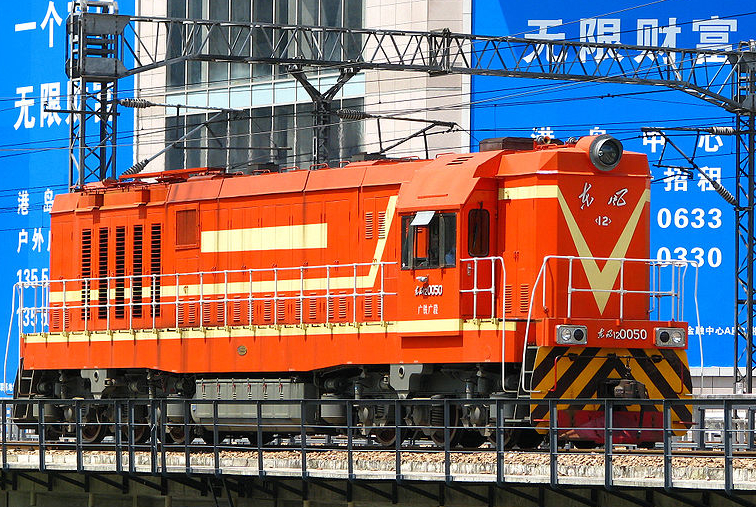
Photos: Diesel engine, alancrh via Wikimedia. Dr. Face poster, dcmaster via Flickr.
More China sun on SmartPlanet:
- U.S. slaps hefty duty on Chinese solar panels
- China cuts solar subsidies
- Top Chinese solar company plans huge expansion
- Up on the roof: 500 megawatts of solar in China. That’s a big roof.
- China to build nuclear scale solar plant
- The dirty side of solar
- If China leads the world in clean tech, why are people dying?
Slivers of solar tech innovation:
- Black power: Dark solar cell smashes record for absorbing photons
- Another way to make solar panels: Grow ‘em
- Breakthrough: World's most efficient solar panel
- First Solar: Another record in thin-film solar efficiency
- French-California connection sees solar through a new lens
- Magnifying solar electricity’s future
This post was originally published on Smartplanet.com