Follow this blog:
RSS

Harnessing the jet stream for wind turbines

By | July 12, 2012, 4:29 AM PDT

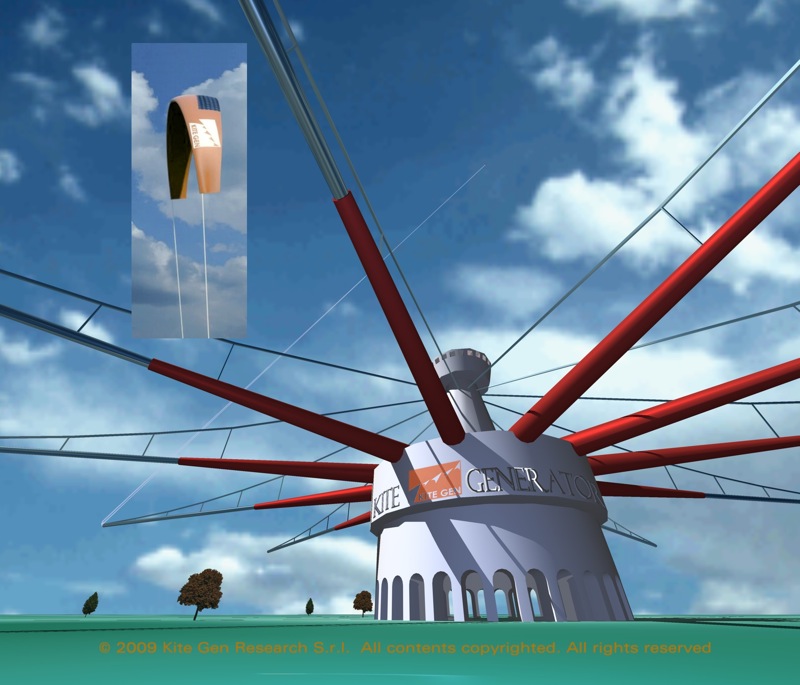
Cranking down: Kite Gen would transfer raging wind energy mechanically to this contraption on terra firma.

Like everyone who lives in the UK, I’m experiencing the summer that never was. Temperatures have settled at November-like levels for the last couple of months and it has rained just about every day, turning the country where I reside into Lake England.

In large swaths of N. America, people have been enduring the opposite, frying the proverbial egg on the sidewalk amid killer heat waves.

Meteorologists blame the jet stream for these anomalies.

For a quick review: Jet streams are rapidly flowing currents of air that howl around 23,000-to-52,000 feet above us. There are four of them. The Northern and Southern Hemispheres each have two.

Jet streams control weather. They can shift, and when they do, your summer can go awry. That’s what has happened this year in the north, where the polar jet stream has snaked south. Regions just below it in the U.S. are boiling. Regions north of it - the UK - are shivering and drowning. (Native Brits tell me that summers used to be glorious here. I have yet to experience such glory in 13 years of residency. Is Britain a nation of liars?).

Electric sky: Sky Windpower's very high altitude flying turbines would transmit electricity via wires tethered to earthly grids.

I got curious to find out more about this cursed draft. I’ll save the discussion as to whether global warming is pushing around the jet stream - feel free to weigh in below with any insights or opinions on that.

But what I noticed in my internet trawl was something that gives a needed PR boost to the wretched high altitude wind: Scientists and engineers want to harness the jet streams to generate electricity for terra firma, and thus blow fossil fuels out of the water for once and for all (at least when it comes to generating electricity).

“The total wind energy in the jet streams is roughly 100 times the global energy demand,” writes Cristina L. Archer and Ken Caldiera in a 2009 edition of the journal Energies. “Because of their abundance, strength and relative persistency, jet stream winds are of particular relevance in wind power development.”

I also noticed that SmartPlanet touched on this three years ago, before my time on the blog. I gather there haven’t been great technological or engineering strides, as I haven’t noticed any glaring headlines anywhere - just the occasional golly-gee article.

To elaborate a bit more on what Archer and Caldiera explained, engineers have proposed two different methods for capturing and converting the jet stream’s energy.

One, backed by Italian company Kite Gen, would use air foils to grab energy at altitude and transfer it mechanically via cable to earthly turbines - as pictured at the top of this story, and as visually displayed in this YouTube video, backed by New Age electrobeat music (perhaps a sure sign that we’re still a fair age away from jet stream-lit cities):

The other would mount turbines on kites tethered to an electricity grid on land (or sea) by kevlar-insulated, aluminum conductors, as in this YouTube video from Sky Windpower, a San Diego company:

The practicalities of these systems strike me as challenging, to say the least. For grandiose schemes, I think I might prefer the vision of generating electricity via satellite-mounted photovolatiacs and beaming it back to earth.

Either way, you gotta dream.

For now, I’m organizing troops to lasso the jet stream and haul it back up north where it belongs. Otherwise I wasted about $11 on the sunscreen I bought a few months ago.

Sign up below for the Jet Stream Posse!

Images from Kite Gen (top) and Sky Windpower.

More energy dreams on SmartPlanet:

Start your week smarter with our weekly e-mail newsletter. It's your cheat sheet for good ideas. Get it.

Mark Halper

About Mark Halper

Mark Halper is a contributing editor for SmartPlanet.

Mark Halper

Mark Halper

Contributing Editor

Mark Halper has written for TIME, Fortune, Financial Times, the UK's Independent on Sunday, Forbes, New York Times, Wired, Variety and The Guardian. He is based in Bristol, U.K.

Follow him on Twitter.

Mark Halper

Mark Halper

Mark has no financial holdings in the companies he writes about. He occasionally travels at the expense of companies or their press relations agencies in order to report on a company or industry event related to it; Mark will prominently disclose this information when appropriate. This relationship will have no influence on his coverage. Companies he covers do not get to review columns in advance, or select or reject topics.

He writes for SmartPlanet and is not an employee of CBS.

If you liked this, don't miss...
6
Comments

Join the conversation!

Follow via:
RSS
0 Votes
+ -
Jet Stream Slowdown
Wouldn't extracting energy from the jet stream slowly but surely slow down the jet stream with catastrophic results on our weather?
Posted by brandonkelton
12th Jul
0 Votes
+ -
It's the same issue with everything.
It's the same issue with everything. It depends on scale. I wondered the same thing.

The problem is overpopulation. I disagree with Theotherwill below. "Small fraction" assumes that the project would be relatively small scale, but anything big enough to make a significant contribution to the power needs of a world overburdened by billions of humans might not be a "small fraction" of anything. There are other issues, too, as pointed out by the same poster below.

Our weather is ravaged by a sometimes fickle jet stream, so now we're going to depend on it for energy?

The biggest problem is the need for energy for so many people. If we could reduce population (hopefully through attrition!), then we wouldn't need "pie in the sky" ideas to generate energy!
Posted by omb00900@...
13th Jul
0 Votes
+ -
Worry about other things
I very much doubt tapping a small fraction of the energy in jet streams will be enough to change the weather. The tethers will have to be over 5 miles long. The technology to make them light enough doesn't exist & may not for many years. And you wouldn't want to be below if 1 of them breaks.
Posted by theotherwill
12th Jul
0 Votes
+ -
Exciting Stuff.
I love the idea of flying turbines; getting out of the slow air in the boundary layer close to Earth has the potential to harness so, so much more power. Taking this as a general aim rather than looking specifically at the jet stream, you wouldn't need such long tethers as those which worry theotherwill. However, there must be big issues in overcoming ensuring they stay airborne no matter what, plus the repercussions that long, strong, invisible strands stretching a thousand feet into the air would have for low-flying aircraft.
Posted by steve_jonesuk@...
13th Jul
0 Votes
+ -
Dangerous Stuff
Great pipe dream but the jet stream is 23,000 to 52,000 feet, we are not talking low flying aircraft, we are talking commercial aircraft (plus) altitudes. Commercial aircraft could fly right into one of them if the governing facility (controlling airspace) misses the restricted altitude by as little as 5,000 feet (comparatively speaking). In the US restricted airspace is called "Bravo" airspace. Atlanta "bravo" airspace is one of the largest bravo airspace's (if not the largest) in the united states, and it is trespassed several times a day. As a private pilot this scares me, we are talking hundreds of miles of restricted airspace for one production station that could be entered into by one radio failure.
Unless someone comes up with a power transmitting cable lighter than a single fiber optic strand, the object will never make it to those altitudes, but if they could the one who trespasses it's airspace will eventually find out how far up that is.
Posted by Mdwannabe
13th Jul
0 Votes
+ -
High Altitude Wind Power, Where, Who and Why
The fearsome concept of anything flying into such a kite should not limit the possibilities. These very same fear mongers would have us believe that a jumbo jet is an ever present danger because it might fall on their heads. Transponders that are powered from the EMF of the cable would be minuscule but effective in protecting the airspace... each pretending to be a jumbo jet flying at near zero speed in stacked formations. While the proof of concept needs to be scalar, access to reliable wind forces to make it economically viable in a test situation could be easily argued in a place like the South Island of New Zealand, positioned in the prevailing 'Roaring Forties'..(no need to reach jet stream heights) and has a mountain terrain, the Southern Alps that fuels both ridge lift and lenticular corridors of standing waves.

Such a craft, suggested by the author during an emerging renewable energy review, can be flown back to Terra firma and landed gracefully should wind/weather present a danger to its performance window. Or a tether malfunction and programed decent via auto-gyro.

On proof of concept a larger unit could be researched/tethered to Banks or Otago Peninsular.Again, well off air routes but smack in the middle of some of the highest speed and most reliable wind resources in the world.If research needs a ROI this is it.
Either location has a University at the bottom of its tether.!

Further, positioned here would mean it was off the flight path of everything but the most wayward aircraft and in an uncluttered sky.Such a project would compliment the South Island's hydro storage capacity and realise a 100% renewable potential. I called the applied concept "Project Kotuku" named after the rare white spirited heron (Egretta alba modesta) that flies over the Southern Alps, on the very same winds.
Posted by MildGreens
Updated - 17th Sep
Join the conversation
Formatting +
BB Codes - Note: HTML is not supported in forums
  • [b] Bold [/b]
  • [i] Italic [/i]
  • [u] Underline [/u]
  • [s] Strikethrough [/s]
  • [q] "Quote" [/q]
  • [ol][*] 1. Ordered List [/ol]
  • [ul][*] · Unordered List [/ul]
  • [pre] Preformat [/pre]
  • [quote] "Blockquote" [/quote]

Join the SmartPlanet community and join the conversation! Signing up is fast and free. Don't wait -- we want to hear your opinion!