Follow this blog:
RSS

Faster-than-light neutrinos come down to earth

By | September 29, 2011, 2:27 AM PDT

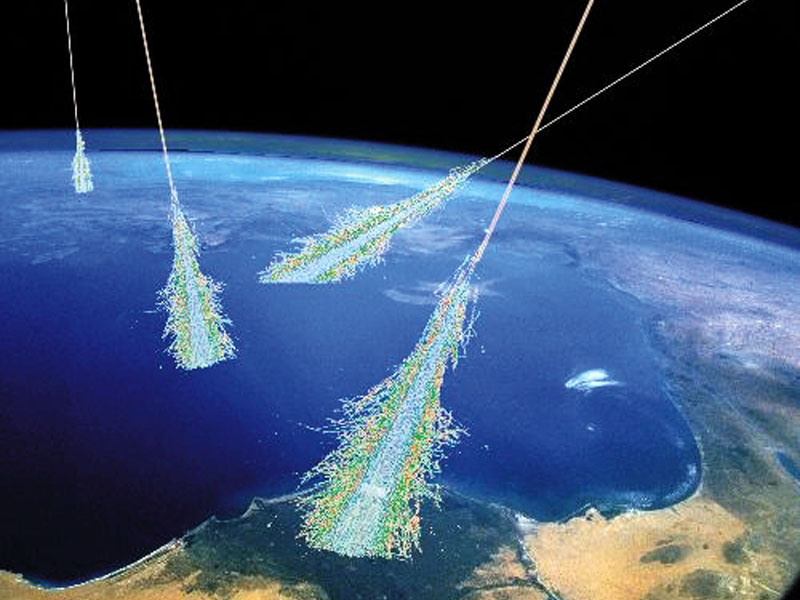
Neutrinos are associated with cosmic rays, the sun and supernova. But as CERN noticed, they can race through terra firma at gold medal speed.

Our recent stories about the neutrinos that travelled from CERN’s Geneva lab to Rome faster than the speed of light have struck a popular chord, so I thought I’d update you with the latest explanation.

CERN probably goofed.

So postulates Frank Close, professor of theoretical physics at Oxford University. Writing in the Guardian newspaper, he notes, “the only thing that travels faster than light is a rumor.”

Professor Close has credentials. He wrote the book Neutrino, so he would seem to know the tendencies of the shadowy subatomic particles that move unobstructed through earth. (That’s how CERN was able to beam them to Italy’s Gran Sasso lab 75 miles northeast of the Italian capital – it sent them ploughing under the Alps).

CERN wasn’t trying to set any speed records. It was simply watching to see how many neutrinos would flip from a “muon” state to “tau” in the 455-mile journey. But serendipity struck as the neutrinos dashed out to a gold medal sprint and beat light by a few billionths of a second, giving all involved an unnerving surprise.

When the CERN team announced the result, it begged scientists around the world to help them spot any error of their ways.

After all, if their observation is correct, it shatters Albert Einstein’s special theory of relativity, which says that nothing travels faster than light when light is in a vacuum. Defying e=mc2 makes physicists a bit jumpy, because it would require a big rethink of the universe. So, CERN asked, did we make a mistake?

Almost certainly, says Close. Given that the neutrinos nipped light in a photo finish of a 1/500th second race, Close points out several possible flaws in the measurement of speed that could have skewed the timing by a few nanoseconds.

He wonders about the accuracy of measuring equipment. When nanoseconds count, the time it takes for electronic signals to pass through chips, circuits and digital displays could throw things out just enough, he says.

Even though CERN most likely accounted for this, there is still some uncertainty to it all, and there could still have been “some unexpected bottleneck, unrecognized and hence unaccounted for,” he says.

Mr. Relativity

“Light travels slower through water, glass, even air, than through a vacuum,” writes Close. “So light can be slowed down, but not sped up: the vacuum is nature’s open road where light travels at the speed limit. We need to be careful when asking what exactly has the CERN experiment done, or, more pertinently, how did it do it?”

Another measurement that could be fraught with tiny mistakes: Measuring the exact distance – a factor in the speed equation - between the departure platform at CERN and the arrival gate at Gran Sasso.

“Precisely how this is done is, to me at least, still one of the many mysteries in this experiment,” notes Close. “You certainly don’t do it with a tape measure, even if you had one that was accurate to atomic sizes.”

His explanation is neither the first nor last word on this subject. Another British physicist, Brian Cox has loosely suggested that the neutrinos could have taken a short cut through an undiscovered dimension.

Professor Close, the Neutrino author, is basically saying that CERN probably got something wrong in the infinitesimal measurements of light, neutrinos, time, speed and distance – as the CERN scientists themselves have wondered.

His interpretation echoes many of the astute comments that readers of this blog have sent. (Thanks to reader Daniel Isakevich who pointed to Professor Close’s Guardian article).

Keep ‘em coming!

Images: Top, Nasa/Wikimedia. Middle, Derek Jensen/Wikimedia. Bottom, Wikimedia

More on the mega meaning of tiny things:

Start your week smarter with our weekly e-mail newsletter. It's your cheat sheet for good ideas. Get it.

Mark Halper

About Mark Halper

Mark Halper is a contributing editor for SmartPlanet.

Mark Halper

Mark Halper

Contributing Editor

Mark Halper has written for TIME, Fortune, Financial Times, the UK's Independent on Sunday, Forbes, New York Times, Wired, Variety and The Guardian. He is based in Bristol, U.K.

Follow him on Twitter.

Mark Halper

Mark Halper

Mark has no financial holdings in the companies he writes about. He occasionally travels at the expense of companies or their press relations agencies in order to report on a company or industry event related to it; Mark will prominently disclose this information when appropriate. This relationship will have no influence on his coverage. Companies he covers do not get to review columns in advance, or select or reject topics.

He writes for SmartPlanet and is not an employee of CBS.

If you liked this, don't miss...
8
Comments

Join the conversation!

Follow via:
RSS
+1 Vote
+ -
CERN Findings - Speed of Light Change
1. CERN is composed of highly qualified and credentialed Scientists.
2. They were put there to ensure that the vast amount of money that was invested results in solid science, and empiracle results.
Don't underestimate what these folks have had the stones to publish!
Posted by kevin.hillman@...
29th Sep 2011
+1 Vote
+ -
Role models
The Opera people at CERN deserve credit for their attitude about their observations. They've neither concealed them in the interest of defending orthodoxy nor exaggerated them out of self interest. Close hasn't said anything the Opera people haven't said themselves.
Posted by hoodedswan
29th Sep 2011
+1 Vote
+ -
Reproducable results
While the data is being analyzed, the experiment should be done at other facilities to see if the results are reproducable. CERN did not release this news about their discovery until they checked their facts and it is great that they are presenting their data to be examined by other scientists. If the results are reproducable then it will take a lot of work to explain what and why.

Part of the problem is that Einstein's theories work great in explaining the macro scale side of physics but not so well at sub atomic levels. String theory may be a good theory but it is extremely hard to design an experiment to observe objects smaller than quarks as strings are proposed to be in theory.

An important aspect of this is that an established theory is being challenged with new information. If the new information is found to be true then established theory would need to be modified to accomodate the new information or abandoned for a better theory. Newtonian physics is still useful for most of what we deal with daily, Einsteinian physics go further and the next theory will go further as well. Theories have 2 aspects; one is to explain and the other is to predict but not always both.
Posted by sboverie
29th Sep 2011
+1 Vote
+ -
E=MC**2
Once f=ma, then Maxwell came up with the idea that the speed of light is a universal constant in his famous electrodynamic equations. James Maxwell knew well the implications of this so kept things under his hat and explained it away by coming up with the luminiferous ether as the substance light propagated through. He did not want the world to figure out that e=mc**2 in 1867, nor probably for a long time. Einstein was Maxwell's greatest fan. He took Maxwell's observations and used reference framing to show the world e=mc**2. What a mistake, as this was the formula that may ultimately be our undoing as humans.
In any case, it is possible that neutrinos do travel faster than the speed of light. I hope it is found that they do. The finding would upend current thinking in physics and allow for a quantum leap in our knowledge. E=mc**2 would be the new f=ma.
I believe nothing can move faster than the rate of expansion of the universe. If it did, it would leave the universe. Perhaps c is fixed to this rate of expansion and those neutrinos were in another universe for a few nanoseconds. This could explain the rate increase.
Posted by Arctic Char
Updated - 29th Sep 2011
+1 Vote
+ -
How did they measure the distance?
The measuring stations are underground. Verticals at each end are not parallel. The earth is curved but not spherical. IMHO most likely source of human error - if that is what it is ...
Posted by PassingWind
29th Sep 2011
+1 Vote
+ -
Light speed
What's all the fuss about.We knew the earth was flat,the earth was at the center of the universe and the fastest thing on earth is Usain Bolt.Just maybe the guys at CERN were right.Every one's trying to prove how Einstein was not wrong,and a mistake was made.I hope the findings are indeed true,as it opens up our small brains and our concept of size,mass,time and speed and everything else for that matter.Light in a vacuum.Is there nothing else acting upon it,or is there nothing else we know of, or how to prove is actually there.......I can not grasp the concept of nothingness as described before the big bang,i'm limited that way,but they can't grasp faster than light movement.That would mean everything you thought you know ,you don't..That is scary.
Posted by VALKYRIEAN
30th Sep 2011
+1 Vote
+ -
Usain Bolt
Hmmmm, if it turns out that the Neutrino's, as per Prof Brian Cox's assertions, slipped through a different dimension to arrive at the destination faster than light, then how can we be so sure that Usain Bolt didn't cheat and do the same. Time for some Olympic Medal recalls me thinks ;o)
Posted by Mouseboy007
3rd Oct 2011
+1 Vote
+ -
Could this be the explanation...?
This is one science writers explanation that I have not seen discussed any where before now.

http://milesmathis.com/neutrino.pdf

The Great NEUTRINO Muddle
by Miles Mathis

I began getting swamped with emails several days ago on the neutrino problem. I didn't take it too seriously, because I intuitively felt that this was a minor problem of math, not the gigantic physicsending problem it was being sold as. After looking at the paper at ArXiv for about ten minutes, my intuition was proven correct.
The problem was reported by researchers at the OPERA experiment in the Gran Sasso laboratories, in collaboration with CERN. These researchers reported an average neutrino speed 100.00248% that of c, which is about 7,440m/s over c. This corresponds to a margin of error from expectations of (v ??? c)/c = 2.48 x 10⁻⁵, or about 1 part in 40,300. We are told that is outside, or larger than, the margin of error of the experiment (by almost a hundred times!), and alarm bells were set off all over the world.

But it isn't outside the margin of error of the experiment. I could see this by paragraph 4 of the introduction (in a paper of about 55 paragraphs, 23 pages, 22 fancy figures and tables, and 175 coauthors). The key numbers are here: (missing reference???)

The measurement also relies on a high-accuracy geodesy campaign that allowed measuring the 730 km CNGS baseline with a precision of 20 cm.

That is your cause of error, right there, although no one seems to realize it. No one appears to know how velocity, distance, and time relate to one another, so no one knows how to calculate the margin of error here. So I will do it for you. What they have done, no doubt, is divide the first number by the second, to get 3,650,000. The CNGS measurement is correct to one part in 3,650,000, right? The neutrino over-measurement is a lot bigger than that, therefore we have a major problem. But the neutrino measurement is a velocity and the CNGS measurement is a distance. Therefore you can't
directly compare the margins of error. Why? Because velocity depends on measuring BOTH time and distance, and you can't measure them both at the same time. As a simple matter of operation, you have to be given a distance from a previous experiment in order to calculate a velocity. We can see that here.
We have two measurements, one by CNGS, one by OPERA. One is the distance measurement, one is the velocity measurement. OPERA can't measure the distance and the velocity at the same time, in the
same experiment, can they? Think about it.

The velocity is actually a calculation. What OPERA is actually measuring is the time. They then use the number from CNGS to calculate a velocity. Why is this important? Because it means the margin of error is entering the experiment twice, in two different places. Both the time and the distance have the margin of error, not just the distance. I will be told that these researchers were using atomic clocks of some sort, with negligible margins of error, but that is to miss the point of how the time of the experiment is actually measured. Even if the clocks have zero margin of error themselves, the clocks are being used to measure a distance gap. The distance gap has the margin of error exclusive of any margin of error in the timepieces. Think of it this way: how do you synchronize perfect clocks that are 730km apart? You have to send something over and back to synchronize them, probably a series of photons. Either that or you just assume they are synchronized because they were synchronized when they were together. Either way, your margin of error creeps back in. The assumption is unscientific, and the photon going over obviously brings the margin of error back in.

This means that the margin of error when calculating a velocity in this experiment is not 1/3,650,000 = 2.73 x 10⁻⁷. It is 1/???3,650,000 = 5.23 x 10⁻⁴, or about one part in 1,910. Since that is larger than 2.48 x 10⁻⁵, we have no problem here. The calculation of the velocity is well within the margin of error.

In conclusion, we see that the 175 co-authors of this paper don't know how to do basic math or physics.

This muddle stands as perfect proof of my assertion over the past decade that physics is in serious crisis. It is in crisis not because it has bumped up against insoluble problems, but because it has
detached itself from mechanics and from basic math. It has been diverted into mysticism and cloaking math since at least the time of Bohr, and probably since the time Maxwell embraced quaternions, more than 150 years ago. No, we can set that back even further, to the time of Laplace and Lagrange, since I have shown precisely how they ignored mechanics and hid in big equations. I have shown hundreds of instances of top physicists hiding behind esoteric maths, these same physicists unable to do college or even highschool level mechanics and algebra. This is just one more case to add to the already long list.

Also notice how this paper proves my other recent assertion about hiding behind numbers. 175 coauthors? Guys, the only way to really avoid personal scrutiny is to publish anonymously. You might want to run that idea by peer review. I am sure the ???peers??? will love it, since they already get to review anonymously. But don't expect my paper to get much traction. The mainstream has been ignoring me on purpose for many years. My readers, after seeing my simple solution, have said, ???Oh, these guys will have egg on their faces!??? Not likely. Contemporary physicists don't want real solutions, and they want the simple solutions the least. They exist on these big manufactured controversies and the fake temporary jerryrigged solutions to them. No one is chagrined here, and no one is likely to be. It is all part of the plan to generate continued interest in physics, just like the manufactured dark matter controversy that you see on the cover of every magazine. Notice how well it has worked. Emails are flying all over the world, the internet is buzzing. No one has the time or inclination to read one of my papers, but they have time to waste on this non-problem, with committees working on it for months and months. That is no accident. These committees get paid for working on problems. They don't get paid for solving them. Which is precisely why I don't bother couching this solution in cuddly language. My goal is not to be accepted by the status quo, but to drive around it altogether. I have no interest in being hired as some kind of trouble-shooter for these committees of the inept. When top committees of physicists can't even calculate a margin of error, it is time to close up shop and start over. We have to re-educate a whole new generation of physicists, starting from the ground floor.

That's right. Although my solution proves this miscalculation does not require any revolution in c, physics should not think itself safe from revolution. The revolution has already taken place, although
few have heard the news. Like a star exploding in the far reach of the galaxy, the event and the knowledge of the event here on Earth are two different things. Addendum, 9/26/2011: As I expected, this paper is already being dismissed because ???the clocks used were correct to within billionths of a second.??? Meaning, the mainstream once again can't understand simple logic. If you want to see another glaring example of this, visit my paper on the Galilean transformation, where both the jurors and the editors at AJP couldn't see my point though it was a truism of first-year physics. Here, what is not understood is that the clocks are not only measuring a time, they are measuring a distance. In measuring the time, yes, they may be nearly absolutely correct, and therefore they don't add to the margin of error of the velocity calculation. But in measuring the distance, they must include the original margin of error once again. To try to make you see this, let me ask you this: ???Let us just assume you have the two clocks synchronized, at the beginning and end of the experiment. I won't even ask how you synchronized them. We will let that go for now. But where are the clocks? You have to have them very close to the actual release and capture of the neutrinos, or problems arise, right?
You will say, 'Of course, we have the timers tripped by the neutrinos directly,' or something like that.
But even so, I can ask, 'OK, how far apart are the clocks?' You either say, 'They are 730km apart,' in which case I have you; or you say, 'It doesn't matter.' If you say it doesn't matter, then I assume you are saying that the clocks could be placed anywhere along the line. They could be hundreds of kilometers away from the release and capture points. But if that is the case, then I can point out that
knowledge of the end event must travel from the point of the event to the clock, and that takes time.
Photons would have to travel that distance to the clock. Even if you took that into account, you would still have to know how far the photons traveled between end event and end clock, and we would be
back to question one. I would have you. Or, think of it another way. Velocity is distance over time. V=D/T. The velocity calculated for the
neutrinos requires that we fill in both the numerator and the denominator, correct? We know the distance from CNGS, so that is one experiment, and one margin of error. Total margin of error so far,
2.73 x 10⁻⁷. That margin of error belongs to the CNGS experiment, not to the OPERA experiment. That margin of error now pre-exists, even before we start the OPERA experiment. Now we need the
time. That is the OPERA experiment. Second experiment. In measuring the time, we have to know the distance again, since we have to know how far apart our clocks are. Time is just a second
measurement of distance, so that we can create a ratio and calculate a velocity [see my paper on time
and velocity.] Each experiment has a margin of error, due to the distance, and we have two experiments. In the equation V=D/T, both the numerator and the denominator have a margin of error.
Because a velocity requires two separate measurements, any velocity will contain two margins of error.
And since we multiply margins of error, not add, the actual margin of error in the OPERA experiment is 5.23 x 10⁻⁴.* Some still won't get it. They will say something like, ???What do you mean the clocks are measuring the distance? The clocks are measuring the time and we are given the distance. Clocks don't measure distance, you ninny! Yes we have the margins of error in the numerator and denominator, but the error in the denominator is negligible.??? Stated with enough surety, that almost sounds convincing, which is why a lot of top physicists can't see the truth here, I guess. So I remind everyone that one clock is not the same as two clocks separated by a distance. Yes, if we had one atomic clock in the OPERA experiment, at no distance from the experiment, the margin of error in the time would be near zero.
But you cannot measure neutrinos going 730km with one clock, can you? Those who say this are refusing to study the actual operation of measurement of time. You have two clocks separated by a
specific distance, and that distance of separation matters. Not for reasons of relativity, but for reasons of operation. It matters that the clocks are 730km apart, and not any other distance, because if they
were at any other distance they could not measure the time of the experiment. In this way, the distancebetween them enters the margin of error in the denominator. The margin of error enters the calculation of the velocity twice. One final way, different from the rest. I will use calculus-talk to try to explain it. Velocity is the rate of
change of distance, right? It is the derivative of the distance. If we used primed variables to mark our parameters, the distance is unprimed, the velocity is single primed (and acceleration would be double primed). Well, the only time variables can be compared as regards margins of error is if the variables have the same priming. When we are talking margins of error, you can compare distances to distances and velocities to velocities, but you cannot compare distances to velocities. Why? Because if you
compare a velocity to a distance, you are ignoring a level of dependence. Calculus requires dependent variables, remember? They are called functions. Velocity is a function of distance, and a rate of change of distance, and both are telling us the velocity is one step more complex than distance. How?
The velocity also has a time dependence that distance does not have. More complexity in a variable automatically tells us it has multiple margins of error. Just as a velocity has two margins of error
embedded in it, an acceleration has three. A cubed acceleration has four. Every distance or time constituent in a variable implies another margin of error, since each constituent must be measured separately.
Now, admittedly, this last part is not common knowledge, and I shouldn't expect everyone to know it. I was not taught it and I am not aware that it is taught at all. But even without that, scientists should
know, as a simple matter of logic, that two experiments imply two margins of error. This late in the history of experiments, things like this should be known. It is incredible they aren't known.
*Please don't ask me why the margin of error is not 2.73 x 10⁻⁷
squared. I have done all the remedial math I am
going to do in this paper.
Posted by josephhyde@...
4th Oct 2011
Join the conversation
Formatting +
BB Codes - Note: HTML is not supported in forums
  • [b] Bold [/b]
  • [i] Italic [/i]
  • [u] Underline [/u]
  • [s] Strikethrough [/s]
  • [q] "Quote" [/q]
  • [ol][*] 1. Ordered List [/ol]
  • [ul][*] · Unordered List [/ul]
  • [pre] Preformat [/pre]
  • [quote] "Blockquote" [/quote]

Join the SmartPlanet community and join the conversation! Signing up is fast and free. Don't wait -- we want to hear your opinion!