Follow this blog:
RSS

Ethanol in gas: how much is too much?

By | May 7, 2010, 9:08 AM PDT

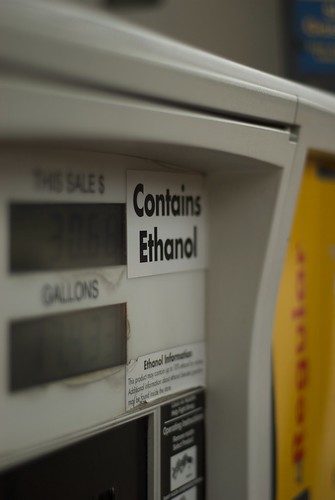
Ethanol-gasoline blends cut the carbon emissions spewing from your exhaust pipe and give the country another thing to do with all the corn it grows. The biofuel blends may even save you some money at the pump—that is, if it doesn’t overheat your car’s engine.

That is what the Alliance of Automobile Manufacturers fear might happen if the Environmental Protection Agency raises the allowable ethanol content in gasoline from 10 to 15 percent.

The automakers say more than half the engines that they’ve tested with the 15-percent-biofuel blend have experienced trouble. The fuel may damage catalytic converters and engine cylinders in some cars.

In yesterday’s New York Times, Matthew L. Wald reports:

One major reason for concern is that modern cars sense the amount of oxygen in the exhaust and use that measurement to modify the fuel/air mixture going into the cylinders. This works fine for straight gasoline. But the ethanol molecule contains an oxygen atom, and that may confuse the sensor into making the mixture too lean; lean engines produce exhaust hot enough to damage catalytic converters, industry experts say, and may also produce more nitrogen oxides, an ingredient of smog.

The oil companies are welcoming the extra ethanol as a way of fulfilling their renewable fuels requirements under the EPA. The ethanol industry, of course, is also pushing for the change. The Renewable Fuels Association estimates the higher-ethanol blend could save American around 5 cents for every gallon.

RFA President Bob Dinneen in a statement:

Drivers could be saving significant money at the pump, were it not for the current antiquated regulations. EPA must avoid adding insult to injury by excluding up to half of U.S. drivers from utilizing cost-effective higher ethanol blends.

Automakers are urging the EPA to postpone any change to the ethanol blend until more testing is done. On Wednesday, the industries are gathering to try to work something out.

Image: Flickr/Fatty Tuna
Via: NYTimes

Start your week smarter with our weekly e-mail newsletter. It's your cheat sheet for good ideas. Get it.

Melissa Mahony

About Melissa Mahony

Melissa Mahony was a contributing editor for SmartPlanet from 2010 to 2011.

Melissa Mahony

Melissa Mahony

Contributing Editor, Energy

Melissa Mahony has written for Scientific American Mind, Audubon Magazine, Plenty Magazine and LiveScience. Formerly, she was an editor at Wildlife Conservation magazine. She holds degrees from Boston College and New York University's Science, Health, and Environmental Reporting Program. She is based in New York.

Follow her on Twitter.

Melissa Mahony

Melissa Mahony

Melissa does not have financial holdings that would influence how or what she covers. She currently works for the Wildlife Conservation Society as an editor. Should Melissa cover a topic in which the WCS is involved, she will disclose this fact in her writing.

She writes for SmartPlanet and is not an employee of CBS.

If you liked this, don't miss...
23
Comments

Join the conversation!

Follow via:
RSS
+1 Vote
+ -
RE: Ethanol in gas: how much is too much?
The oil companies are not welcoming the change. Where did you
get that information?
Posted by OrngCrush
7th May 2010
+1 Vote
+ -
RE: Ethanol in gas: how much is too much?
The trouble is that you may save money at the pump, but your mileage per gallon decreases. In my GMC Acadia, the blend drops my gas mileage by approximately the 10% they add in, so in essence the price per mile driven goes up!!!! So when they make it 15% ethanol then I will lose another 5% on MPG.
Posted by chrisaturk
10th May 2010
+1 Vote
+ -
Does emissions reduction offset the increased rate of burn?
Does the reduction in emissions offset the increased fuel usage to cover the same distance? (ie: may burn cleaner but overal MPG is reduced, does the reduced emissions offset the increased fuel burn to get the same work / distance done with more fuel?)

Guess the automakers may also welcome this as more existing cars may be turned to junk, but then again with the increased production of new automobiles, does the reduced tailpipe emissions also offset the global emissions created in the manufacture of the automibles?

I'm all with reduced emissions as long as it is done smartly!
Posted by jhimes
10th May 2010
+1 Vote
+ -
Proverb:hugging trees too tightly while wearing shorts leaves bark marks...
Not sure where to begin with this one.

First of all, industrial farms have switched from (not in addition to) wheat and other grains to corn production for the almighty dollar. This has left a glut in the other grains forcing prices on other foods to go up.

Second, it costs nearly twice to produce ethanol than what it does refined gasoline so not sure how that's saving the environment.

Third, ethanol is an additive that has been mandated by a politcally and ecologically motivated government organization committed to convincing itself and others that it knows what's best for the environment without taking into account other factors like loss of MPG thanks to ethanol's inability to perform like other gas saving additives.

Fourth, why is it that Brazil has done it better by using sugar-based ethanol - cheaper and less human-impacting than converting massive farmland over to corn production?

Finally, why isn't the U.S. Government and industry pushing for fuel cell vehicle technology for fleet and shipping companies (FedEx, UPS, USPS, etc.)? Are we so locked in globally and financially to special interests that switching over our nations commercial fleet is out of the question in terms of feasibility and trade offs? Yes, I get it - up front capital funding for hydrogen infrastructure and vehicles will be massive but until that happens this planet will never get off oil-based vehicles since most consumers will not take a plunge on buying a vehicle without an established infrastructure.
Posted by cyb3rs3cur1ty
10th May 2010
+1 Vote
+ -
RE: Ethanol in gas: how much is too much?
My experience with ethanol-gasoline blends is that they neither reduce carbon emissions nor reduce fuel costs because of the 1 to 1 or higher loss in mileage experienced. (I have one vehicle that drops 10% mileage for 10% ethanol, another with flex-fuel capability that drops 15% mileage for 10% ethanol). This tells me that the ethanol industry (and users) actually consume more fuel than they produce resulting in a net loss when everything is considered. The ethanol industry exists because of the Iowa political clout and for no other reason.
Posted by ccwis5@...
10th May 2010
+1 Vote
+ -
RE: Ethanol in gas: how much is too much?
The government needs accountability. They should pay for every
engine that EPA policies damage. It's runaway plans, projects, and
policies are looking more and more like Mr. Toad's Wild Ride.
Posted by wraith404
10th May 2010
+1 Vote
+ -
RE: Ethanol in gas: how much is too much?
Anybody that tells you Ethanol has no side effects is lying to you.
Ethanol is trumped up by the farming community and rightly so. They stand to gain in sales and increased demand for corn. Of course they want Ethanol. The issues with Ethanol are many, such as lower energy content vs gasoline, less lubrication and a drying effect on rubber seals. Some of this has been helped by better seals. But in the end Ethanol is in fact a scam and that we should not allow more then 10% in our gasoline. In fact it would be much better to reduce it to %5.
Posted by jscott418
10th May 2010
+1 Vote
+ -
RE: Ethanol in gas: how much is too much?
View from across the pond - the ethanol/ corn thing is more political/lobby fed than environmental and diesel engines are cheaper - and generally cleaner - than gas engines (don't believe the propaganda from the lobbies to the contrary).
Posted by jw@...
10th May 2010
-1 Votes
+ -
RE: Ethanol in gas: how much is too much?
Any ethanol is too much ethanol.

Do Ethanol Regulations Make Sense? by Martin Fridson, Hillsdale College Champions of Freedom, Volume 37.....
Posted by Mr_Wizard
10th May 2010
+1 Vote
+ -
RE: Ethanol in gas: how much is too much?
I think they should get rid of the 87 octane and only sell 93/94 octane, which would bring it's overall cost down to around the current 87 octane price. Then the auto manufacturers could build engines with higher compression ratios which would allow the engines to take fuller advantage of the energy available in each gallon of gasoline AND ethanol.
Posted by j_mower04
10th May 2010
+1 Vote
+ -
RE: Ethanol in gas: how much is too much?
When I was younger we gauged a car by it's exhaust pipe, if it was white or clear you was looking at a good motor, now you don't see clear exhaust pipes only black ones. less carbon going into the air, duh, I don't think so!
Posted by acyron
10th May 2010
+1 Vote
+ -
RE: Ethanol in gas: how much is too much?
Just check with many of the auto repair shops and see how many complaints the have had about the CHECK ENGINE lights coming on and staying on since the Gov. put the ethanol in our tanks.
Posted by schneevogel
10th May 2010
+1 Vote
+ -
RE: Ethanol in gas: how much is too much?
I think we should look at the background behind ethanol becoming the leading octane enhancer/oxygenated fuel additive.

During the 1990's we had an octane enhancer and oxygenated fuel additive, methyl tertiary butyl ether (MTBE), which did a fine job of increasing octane (so necessary with unleaded gasoline) and providing a little oxygen to reduce carbon monoxide emissions in non-compliant areas. Unfortunately mother nature threw a showstopper in our faces when MTBE was found to be fouling water wells and surface waters in some areas, owing to leaking service station gas tanks and 2-stroke outboard motors (2-stroke engines are notorious smog machines).

Methanol has been proposed and used as a gasoline additive, but is even more obnoxious than ethanol in many respects. It is worse than ethanol in increasing vapor pressure, making gasoline susceptible to moisture-induced phase separation, and attacking elastomers and polymers likely to be present in a car's fuel system. So our nation turned to ethanol.

I suggest that all government vehicles (local, state, and federal levels) with flex-fuel capability, be required to use E-85 wherever it is available. That would provide a market for ethanol. GM and Ford are right now doing their part, by making more and more of their vehicles capable of handling ethanol-gasoline blends ranging from E-10 to E-85.

As long as there are so many cars out there that would be damaged by ethanol content above 10%, I suggest making E-85 more readily available, but maintaining E-10 as the standard for fuels other than E-85.
Posted by AlexKovnat
10th May 2010
+1 Vote
+ -
RE: Ethanol in gas: how much is too much?
Why is it that cars in South America can run on either gas or ethanol? Because the auto makers (namely GM) have built them to accept either by adjusting the fuel/air mixture. Ethanol will also give better fuel milage and performance due to higher octane rating. Why can't the auto makers here do it. Do we need goverment to force everything? I guess so. So the goverment should pass a law requiring all vehicles produced after Aug. 2010, (2011 models), be able to operate on anything from 100% gas to 100% ethanol. The computer will do the work. The oil companies don't want it because it cuts their profits. They should get in the ethanol business full time.
Posted by kgreports@...
10th May 2010
+1 Vote
+ -
RE: Ethanol in gas: how much is too much?
In the Law if Diffusion of Innovation the above contributors would be considered laggards. Lets go even beyond Ethanol and quit making the Arab countries rich.
Posted by jimzim
10th May 2010
+1 Vote
+ -
Already ruining small engines
Ethanol and the water it invites ruins small engines, especially when allowed to sit too long. I spoke to a small-engine mechanic in a town of only only about 6000 souls, and he said they replaced about 200 carburetors last year in chainsaws, generators, mowers, etc. All were ruined by the new, ecologically correct gas. I use any gas for my car, but my chainsaw and mower don't get used nearly as much. For them I buy only gas with no alcohol. Only one gas station in or near this town has gas that won't gum up the carb or overheat the engine.
If alcohol-free gas becomes unavailable millions of these small engines will succumb, and millions more replacements will be manufactured to replace them, at significant environmental cost.
Posted by kidtree
10th May 2010
+1 Vote
+ -
RE: Ethanol in gas: how much is too much?
cyb3rs3cur1ty,

#1 Where are you getting your info? We have the highest wheat
stocks in a decade, and we just harvested a record soybean
crop. Where do you see production of other grains going down?

#2 It costs way more than twice the cost of oil to produce ethanol,
and that's the problem. Venezuela, Saudi Arabia and other OPEC
countries pull it out of the ground for less than $1 per barrel and
sell it for $80 per barrel. Where's that money going? We have no
control over the price of oil, it's up to the whims of religious
zealots and maniacs controlling foreign governments. They can
flood the market with cheap oil to hammer down any alternatives,
then jack it back up to $140 per barrel once there are no options
in sight. They've done it before.

#3 Ethanol has about 2/3 the btu of gasoline. At a 10 percent
blend, you'll lose about 3% of your mileage. Anyone who says
different is probably comparing summer and winter gas, which is
a totally different dynamic and has little to do with the ethanol
content. If filling up a few times more per year is the big issue,
than you're beyond reach.

#4 Brazil uses sugar because Brazil has land and a climate
suitable for growing sugar. We have land and a climate suitable
for growing corn, so we use corn.

#5 What you propose for hydrogen fuel cells is exactly what you
previously said is wrong with the ethanol program: "ethanol is an
additive that has been mandated by a politcally and ecologically
motivated government organization committed to convincing itself
and others that it knows what's best." But now you want them to
convince themselves that hydrogen fuel cells are best and
commit the hundreds of billions to infrastructure to convert to a
technology that no one's using today? That's pretty inconsistent.
Posted by OrngCrush
11th May 2010
+1 Vote
+ -
RE: Ethanol in gas: how much is too much?
Brazil uses about 27% of ethanol mix in "Gasoline only" cars for
many years without a trouble.

This means millions of cars, from several different manufacturers,
produced along many years. using standard American and
European technologies. What could be a better proof than this?
Posted by julio.coutinho@...
11th May 2010
+1 Vote
+ -
RE: Ethanol in gas: how much is too much?
Ethanol and gasoline have two different burn rates..So no matter how one slices up the ethanol pie it always comes out you really are using up more resources adding this wonder product in with gas..It saves nothing..It's like a shell game... Here is how..

Gasoline is a by product of kerosine..In order to make gasoline you must first make kerosine.. Gas is just run off in the process..
It's like mixing water and oil -- oil floats to the top... Just about the same here with gasoline... Deisel fuel is just strained out kerosine..

Mixing ethanol in with gas causes a burn rate change You have to burn ethanol at a higher rate then gas.. So mixing it together the burn rate inceases with the more ethanol you add.. Resulting in poorer gas mileage... You actually use up more gas then it saves... Noway around it.. Heck you might be better off drinking the ethanol and then peeing into your tank..It might save you a buck or two in the end.. Ethanol use reduces mileage..Reduced mileage means more fuel being use to go the same distance.. NO WINNER..
Posted by thinksoutsidebox
17th May 2010
+1 Vote
+ -
RE: Ethanol in gas: how much is too much?
Something you may not know... Ethanol separates from gasoline when it encounters moisture in pipes and storage tanks... You have more vapor emissions when you're refueling and when your car is sitting in a parking lot on a hot summer day. And ethanol can degrade systems in cars, so you'll get more leaks.

There are "no environmental benefits" to ethanol, science clearly shows that there are enormous environmental costs. For example, the general use of ethanol significantly increases air pollution. Ethanol evaporates faster than gasoline. So while gasoline reformulated with ethanol may release less carbon monoxide, it releases more volatile organic compounds, hydrocarbons, and nitrogen oxides. "Adding ethanol to our fuel supply causes air pollution,". Simple as that...
Posted by thinksoutsidebox
17th May 2010
+1 Vote
+ -
Climate Suitability & Subsidies? Compromise irt Resources & Externalities
I'm glad the energy equation has been addressed and some other comments are worth regarding, however many need to check on how the resources and budgets that have been compromised to promote ethanol especially from corn. It is a negative energy effort and wasn't meant to be a noble effort in reducing carbon emissions but as a substitute for petroleum. It doesn't matter either way because it won't fix the grand problem.
The climate, soil and water are not meant to grow corn, or many other crops for that matter, especially in the amounts that are harvested. Water mining, denutrification, and soil loss are among the issues that are falsely remdied by diversions and synthetic fertilization. Regardless of other environmental compromises, those are energy intensive endeavours themselves. Industrial and agricultural ventures don't pay equitable costs for the water or other environmental issues that result from their business methods as well can make bank or receive special consideration in many ways whether they produce or not such as the fallowed field subsidy. There are some measures that are recapturing energy and resources but too much money is being put into technology that otherwise wouldn't be affordable because it isn't sustainable.
It's a matter of misguided and self-interested politics that is dithering away precious time, resources, and effort into ventures that won't last. I guess that if you receive this kind of social support then you won't care but meanwhile many others are missing the opportunity and being ignored merely because of the selfishness. Like selflessness is a value that matters anymore.
Posted by donnydo77@...
30th May 2010
+1 Vote
+ -
Syntek Global
I came across this company that many people should really start looking to as a solution for improving fuel efficently enough to sustain longer and environmentally effienct gas...I really can not figure out why the government keep over looking this company and its products

www.myfutureearnings.goxft.com
Posted by ceejames
22nd Oct
+1 Vote
+ -
RE: Ethanol in gas: how much is too much?
Is anyone out there actually reading and paying attention to these replys? All of these people are correct about the loss of MPG and damage to engines and other emissions equipment. Not to mention now we are looking at the huge increase in food costs. EPA needs to change this I have personally tested this on two of my units. One a gas motor and I loose 2-3 mpg when I use ethanol mixed gas, second is diesel and I get worse here. I loose 3-4 mpg when I run ethanol in it. It makes no sense and I agree with everyone posting it is political based not science based that it's actually saving the planet and costs.
Posted by gomentmule
18th Nov
Join the conversation
Formatting +
BB Codes - Note: HTML is not supported in forums
  • [b] Bold [/b]
  • [i] Italic [/i]
  • [u] Underline [/u]
  • [s] Strikethrough [/s]
  • [q] "Quote" [/q]
  • [ol][*] 1. Ordered List [/ol]
  • [ul][*] · Unordered List [/ul]
  • [pre] Preformat [/pre]
  • [quote] "Blockquote" [/quote]

Join the SmartPlanet community and join the conversation! Signing up is fast and free. Don't wait -- we want to hear your opinion!