Does Siemens have world's most efficient LED?

FRANKFURT - I was at the Light + Building trade fair here earlier this week when a dull-sounding Siemens press release grabbed my attention for the wrong reason.
Never mind the release's headline, which might put you to sleep as it almost did me: "Global Standard to Help LEDs Market Breakthrough" it intoned - not exactly a screamer, let alone decipherable.
I know from experience that Siemens often has something good to say even if it sometimes has trouble saying it, so I read on.
Ach du lieber! There, at one of the word's largest lighting exhibitions, Siemens' Osram lighting division was displaying a new LED lighting module that the release claimed to be "ten times more efficient than an incandescent lighting lamp."
Ten times more efficient! If I'm inverting my math correctly, the average LED bulb available today is about five times more efficient than an incandescent - LED vendors such as Siemens and Royal Philips Electronics routinely claim that their current LED bulbs require only about a fifth of the electricity compared to incandescents. The Siemens release seemed to quietly declare a doubling of that.
Many of us are already excited about the potential savings in fuel bills and CO2 emissions from today's 5-times more efficient LEDs. Philips CEO Frans van Houten said here at Light + Building that a full conversion to LEDs would save the world around €130 billion ($171 billion) in running costs and could eliminate 640 medium-sized power plants. (As I wrote here yesterday, Philips is cutting LED prices and implementing new business models as part of its LED campaign). The Japanese government has calculated that Japan could permanently shut down 13 nuclear reactors by replacing 1.6 million lightbulbs with LEDs.
So I wandered over to have a look at the new 10-times more efficient Osram module, which to extrapolate from van Houten (sorry, Philips, for applying your numbers to illustrate a rival's product), could now save the world $342 billion and 1,280 power stations.
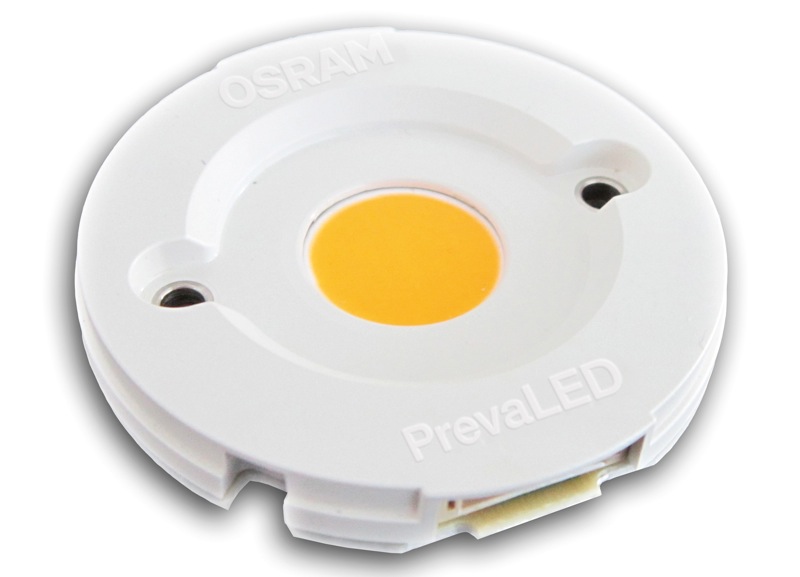
There it was: The Osram (you might know them in the U.S. as Sylvania) PrevaLED Core Z2, designed for sale to "original equipment manufacturers" (OEMs) to build into a finished downlight or spotlight for use in retails shops or other commercial settings. Osram was also showing three other varieties of the PrevaLED, each with a more linear, strip design than the round light source in the Core Z2: The PrevaLED Linear, Linear Slim and Compact.
It was hard to get near the display cases to find out more - crowds of people from OEM companies kept swarming by. Despite my best advanced efforts, there wasn't a press person in sight to assist (come on Siemens, why are you making it so difficult?!).
One factoid I noticed on the information placards: the PrevaLED Core Z2 delivers "up to 111 lumens per watt." That's good, but it doesn't necessarily translate into LED efficiencies that are twice that of existing LEDs. I've seen plenty of LED announcements over the last year that claim similar "lm/w" performance. I have a year-old Philips 60-watt equivalent LED bulb on the desk where I'm writing this blog post, and it's rated at 67 lumens per watt - well over half of 111.
So, is this new Osram module really twice as efficient as the going LED bulbs? An Osram technologist told me in broken English that unlike LED bulbs, the PrevaLED was designed from the ground up for efficiency, not for retrofitting into existing sockets. She said she had no information on pricing - perhaps a sign that PrevaLED won't be cheap, which probably explains why Osram is positioning it for the commercial market rather than residential.
I did manage to snap some grainy photos with my aging Blackberry. PrevaLED has several components, including the LED light source, a set of "driver" electronics made in Italy, and cabling. OEMs add heat sinks and reflectors.
The PrevaLED marks Osram's first LED module that conforms to the Zhaga standard. Zhaga is a consortium of over 180 companies that have agreed on basic design specifications that make the various components of LED modules interchangeable from one manufacture to another. Thus the press release's "global standard" headline.
Is PrevaLED the big efficiency breakthrough that it appears to be?
More LED illumination on SmartPlanet:
- Philips CEO: LED bulb prices must fall to 'well below $10'
- The LED that gives more power than it takes
- Dial-a-Photon: Cellphone and small solar panel buy African power
- What's keeping the lights on in Tokyo?
This post was originally published on Smartplanet.com