Follow this blog:
RSS

DOE: Wireless car charging is the future

By | April 9, 2012, 3:32 PM PDT

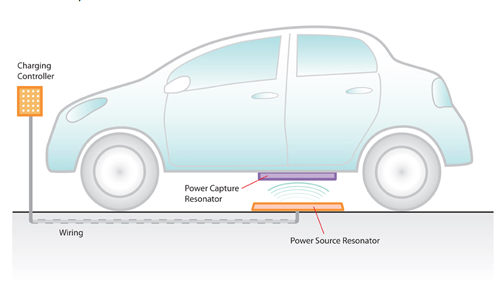
Delphi and WiTricity are partnering to create a wireless car charging system that may meet the DOE's requirements. (Image credit: Delphi)

Delphi and WiTricity are partnering to create a wireless car charging system that may meet the DOE

The U.S. Department of Energy (DOE) is envisioning a future where you can pull into a parking space and be given the option to wirelessly charge your electric car. It just needs somebody to invent the technology.

Up to four contractors will be rewarded with up to US12 million in DOE grant money for innovation in static wireless charging. The DOE’s National Energy Technology Laboratory published the grant opportunity last week.

Wireless charging technology most overcome problems the DOE has identified in today’s solutions including reduced efficiency, high vehicle integration costs, as well as unproven reliability and safety performance, it says. Extra charging locations could reduce vehicle weight, further driving energy efficiency, the DOE noted.

The auto industry also see this need. Auto parts maker Delphi is working on a high-efficiency wireless charging technology in partnership with WiTricity Corp. It has obtained patent rights from MIT to build its solution. Several automakers are also investigating wireless solutions.

The technology that DOE envision creates a very interesting business opportunity. Just imagine restaurants, hotels, and parking garages offering customers the option to charge up while they wait. Park, and an alert on your vehicle’s touchscreen console will prompt you to start the process. A cash transaction wouldn’t even be necessary - payment could be charged to an iTunes like account.

Of course, this type of system is much easier to envision than to build MIT scientists first demonstrated its wireless power transfer system (for consumer electronics) back in 2007. Maybe Delphi’s implementation will fulfill the DOE’s vision, but more people need to own electric cars before your local McDonalds will install charging stations.

The concept of wireless charging hasn’t caught on in the mass market beyond the Powermat concept for cell phones. Apple applied for its own wireless charging patent last year. If any company could advance wireless charging, it’s probably Apple. The DOE’s best effort aside, I think that it’s more likely we’ll see this type of technology in the cell phone market before it takes the automotive world by storm.

Still, it’s nice to see what the future holds.

Related on SmartPlanet:

Start your week smarter with our weekly e-mail newsletter. It's your cheat sheet for good ideas. Get it.

David Worthington

About David Worthington

David Worthington is a contributing editor for SmartPlanet.

David Worthington

David Worthington

Contributing Editor

David Worthington has written for BetaNews, eWeek, PC World, Technologizer and ZDNet. Formerly, he was a senior editor at SD Times. He holds a degree from Temple University. He is based in New York.

Follow him on Twitter.

David Worthington

David Worthington

David does not have financial holdings that would influence how or what he covers. Occasionally he consults for other companies; should David cover a topic in which a client is involved, he will disclose this fact in his writing. His views do not represent those of ScaleOut Software.

He writes for SmartPlanet and is not an employee of CBS.

If you liked this, don't miss...
28
Comments

Join the conversation!

Follow via:
RSS
+2 Votes
+ -
charging
why not develope an alternator to charge the car
Posted by wildwolf93446
10th Apr 2012
0 Votes
+ -
They already have alternators...
The hybrids have alternators and generators for the regenerative breaking. The idea is to use the gas engine as little as possible or gwt away from gas alltogether.
Posted by i8thecat4
10th Apr 2012
0 Votes
+ -
Locally produced EMF
My old unused engineering brain cells remind me of how an EMF can be used to produce a current. Something rotating, some wire coils and bingo, a current is produced to charge a battery. Now, can anyone tell me what part of a car goes round? So why can't the movement in the crank shaft, drive shaft or the wheels not be harnessed?
Posted by PhilM
10th Apr 2012
+3 Votes
+ -
Wireless car charging is the future
This is a ridiculous waste of time and money! It is far more important to develop the efficiency of electric vehicles, better solar charging, and regenerative braking than to worry about how to charge electric vehicles. This is just a ploy for the cities to get more of the taxpayer???s dollar. I do not see any reason that with the advancements that are coming along our new vehicles cannot charge themselves. We need to get the blinders off of the horse!
Posted by ron@...
10th Apr 2012
+1 Vote
+ -
Charging is part of the problem
I disagree. One of the biggest problems with electric cars is the time needed to charge the battery. If has to be done at a "gas station" when you run low, then the process needs to take just minutes. If it can be done during the day while you're spending hours at work, shopping, etc., then it doesn't need to happen as quickly. Inductive charging seems like it will waste a lot of power in transferring the charge, but it does eliminate the need to plug in a cable.
Posted by zackers
10th Apr 2012
0 Votes
+ -
Takes *FOREVER*
My coworker owns a Leaf and with the standard charger, it would take 20+ hours to get to a full charge from empty...
I don't know about you, but I never park at a McDonalds for more than 30 minutes!
And since we all know that inductive charging supplies less power than plug-in charging, this would take even *LONGER*!~
and heaven forbid if a neighbor pet decides to run under your car between the "Power Capture resonator" and "Power Source Resonator" while you are charging!
Posted by tech_ed@...
10th Apr 2012
0 Votes
+ -
Liquid Hydrogen... not electric
The electric gig is just another Obama lie to suck more tax money from the public.
What is with Obama and electric anyway???

The real, "liquid" solution (much like gas) is liquid hydrogen. GM dumped a liquid hydrogen car, not because it didn't work, but most likely because it would end up taking over the electric car.

Scientifically liquid hydrogen production is very doable. Combined with safe nuclear, liquid hydrogen could be produced at night, while during the day electric generation would be produced -- both forms of power would then be transported side-by-side to new power-grid stations (hence, liquid hydrogen distribution stations, like refineries are today),
This is what we should be working on. It's already proven to be doable over time. Like any great investment it would take time. All great inventions do,e.g., trains, phone systems, etc).

There you have it -- but now, instead we are continuously being forced-fed obama care and electric cars. If this chaos in the White House continues we'll all be sick, and your electric bill will be more than you earn in a month.

You're welcome!
Posted by Cyclingmasterseller
10th Apr 2012
+1 Vote
+ -
you are too backwards in your thinking
your thinking is so 1999...
Hydrogen? Really? Heck, if that's the case, then why not go steam! They have these rocks in Pennsylvania that are black, and when you set them on fire, they burn for extended periods of time...we can shove these into some kind of "furnace" to heat a "kettle" of water to produce "steam" which can then be use to somehow propel the vehicle!
Here's an idea...instead of living with your mind firmly planted in prior centuries, why not adopt a truly modern approach to supplying energy.
Let me suggest that you google the term "ionic liquid battery"
Yes, I know that this is not currently available, but it is the most promising technology for rapid fueling of electric power...

You're welcome!
Posted by tech_ed@...
10th Apr 2012
+3 Votes
+ -
Wireless inductive recharging
Both Stanford and MIT have systems for recharging while driving. To me, this makes more sense than huge electric batteries taking hours to recharge. Smartplanet Feb 3, 2012 article:
http://www.smartplanet.com/blog/smart-takes/with-wireless-power-charge-your-electric-car-while-driving/22321?tag=content;siu-container

I have advocated an inductive road system for over 3 years. Each car using the system would have an RFID chip to have the system record the car's electric usage and to activate the induction charge while the vehicle is over the system. Each driver would have an RFID driver's license inserted for use by law enforcement, traffic management, automatic hand's free driving and more. When on the interstate highway, rails would function for maglev transport. Three years ago, I published this web article (go to section 9):
http://www.techok.org/

I believe this system, if adopted nationwide/worldwide would revolutionize transportation as we know it.

John Hite, retired, Oklahoma City
Posted by johnmhite@...
Updated - 10th Apr 2012
0 Votes
+ -
I agree
I was going to comment on this forum suggesting that, when I read what you wrote. I think that is the way things should go: no battery, or a smaller one would solve a big problem in the way of electric cars.
Posted by rgjac
10th Apr 2012
0 Votes
+ -
Other applicants
There are at least 3 other EV charging stations companies that could also do this: Better Place, Coulomb Technologies (they are hiring: (http://www.thegreenjobbank.com/employers/coulomb-technologies), and Amprius (from Stanford U.).
I wouldn't be surprised if one of more of them picked up some of the 4 contracts.
Posted by GreenJobsGuru
10th Apr 2012
+1 Vote
+ -
The technology is almost ready for prime time.
Imbedded inductive chargers a health hazard for anyone with a pace maker or other implanted device. Federal safety regulations limit the power output of both in ground or over head charging units in public places where people might walk over or under them.

This power restriction limits the effective range of recharge to just a few inches. Efficiency decreases with increasing distance between elements. Boosting power helps to a point, but makes them more dangerous to people with implanted devices.

An under vehicle charger where a person with an implanted device might drive over brings up concerns over proper shielding of the under carriage to protect the driver because the driver is closer to the ground than walking over a charging pad.

An increasing number of implanted medical devices are recharged using low power inductive charging. This advance in medicine makes them more vulnerable to strong recharging fields than older implanted devices.

This safety concern has been the downfall of all attempts at imbedded or overhead recharging of EV???s.

Progress is being made in improve efficiency at greater ranges and lower power levels. It is almost there.
Posted by Hates Idiots
10th Apr 2012
0 Votes
+ -
EV Charging schemes
Just who do you think will be paying for these high-tech charging schemes?
Whatever the process, it needs to be easy and cheap. So far, the long-term plugin has the advantage, whether at home or at the workplace or shopping place.
Posted by pmishler
10th Apr 2012
+2 Votes
+ -
What about the inefficiency?
It does seem a bit dim to me. Wireless power transfer is a up-coming thing in (for example) contactless payment systems (Near Field Communications). However these systems need only to transfer milliwatts of power. Inefficiencies are not too important. Up-scaling this to transfer KW will involve very high power AC magnetic fields. These are not only hazardous to those with pacemakers! There will be also be large leakage fields.

Furthermore, a connector is essentially 100% efficient. In an age when energy efficiency will be so critically important. Given the very big energy needed for heavy road transport fleets anyway, the loss of only a few percent would be irresponsible and damaging. The energy efficiency of these systems will be far from ideal, especially given the inherent variabilities in what needs to be a very carefully tuned system. Who pays for the powerlosses, and do they have the "right" or moral authority to throw away energy in this way?
Posted by jneedham1
Updated - 10th Apr 2012
0 Votes
+ -
And it won't half get noisy as well..
And it won't half get noisy. If something can resonate it will. We have a lot of steel in our cars. Whoa, - there will be so many problems with those powerful stray AC magnetic fields.
And more on safety. - Who pays when a shorted coil of wire in the back of an electrician's waggon goes up in smoke?
Posted by jneedham1
10th Apr 2012
0 Votes
+ -
Some of this stuff is just plain scary...
Wireless electricity is generally called lightning... I know this is different, but what about areas with a lot of lightning??? What happens when it strikes an electric car or a hydrogen car? And what happens if you are parked on one of these wireless charging stations and lightning strikes? Or driving along a wireless power grid and lightning strikes? Or what happens when it rains, or the underside of out car gets wet? The odds of being struck by lightning can be increased several magnitude should we fail to consider the inevitable and obvious.

Also... Why are hybrids and electric cars painted and not skinned in PVs? PVs charge in indirect light as well as direct light and making the body out of PVs or skinning a car in PVs sounds like a no brainer to me. Those people would be fighting over the sunny parking spaces.

Also... Why hasn't someone combined a hybrid and hydrogen and solar car all in one??? The car could generate hydrogen with any extra electricity as well as use hydrogen to augment the gas (mix with it to increace fuel efficiency), or run on hydrogen instead of gas. With a solar skin the car could recharge while being driven/parked and if the batteries peaked, then the extra electricity could generate more hydrogen as well as run cooling fans (as this would most likely happen in summer conditions). To me, that also seems like a no brainer.
Posted by i8thecat4
Updated - 10th Apr 2012
0 Votes
+ -
What happened to GENERATORS AND ALTERNATORS ???
Please correct me if I'm wrong but didn't a generator/alternator keep a car battery charged while driving?
With all the energy that a car produces as it is moving, can't that energy be harnessed in an electric car and keep the battery charged so the driver doesn't have to stop every 300 to 400 miles to recharge for hours?
And whatever happened to "Hydrogen" power? I thought the California Governor had a great idea. Too bad California didn't have the money in their budget to continue their project.
Posted by isciencenat1
Updated - 10th Apr 2012
0 Votes
+ -
Look it up...
"can't that energy be harnessed in an electric car and keep the battery charged"

Uh...what you're talking about is called "Perpetual motion" and it is not possible...something to do with the laws of physics and the first *AND* second laws of thermodynamics...
Look it up.
Posted by tech_ed@...
10th Apr 2012
0 Votes
+ -
battery charging
It does not exist such a generator/alternator able to generate more current than the necessary for generate it. Battery power in the electric car transforms into mechanical power, which feeds the generator/alternator. Final electric power obtained at this stage is much less than the consumed energy for moving the car.
Otherwise, we??ve got the perpetual movement solved.
Posted by zolerino@...
28th Apr 2012
+1 Vote
+ -
Ow, common!
Seriously?! 12 million dollar to invent stuff? That might not even be possible... What happenend to eletrical "gas"-stations?

You can also increase the usage of a car by putting solar panels on the roof.

Plus, we are not doen developping the basis of electrical cars! Their are still a lot of gas - powered cars out there. So quite the nonsense and do something that matters.
Posted by wompai
10th Apr 2012
0 Votes
+ -
Wireless Charging of the Future
Great idea and marvell wait to solve solution. We must focus on many challenges to streamline our car charging and battery to embrace mass market adoption. Then we will take another next step.
Posted by Netteligent
10th Apr 2012
0 Votes
+ -
Wireless electricity is here already
You jusy need the infrastructure to support it. An example is http://www.thinkgeek.com/stuff/41/wec.shtml and http://www.powercastco.com/
Posted by dontseme
10th Apr 2012
0 Votes
+ -
not just when parking
Maybe batteries will improve quickly but ive previously thought that charging might be needed at traffic lights etc. And depending on charge times etc it might be better to have several batteries per car and have battery stations that you drive on to that automatically swap one or more from underneith ur car.
Posted by John in Brisbane
10th Apr 2012
0 Votes
+ -
Wireless charging
This could be extended to charging on the highways by having charging plates imbeded in the roadways, eliminating large battery requirements.Coded signals transmitted by the vehicles would turn them on only as the vehicle passed over them, saving power! This could be kept track of amounts of power used, and billed to owners. Also, the tracking, and possibly disabling, of the vehicle could be done, VERY handy for 'Big Brother'!
Posted by mogul264
10th Apr 2012
0 Votes
+ -
infra red
I saw a documentary quite a while ago, where similar to solar panels, they use infra red panels to carry over power remotely, this should work and also it would charge from the sun also...
Posted by james_linde
11th Apr 2012
0 Votes
+ -
investing in wireless charging
Q: What is the inevitable result of investing your (or taxpayers') money into developing a product whose potential customers are loudly screaming they do not want and will not buy?
A: Adios dollars.

See EV sales figures from Automotive Digest:

Hybrid and EV Sales Numbers Slim, at Least for Now

Posted on February 27, 2012 by jonlesage http://www.automotivedigest.com/GreenMachineDigest/index.php/2012/02/hybrid-and-ev-sales-numbers-slim/

As is well known, hybrid and electric vehicles still make up a very small slice of US new vehicle sales, with small fuel efficient cars and crossovers taking up some of the slack for now in hitting federal fuel economy targets. Plug-in electric vehicles closed 2011 at 17,813 units sold in the US, and hybrid electric vehicles represented 268,807 units sold out of about 12.7 million new vehicles sold.

As for January 2012 sales figures, 21,778 hybrids were sold in the US market and 1,427 plug-in electric vehicles. The BMW Active E was added to the plug-in list and it sold 112 units in the US market in January. The Chevy Volt was clearly affected by its safety investigation, which was closed by NHTSA in January. Its sales were down 60% from December 2011.
Posted by bbeaven@...
13th Apr 2012
+1 Vote
+ -
Possibilities
I guess it's worthwhile to brainstorm concepts like this, we used to have sessions at work where people could throw out all kinds of outlandish ideas to solve a problem. Although many of these off-the-cuff suggestions were more laughable than practical, now and then the germ of an idea could develop into something real.

Like inductive charging -- with a large space between the terminals, that does present problems with efficiency and leakage. Consider though, perhaps the car's terminal plate could lower itself to become in virtual contact with the charging plate, greatly alleviating both problems. Or just techniques to shape and concentrate the magnetic field.

Is inductive-coupling efficient? That's what transformers are, and can be 99% efficient.

I'd be more worried about the mechanical issues, like getting your car positioned exactly right, the effects of snow, etc.

I think one thing some readers here lose sight of, when discussing issues like regenerative braking, solar charging, is the rather large amount of energy that must be transferred to the battery system. A lot of schemes seem doable at first blush, until you grind the numbers.

BTW, we already have ways of running electric vehicles along highways without batteries, generators, etc. They're called TROLLEYS! (Can't imagine personal cars going that route though, maybe I need to get back to that brainstorming session).
Posted by ProfQuill
25th Apr 2012
0 Votes
+ -
mizuno soccer cleats
The nike mercurial sl is a dance aerobic sneaker that has all of the features that were mentioned above. Manywomen love this shoe because it is able to provide everything that they require in this shoe and it alsocan be had for a very affordable price.The Nike Musique FeaturesHere are some of the features of this wonderful sneaker. It has all that is needed for any danceaerobics class.

Flexibility is one of The Musique is very lightweight Nike Mercurial victory VIII and supportive, this is courtesy of synthetic leather and a light meshupper. There is also midfoot strapping that allows for support during the different routines. The shoe has extra stability, courtesy of double-lasted forefoot and heel. There is a Phylon midsole that is able to give lightweight cushioning. The rubber outsole gives excellent traction. There is a pivot point on the forefoot of the shoe

Well it seems that a lot of people love the Nike Shox Navina. The shoe is solid and it is perfect forrunning, for use in the gym or casual wear.
nike mercurial talaria v The shoe works very well, but what many people seem to be
blown away by are the varying colors that are available
Posted by adidas23
8th May 2012
Join the conversation
Formatting +
BB Codes - Note: HTML is not supported in forums
  • [b] Bold [/b]
  • [i] Italic [/i]
  • [u] Underline [/u]
  • [s] Strikethrough [/s]
  • [q] "Quote" [/q]
  • [ol][*] 1. Ordered List [/ol]
  • [ul][*] · Unordered List [/ul]
  • [pre] Preformat [/pre]
  • [quote] "Blockquote" [/quote]

Join the SmartPlanet community and join the conversation! Signing up is fast and free. Don't wait -- we want to hear your opinion!