Follow this blog:
RSS

Caffeine pollutes Pacific Ocean

By | August 3, 2012, 4:43 AM PDT

The chilly ocean off America’s Pacific Northwest can make for a bracing swim. Earlier today, the water temperature at a place called Port Orford, Oregon sat at a bone jarring 47 degrees F.

If that sort of thing doesn’t faze you (heck, in Finland they cut holes in frozen Arctic lakes and jump in), there’s something else lurking in the water that could give you a jolt: caffeine.

The National Oceanic and Atmospheric Administration (NOAA) reports that researchers have found “elevated levels of caffeine at several sites in Pacific Ocean waters off the coast of Oregon.”

Now, in case you’re wondering why you’ve probably never heard this before, the NOAA press release explains that the study was “the first ever to look at caffeine contamination off the Oregon coast.” (I’ve added the word “ever” for emphasis, reflecting that I - and perhaps you - am bemusedly wondering why anyone decided to study this in the first place. But I won’t ponder).

Okay, so where does the caffeine come from?

Well, you might be sorry you asked. The answer could make any intrepid swimmer paddle back to dry land faster than they can say “my cojones shrunk” - if they have cojones that is. Female swimmers can substitute some other expression, perhaps “my tootsies are numb.”

Whatever they shout when icy waters turn them blue, the source of the caffeine is, yes, sewage.

In the event you’re not connecting the dots I’ll get you started: caffeine travels from coffee maker to coffee cup to your welcoming lips to, well, you know the rest.

Scientists from Portland State University and Washington State University suspect two main culprits: septic tanks and storm-induced sewage overflows.

They found some of the highest concentrations of caffeine in low population areas - Carl Washburne State Park in Florence, Ore., and at Cape Lookout. “The results suggest that septic tanks, such as those used at the state parks, may be less effective at containing pollution,” the release notes.

Can you connect the dots in the pictures above? Clue: NOAA says caffeine travels from coffee to septic tank to ocean.

Levels also rose elsewhere following a storm “that triggered sewer overflows,” it says.

Curiously, the team found low levels of caffeine near large population centers like Astoria/Warrenton and Coos Bay. The press release does not explain why these places seem more resistant to overflows, although the researchers do say that waste water treatment plants in those areas seem to work well.

“Contrary to our prediction, the waste water treatment plants are not a major source of caffeine to coastal waters,” states Elise Granek, assistant professor of environmental science and management at Portland State University. “However, onsite waste disposal systems may be a big contributor of contaminants to Oregon’s coastal ocean and need to be better studied to fully understand their contribution to pollution of ocean waters.”

To help you cope: Next time you see the foamy break of the wave, just imagine you’re swimming in a giant bowl of cappuccino. Don’t think of that other stuff.

Now, before I completely upset the Oregon tourist board, let me clarify that not all of the state’s beach waters are as frigid as Port Orford’s 47 degrees, a number which I plucked from NOAA charts. Newport’s was 49.3, and Charleston’s climbed to 49.5. Alright, Astoria’s was a comparatively tepid 69.6 (how does that 20-degree range occur?).

But for comparison, thousands of miles to the east, at Cape May, New Jersey, the ocean thermometer hovered at a bathtub-like 82 degrees. I’m not sure what the caffeine count was there. But I bet the taffy total was high.

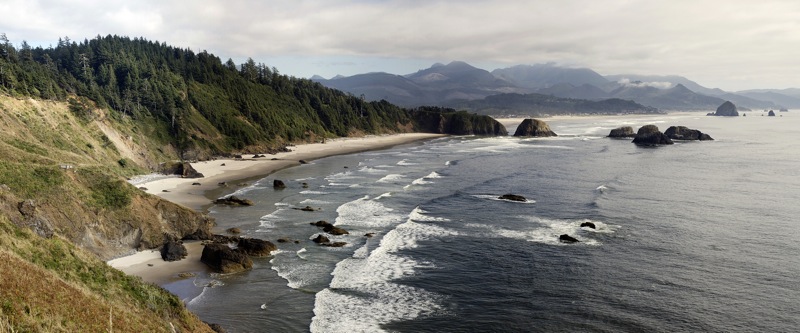
Photos: Latte from Mortefot. Septic tank from EPA. Oregon coastline at Ecola State Park from “Cacophony edit by Noodle Snacks.” All via Wikimedia.

Water water everywhere on SmartPlanet:

Start your week smarter with our weekly e-mail newsletter. It's your cheat sheet for good ideas. Get it.

Mark Halper

About Mark Halper

Mark Halper is a contributing editor for SmartPlanet.

Mark Halper

Mark Halper

Contributing Editor

Mark Halper has written for TIME, Fortune, Financial Times, the UK's Independent on Sunday, Forbes, New York Times, Wired, Variety and The Guardian. He is based in Bristol, U.K.

Follow him on Twitter.

Mark Halper

Mark Halper

Mark has no financial holdings in the companies he writes about. He occasionally travels at the expense of companies or their press relations agencies in order to report on a company or industry event related to it; Mark will prominently disclose this information when appropriate. This relationship will have no influence on his coverage. Companies he covers do not get to review columns in advance, or select or reject topics.

He writes for SmartPlanet and is not an employee of CBS.

If you liked this, don't miss...
20
Comments

Join the conversation!

Follow via:
RSS
+2 Votes
+ -
The 20 degree difference.
Due to Astoria being at the mouth of the Columbia River, where shallow water from the Willamette has been warmed up to 72+.

Caffeine...in the PNW, who would have thought? I'm probably responsible for 1/1000th of anything coming out of the Columbia with my 8+ cups a day.
Posted by gork platter
3rd Aug
+2 Votes
+ -
A river runs through it
Hey thanks Gork. I just knew someone would write in with the 20-degree answer. I owe you a cup of coffee!.
Posted by markhalper
3rd Aug
0 Votes
+ -
No worries.
I'm on my way to finishing my first pot of the day...today might be a 10-mug day today.

It's not just waste water, if you think about it. People in the PNW use coffee grounds and used tea leaves for their composting, especially with SB and others giving out free bags of used coffee grounds for such purposes. With the amount of rain at the coast, I wouldn't be surprised if caffeine leach from caffeinated soil was a major contributor.
Posted by gork platter
3rd Aug
0 Votes
+ -
Right
Astoria is on the Columbia River Estuary, not the open sea. The offshore waters here never get warm, due to the influence of the Alaska Current. The East Coast has the Gulf Stream making the ocean warm.
Posted by Greenknight_z
4th Aug
+1 Vote
+ -
Oh God!
OK! As I see it We are gonna have a good time with this one. I can for see the local and feds placing a TAX yes I said the miserable "T" word on all caffeine products from coffee to the pick me up stimulents. It ought to resolve the deficit spending bill as we have quite a few coffee drinkers in this country!
Posted by geofer50
3rd Aug
+2 Votes
+ -
I challenge -
I challenge the analyzers to look at the volumeteric dilution of caffeine in solution at the points studied that weren't immediately adjacent to a sewage outfall - and then analytically demonstrate their analytical equipment's ability to detect at levels that low. It doesn't take much of an area volume and the resulting dilution to get specific molecules like caffeine down below detectable levels - parts per trillion and even lower. In fact, if the analyst were heavy coffee drinkers, contamination from aerosols in the associated testing atmosphere might be more plausible.

I'm all for eliminating coastal septic tanks, but this isn't a plausible way to demonstrate the need. Measuring phosphates and nitrates would be a lot more convincing that there is a local sewage problem. Anyone tested the local macro alga for caffeine-like molecule production? Lots of plants produce caffeine.
Posted by dduggerbiocepts
Updated - 3rd Aug
+2 Votes
+ -
I have to agree
My first thought also was what natural sources of caffeine there might be.

Of all the substances consumed by humans, it seems caffeine would be low down on the scale. Seems like you might find even higher concentrations of antibiotics and other medications, ammonia and who knows what else?

I, too, have to wonder if someone in the lab didn't spill a spot of coffee!
Posted by omb00900@...
3rd Aug
0 Votes
+ -
Answering the challenge
You both make valid points, Ddugger and Omb, which brings me back to wondering why the scientists embarked on this research in the first place. Of all the things to test for, I'd like to have been there (or maybe not!) when some PhD said "I know, let's analyze the Pacific for caffeine." Huh? What's next, dredging the Mississippi for saccharin?

But now that they've done it, and to address your main point: The researchers seem to regard beverage and food as the main source of the caffeine. They also say that pharmaceuticals released some of the stuff. They RULE OUT natural sources. From the press release (link in the story): "Caffeine is found in many food and beverage products as well as some pharmaceuticals, and caffeine in waterways is directly related to human activity. Although many plant species produce caffeine, there are no natural sources of the substance in the Pacific Northwest. The presence of caffeine in ocean water may also signal additional pollution such as pesticides and pharmaceuticals."

After all this, I'm still sticking with 3 morning cups of strong, black and preferably Italian roast. I'll do my best to leave it out of the ocean. Might be tough, as I live on an Atlantic island.
Posted by markhalper
Updated - 3rd Aug
-1 Votes
+ -
They've been testing streams and lakes for a long time
Scientists for a long time have been testing for chemicals and drugs that humans, um, process and release into streams, rivers, and lakes. This is a big issue in the inland US, where one town processes its sewage, releases it into a stream, and then the next town downstream draws from the same stream for its drinking water.

Most people don't realize it, but if their drinking water is taken from a lake or stream, they're literally drinking someone else's urine and wastewater. Modern sewage treatment plants are very good at taking out solids (garbage, feces, etc.) and killing bacteria, but they can do absolutely nothing with dissolved chemicals. In most inland cities, the runoff from streets following storms or snow melts also goes directly into streams or rivers without any treatment at all (which is why you shouldn't dump your used motor oil down the storm drain). What modern water systems rely on is that these chemicals are so diluted by the rest of the stream or lake water that it isn't an issue. Even so, excreted hormones are suspected of triggering earlier than normal puberty in children.

Of course, in Chicago the issue of the Chicago river dumping wastewater into Lake Michigan (where the city gets its drinking water) was so bad that they reversed the flow of the river so it dumped its water eventually into the Mississippi instead.

Anyway, given the issue with dissolved chemicals in inland waters, it's not so strange that scientists would wonder about the situation near coastal cities.
Posted by zackers
Updated - 3rd Aug
-2 Votes
+ -
I never did like Starbucks.
Now I know why.
Posted by Hates Idiots
3rd Aug
0 Votes
+ -
Puget Sound?
I wonder what the caffeine level is in Puget Sound. The folks in Seattle are even bigger coffee fiends than us Oregonians.
Posted by riverat1
Updated - 3rd Aug
0 Votes
+ -
Just another guild trip
Just another article trying to give people a guilt trip just because they want to tell people how to lead their lives.
Go talk to volcanoes and tell them how much they are polluting the atmosphere and water.
Make sure ya doing that when it's erupting would ya happy
Posted by rocketman67
3rd Aug
+1 Vote
+ -
it's not an article about drink less coffee...
If you think that you missed the whole point. It's about sewage contamination reaching the ocean, at a level where caffeine is measurable.
Posted by kevinrs1
3rd Aug
0 Votes
+ -
See no evil
Yes, it is much better to put your head in the sand.
Posted by dennyinusa
3rd Aug
0 Votes
+ -
Is the caffeine in the ocean causing any problems?
If not -- and none were mentioned -- what's the big deal?
Is it a marker for other chemicals that might cause problems?
Posted by Day Dreamer
3rd Aug
0 Votes
+ -
What removes caffeine from sewage?
The article implies that sewage treatment plants remove caffeine, but septic tanks do not. Since most sewage treatment plants don't do much more than let natural bacteria "process" the sewage (i.e., they do no chemical processing), it seems the caffeine can't be that hard to get rid of. On the other hand, it does does survive the trip from the septic tank through the ground to the ocean, so it must be somewhat persistent. I wonder if it naturally dissipates in the ocean, and if so, how long that would take?
Posted by Day Dreamer
3rd Aug
+2 Votes
+ -
Astoria and ocean currents
Readers comments about Astoria s warmer waters caused by the warmer Columbia river are indeed correct. The west coasts cool waters are due to upwelling and the flow of colder North Pacific waters moving south. There is no Alaskan Current moving south however. It is the California Current which flows south. The Alaska current flows north. I pay attention to these sort of things as a former N Pacific and Alaskan commercial fisherman.
Posted by hugho
4th Aug
0 Votes
+ -
State Parks
The quote from the press release, "septic tanks, such as those used at the state parks, may be less effective at containing pollution," is significant. Oregon's coast has more than 80 State Parks. Most of these are day use only, but that's still a lot of public toilets. And you're as likely to find regular colas involved as coffee, a potentially potent combination. There are also a number of well-used campgrounds including both Carl Washburne and Cape Lookout State Parks, among the highest concentration areas mentioned in the article.
Posted by Ovalescent
9th Aug
0 Votes
+ -
Composting toilets.
I wonder if composting breaks down caffeine?

This companys composting toilets are seeing growing use in New England highway rest stops and state parks. Their site shows a few examples of installed locations.

http://www.clivusmultrum.com/
Posted by Hates Idiots
9th Aug
0 Votes
+ -
Composting and caffeine
Yes, if this statement is to be believed:
"These caffeine residues break down completely in compost."

Found that here:
http://www.the-compost-gardener.com/coffee-grounds-compost.html#axzz237rz0OHK

This was in response to the question posed under "Composting toilets" -- forgot to use the reply button after coming back from researching the answer.
Posted by Ovalescent
Updated - 10th Aug
Join the conversation
Formatting +
BB Codes - Note: HTML is not supported in forums
  • [b] Bold [/b]
  • [i] Italic [/i]
  • [u] Underline [/u]
  • [s] Strikethrough [/s]
  • [q] "Quote" [/q]
  • [ol][*] 1. Ordered List [/ol]
  • [ul][*] · Unordered List [/ul]
  • [pre] Preformat [/pre]
  • [quote] "Blockquote" [/quote]

Join the SmartPlanet community and join the conversation! Signing up is fast and free. Don't wait -- we want to hear your opinion!