Follow this blog:
RSS

A sharkskin coating for ships, planes and blades

By | May 25, 2010, 4:00 AM PDT

A few weeks ago, I wrote about bionic cargo ships, inspired by a hydrophobic fern, that would decrease a ship’s drag as it cruises through the ocean. In another effort to make surfaces slicker, researchers from the Fraunhofer Institute for Manufacturing Engineering and Applied Materials Research (IFAM) are looking to sharks.

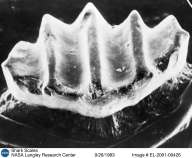
The ridged scales of sharks reduce friction between the animals and their watery surroundings. This helps sharks to swim swiftly and silently through the water. In short bursts, some sharks can reach more than 30 miles per hour with little effort.

Known as the “riblet effect,” the hydrodynamic* advantage sharkskin may provide to seafaring vessels might also reduce resistance for objects gliding through the air, such as airplanes or the blades of windmills. [*edit]

German researchers have developed a paint that mimics the dermal dentricles, or placoid scales, of fast-swimming sharks. According to the scientists, the coating covers 3-dimensional surfaces easily and reduced friction by more than 5 percent in tests at a ship construction facility. Container ships transport about 90 percent of global trade from port to port and are big, heavy and huge fuel guzzlers. Over the course of a year, one large cargo ship could potentially save 2,000 tons of fuel.

Of course, there are some lifestyle differences between a shark and an airplane, a turbine, and a boat. So nanoparticles within the paint allow it to withstand ultra-violet radiation, temperature fluctuations (between -67 and 158 degrees Fahrenheit), and mechanical loads.
Volkmar Stenzel in a statement:

Paint offers more advantages. It is applied as the outermost coating on the plane, so that no other layer of material is required. It adds no additional weight, and even when the airplane is stripped – about every five years, the paint has to be completely removed and reapplied – no additional costs are incurred.

By applying the paint to a plane via a stencil, the surface achieves the correct texture.

The next step for the researchers? Determining how to keep barnacles and algae from gumming on to ship hulls and gumming up the vessel’s fuel efficiency.

Image 1: Flickr/Alfonsator
Image 2
: NASA

Start your week smarter with our weekly e-mail newsletter. It's your cheat sheet for good ideas. Get it.

Melissa Mahony

About Melissa Mahony

Melissa Mahony was a contributing editor for SmartPlanet from 2010 to 2011.

Melissa Mahony

Melissa Mahony

Contributing Editor

Melissa Mahony has written for Scientific American Mind, Audubon Magazine, Plenty Magazine and LiveScience. Formerly, she was an editor at Wildlife Conservation magazine. She holds degrees from Boston College and New York University's Science, Health, and Environmental Reporting Program. She is based in New York.

Follow her on Twitter.

Melissa Mahony

Melissa Mahony

Melissa does not have financial holdings that would influence how or what she covers. She currently works for the Wildlife Conservation Society as an editor. Should Melissa cover a topic in which the WCS is involved, she will disclose this fact in her writing.

She writes for SmartPlanet and is not an employee of CBS.

If you liked this, don't miss...
10
Comments

Join the conversation!

Follow via:
RSS
0 Votes
+ -
RE: A sharkskin coating for ships, planes and blades
Airbus did try riblets skins in the 1980s. In 1987, the winner of the America's Cup had riblet skins. So its hardly news! The problem is maintenance. You can't keep the nanocracks clean of fouling and algaes, or of the normal dust and insects on airplanes. Only operational constraints decide when an invention is ripe to use...
D. Charles
Posted by 060249
25th May 2010
-1 Votes
+ -
RE: A sharkskin coating for ships, planes and blades
Aerodynamics???? Hydrodynamics!!! Sheeesh.
Posted by jonorama@...
25th May 2010
0 Votes
+ -
RE: A sharkskin coating for ships, planes and blades
So long as they only coat the fuselage of planes and not the
undersides of the wings...
Posted by _crystalsinger_
25th May 2010
0 Votes
+ -
RE: A sharkskin coating for ships, planes and blades
Why don't they use the lotus leaf technique that other researchers have shown which doesnt even let the water touch the surface, surely that would solve all problems.
Posted by daveedwards
25th May 2010
0 Votes
+ -
RE: A sharkskin coating for ships, planes and blades
Just read the bionic cargo ship article, nevermind. lol
Posted by daveedwards
25th May 2010
0 Votes
+ -
@_crystalsinger_
Why not coat the underside of wings? Do you fear that it would reduce lift?

Don't fear, my friend. Lift on a wing is not related to friction at all. It depends only in the difference in distance the air have to travel between going over or under the wing, and the speed of the wing through the air.
Posted by Kualinar
25th May 2010
0 Votes
+ -
Words mean things...
Hydro-dynamics unless you are talking about sharks that can fly.
Posted by mikifinaz1@...
25th May 2010
0 Votes
+ -
I've never understood...
why they don't coat airplanes (or racecars for that matter), with the same stuff that's on the outside of golf balls.
Posted by TranMan
26th May 2010
+1 Vote
+ -
Aerodynamics/Hydrodynamics
Yes, words do have meaning, but aerodynamics and hydrodynamics are both just subsets of fluid dynamics, and there is no difference in the math.

Only the density of the fluids vary.
Posted by wizoddg
26th May 2010
0 Votes
+ -
RE: A sharkskin coating for ships, planes and blades
As long as the top of the wing is painted with or without painting
the underside of the wing, the lift should be maintained. Some
aircraft have used a slightly different twist on this in the form of
laminar airflow, over the top surface of the wing. The only real
problem (I can recall) of decreasing turbulence over the upper
surface occurs when the technology is defeated by environmental
factors like ice on the wings. This problem has resulted in few
aircraft falling out of the sky. Laminar air flow was employed (still
is) on fighter aircraft. I would guess that the military is already
testing sharkskin paint. What does this technical advance
promise us in the fashion world, I wonder? Will we return to
wearing shark skin suits? Will we be better able to withstand wind
while being fashionably dressed at the same time? What color tie
goes well with a shark skin suit? How silly will aircraft look wearing
ties? Why do so many readers attack Melissa and other writers
over word choices like aerodynamics vs. hydrodynamics vs. fluid
dynamics? I found the article interesting and informative. Kudos
to Melissa. Kudos as well to wizoddg for expanding my horizons
about fluid dynamics.
Posted by scott.f.birnbaum@...
26th May 2010
Join the conversation
Formatting +
BB Codes - Note: HTML is not supported in forums
  • [b] Bold [/b]
  • [i] Italic [/i]
  • [u] Underline [/u]
  • [s] Strikethrough [/s]
  • [q] "Quote" [/q]
  • [ol][*] 1. Ordered List [/ol]
  • [ul][*] · Unordered List [/ul]
  • [pre] Preformat [/pre]
  • [quote] "Blockquote" [/quote]

Join the SmartPlanet community and join the conversation! Signing up is fast and free. Don't wait -- we want to hear your opinion!