When does a city have too many tourists?

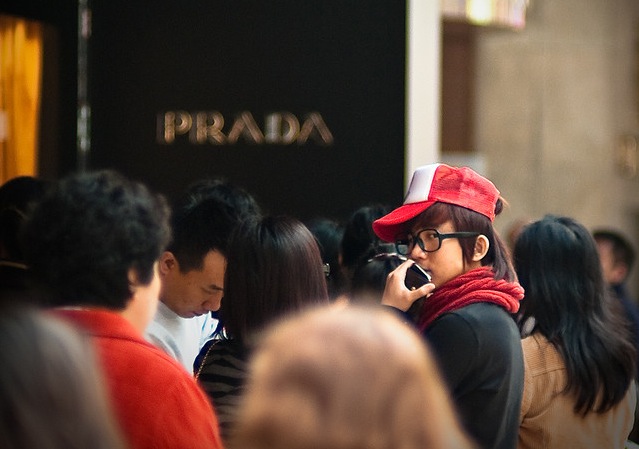
HONG KONG -- On a Thursday afternoon in 93-degree sweltering heat, double-decker buses trail hot clouds of exhaust on Canton Road, a main thoroughfare for high-end shopping.
But tourists are not deterred. Customers line up along shop windows of Dior, Louis Vuitton and Gucci, waiting behind velvet ropes. The orderly entry of customers as others exit is managed by a security guard at each store.
Huang Ping, a trendily-dressed 20-something, just came out of Louis Vuitton. She stopped for a few minutes next to the store to rearrange a tightly stuffed roller suitcase in which she stored the day’s finds. She didn’t buy anything today at Louis Vuitton but picked up a few things at Chanel and Gucci.
Huang is from mainland China and says she visits about twice a year, spending around US$3,000 on shopping each time. She, like many other mainland Chinese tourists, says they come to shop in Hong Kong because there are more brands and styles available here, and, because of tax differences, prices are cheaper.
The lines weren’t too bad today, she said, “only 10-minute waits.”
Beginning in 2003, Hong Kong, a semi-autonomous region from the rest of China, began to allow entry to individual tourists from the mainland for the first time. Prior to this, they had to be visiting on business or be part of an organized tour group. That is when these lines outside luxury stores became necessary to properly accommodate the large number of wealthy mainland tourists.
Locals acknowledge that tourists are keeping Hong Kong’s economy strong, but the influx has been causing friction ever since. The numbers of Chinese tourists allowed in has increased in phases. Last year, 28 million mainland Chinese visited Hong Kong, which only has 7 million people.
The most recent attempt to change the rules, which would have opened the door for nearly unfettered entry to the population of 4.1 million living over the border in the city of Shenzhen, caused such an outcry that the plan, originally set to begin on Sept. 1, has been put on hold.
The problems are manifold. Hong Kong is crowded to the point where walking around busy areas is a strenuous undertaking. The most outspoken advocate for limiting tourism is Green Sense, an environmental group. Although Hong Kong has not conducted a formal study of tourism carrying capacity, Green Sense's president, Roy Tam, says general comments from the public is telling enough about the overcrowding of tourists. "The number is too high, making Hong Kong very crowded," he said.
Among the factors that go into determining a city’s carrying capacity from tourism, one component is its social carrying capacity, which an E.U. report describes in part as the tourism load that does not affect “the sense of identity, life style and social patterns and activities of host communities.”
The way tourism is affecting locals’ quality of living is more than physical discomfort. Most Chinese tourists who come to Hong Kong are wealthy, and their interest in acquiring status symbols like expensive handbags has led more designer stores to move in, ones that most locals cannot afford to shop at, while pushing out mom-and-pop stores that can no longer afford the skyrocketing rents.
It seems like "we cannot find daily necessities for regular people in major tourist areas, because all these shops are selling luxury goods like jewelry, gold or watches," Tam said.
The issue also raises questions about visitors who are not here to be tourists. The city has, for example, become a place for people across the border to buy safe and inexpensive food items. Cases of tainted food on the mainland, most notably with the baby formula found to contain melamine in 2008, has helped create a class of Chinese visitors who come to Hong Kong looking to sweep supermarkets of such necessities -- considered safe because of their reliable foreign brands and cheaper because of different tariffs -- for resale on the mainland.
Competing for services and products deprives local communities when shelves of baby formula are empty. Although these visitors do not fit the traditional definition of tourists, they are permitted entry under the same rules.
Then there is the perceived attitude of those pandering to mainland money, which brings us back to luxury handbags. Since the lucrative influx of tourists started, salespeople have understandably turned their attention to the new big spenders -- it is an easy sell -- and have left the relatively frugal locals to browse thousand-dollar handbags discretely. But there are many signs of frustration among locals, most notably a protest that broke out in front of the D&G store on Canton Road earlier this year, because it was seen as giving tourists preferential treatment over locals, when security guards stopped locals from taking photos of its storefront while allowing tourists to do so.
Studies of tourism carrying capacity are more frequently done in places that have attractions with high heritage or environmental value. It is doubtful that Hong Kong will significantly curb tourism though, despite the negative public sentiment, because of the economic benefits they bring.
When it comes to mainland Chinese’s spending, “there’s no comparison to locals. It’s double,” said Mandy, a saleswoman at Sasa, a large cosmetics chain popular with Chinese tourists, while smoking a cigarette on her break. "Mainlanders are the ones traveling and spending these days -- not just here but around the world.”
Photo: Flickr/Robert S. Donovan
This post was originally published on Smartplanet.com