Organic-only for Beijing's middle-class moms


BEIJING -- Locals call them “Sleep Towns” – commuter districts which empty out during office hours. Late one Friday morning, the streets of northern Beijing’s Huilongguan district are virtually free of traffic. But one fleet of cars remains on the roads, ferrying soily of vegetables to far-flung apartment blocks.
The cars belong to the “Green League” an organic food delivery firm set up by a band of local mothers. More than 100 families, as well as a nearby kindergarten, buy food from the League, receiving deliveries twice a week. “We put food safety before profit,” Liu Yujing, one of the League’s founders, said.
Yujing, and other families in Huilongguan, enjoy the trappings of the global middle class, including saloon cars, spacious apartments, and (at least domestic) air travel for their vacations. But these parents are worried about the threat pollution poses to their quality of life. “We have a lot of nice things in Huilongguan,” Meng Yu, one of the Green Leagues customers, says “But the environment is bad.”
China has been afflicted by a string of food safety scandals in recent years, from lethal baby-milk powder to fake pig-trotters. The parents, who met at a local kindergarten’s after school book-club, were also scared by reports that Chinese farms use more than 3 times global average amounts of chemical pesticides. “It seemed like there was some new food safety scandal every other day,” Yujing said. “We wanted to guarantee that our food was safe.”
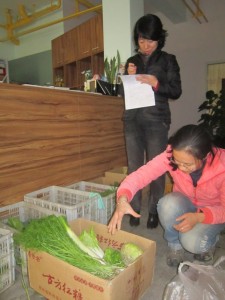
Yujing and the other mothers (the founders were all female), went to visit nearby farms which grow fruit and vegetables without pesticides. They discovered at least 12 organic farms in the Beijing area, and all produce sold by the Green League is now completely organic. “If we can’t find an organic provider, we don’t sell the product,” Yujing said.
Chinese demand for organic food has quadrupled in the past five years, and is the market is thought to be worth 10 billion yuan ($1.55 billion) annually. Chinese supermarkets have been eager to jump on the organic bandwagon, with foreign chains like Carrefour and Walmart leading the way with their own ranges of organic produce.
But many Chinese parents are suspicious of super-market chains, and their suspicions have been intensified by some recent cases of fraudulent labelling, including one Carrefour supermarket where “Green” (not necessarily organic) produce was found to have been labelled incorrectly. “There are a lot of fake organic products in China,” Yujing said. “I don’t trust big brands to put safety before profits.”
That’s why Yujing will continue to spend her Friday mornings lugging bags of cabbage, radishes and turnips up the staircases of Huilongguan’s suburban apartment blocks. The mothers make a small profit from the venture, and they have won imitators in other parts of China “We’ve had groups of mothers from other cities in south and central China coming to study our business model,” Yujing said.
The Green League's produce, such as carrots, can cost four times as much as equivalents in local supermarkets. Combined with rapidly rising food prices (Beijing’s food price inflation was over 13 percent this September), organic vegetables are beyond the means of the majority of Beijing’s households. “We even have some parents who order the vegetables for their child, but eat non-organic vegetables themselves,” Yujing said. "It's would be better if more people could enjoy food as clean as this."
This post was originally published on Smartplanet.com