Meet a human ancestor, live and over the Web

JOHANNESBURG -- Around two million years ago, in rolling grasslands 30 miles north of present-day Johannesburg, a number of early human ancestors struggled to survive. A handful of the unlucky ones fell through hidden cave openings and nearly 17 stories to their deaths. Rains cleared away the bodies of the hominids, and a number of other prehistoric animals, into large underground lakes, that along with runoff, solidified "like quick drying concrete."
In August 2008, the cave, now known as Malapa, was rediscovered by researchers from Wits University. Led by Professor Lee Berger, the site has been a treasure-trove of fossils from the earliest bipedal creatures known to have existed. So far, more than 240 bones from five individuals have been unearthed.
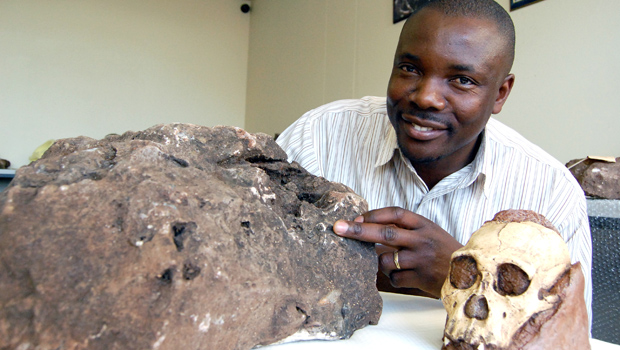
Last week Berger announced possibly the most important find from Malapa to date. At a conference held at the Shanghai Science and Technology Museum -- meant to draw Shanghai and Johannesburg closer together and promote trade and travel between the two cities -- Berger said that researchers in his department recently uncovered what could be an extraordinarily complete skeleton of Australopithecus sediba, an early ancestor of modern humans. They've named the skeleton 'Karabo' and have begun slowly etching away the calcified rock from the fossil.
 “This discovery will almost certainly make Karabo the most complete early human ancestor skeleton ever discovered," Berger said in a statement. "We are obviously quite excited as it appears that we now have some of the most critical and complete remains of the skeleton, albeit encased in solid rock. It’s a big day for us as a team and for our field as a whole”
The rock that yielded the fossil was in Wits's possession for years, but remained unexplored until Justin Mukanku noticed a small tooth protruding from the stone. With the help of Berger's wife, Jackie Smilg, a radiologist who uses CT scans to look at fossils trapped in rocks, the team was able to peer inside and discover Karabo.
Berger's team plans to share the excavation of the fossil live, for free across the Internet. In a specially built laboratory, designed in cooperation with the National Geographic Society, video of the exploration of the skeleton will be beamed into labs at Wits and throughout the rest of the world.
National Geographic Executive Vice President Terry Garcia told Wits, "We can't wait to watch paleontology happening in real time."
Berger said that talks are underway with the Smithsonian, London's Museum of Natural History and the Shanghai Science and Technology Museum to set up "virtual outposts" in the near future. Casts of existing Australopithecus sediba skeletons have already been donated.
This post was originally published on Smartplanet.com