Follow this blog:
RSS

In cramped Hong Kong, a home under the bridge

By | February 28, 2013, 3:00 AM PST

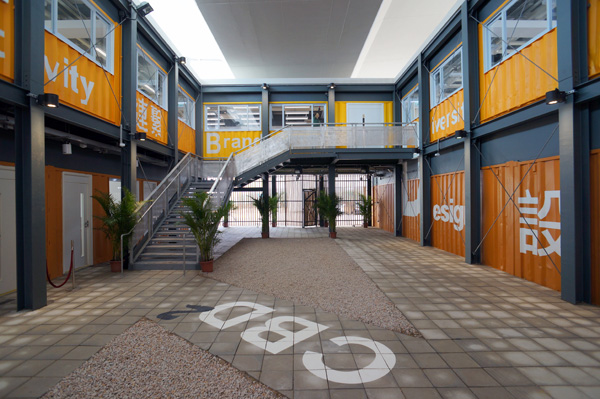
Energize Kowloon East, a district community office, was built in Kwun Tong under an overpass, which can be seen running along the top.

Energizing Kowloon East Office, a temporary district affairs office, was built in Kwun Tong under an overpass, which can be seen running above the open-air courtyard.

HONG KONG — The expanse under an overpass in Kwun Tong, an industrial area of Hong Kong, is indeed large, and it seems to stretch forever. On one side is road traffic, and on the other is the harbor. Above, vehicles rumble by on a highway.

As with most of Hong Kong’s overpasses — or flyovers, as they are more commonly called here — this wall of space below is largely unused. Across town, sometimes these bridges shade crosswalks or decorative plants. Often, all there is are empty slabs of concrete.

It is in empty spaces like this that a group is campaigning for the government to build youth hostels, arts performance venues, offices for small- to mid-sized businesses and, most intriguingly, temporary housing. The group sees this unused land as an opportunity to alleviate Hong Kong’s problem of young people not being able to afford to rent in the world’s most expensive property market.

“There could be some temporary homes set up for the first few years, and during this time, the government could look into how to put space under bridges to good long-term use,” said Mathias Woo, an art critic who is part of the group called Under Bridge Action, at a media conference.

Hong Kong’s expensive housing is partially the result of not having enough land to build on, which is related to a hilly topography and limits controlled by the government. So any unused land in the city center might be thought of as a valuable asset going to waste.

One project based on this concept is now completed: a district affairs office built under the overpass in Kwun Tong, which wraps dramatically around a large pylon supporting the bridge. Campaigners see this structure as a starting point that would demonstrate to the public the feasibility of using this empty space. Currently, residential units are not permitted to be built under overpasses.

The group says there are more than 1,900 such bridges, including pedestrian walkways, throughout the city. They contend that under the Kwun Tong overpass alone, 300 to 500 temporary container homes could be built in just several months, compared with the years it takes the government to build a block of public housing.

Hold on — container homes? Under an overpass?

Woo urges critics to visit the harbor-facing overpass in Kwun Tong.

Mathias Woo urges critics to visit the harbor-facing overpass in Kwun Tong.

The idea that cash-strapped young people could live in metal shipping containers was bound to raise a few eyebrows, and the proposal has received much criticism in the local media.

“Young people and artists need space, and they need dignified space,” wrote one columnist on the news site Independent Media. “Senior officials should put themselves in their shoes, experience life under a bridge, and then make suggestions.”

A commentator on Commercial Radio said that noise pollution, air pollution and lack of sunlight are practical disadvantages of these spaces, but there are psychological considerations as well. “In many people’s minds, living under a bridge is connected to homelessness,” he said.

But the reality of Hong Kong’s living situations has led campaigners to claim that container homes are better than some of the existing alternatives.

Hong Kong’s high rents have forced thousands of the poor to live in tiny subdivided flats, some of them called “coffin homes” because of their size. There is also the phenomenon of “cage homes,” which are cramped wire-mesh cages the length of a person, stacked two high like a bunk bed. Crammed into run-down buildings where usually more than a dozen tenants share a bathroom, cage homes often still cost more than US$175 to rent per month and have come to symbolize the dire housing situation as well as the extreme rich-poor divide in a glitzy financial center.

Homes under overpasses “would be better than ‘coffin homes,’ better than those homes without windows, without air, where the bathroom and kitchen are put together,” Woo told the media.

Chan Yuen-han, a politician who is part of the campaign group, similarly described the container homes under the initiative as “a hundred times better than cage homes.”

The lack of affordable homes for young adults is said to be contributing to increasingly late marriages and low birth rates. A study by the Hong Kong Federation of Youth Groups found that young people in the city tend to be economically dependent on family, primarily because they cannot afford to live alone.

In response to naysayers, Woo told SmartPlanet that they should visit the Kwun Tong site, which has a view of the water and is close to the subway system. “Architects and designers could come up with lots of livable and innovative design ideas,” he said. “There are many such sites in Hong Kong that we should explore rather sitting there and making judgments without any knowledge about design in a Hong Kong context.”

The group plans to conduct a thorough study of the usability of spaces under overpasses and submit a proposal to the government in coming months.

Top Photo: Hong Kong Development Bureau; Bottom Photo: Courtesy of Mathias Woo

Start your week smarter with our weekly e-mail newsletter. It's your cheat sheet for good ideas. Get it.

Vanessa Ko

About Vanessa Ko

Vanessa Ko is a Hong Kong correspondent for SmartPlanet.

Vanessa Ko

Vanessa Ko

Correspondent, Hong Kong

Vanessa Ko has written for TIME, South China Morning Post and Phnom Penh Post. She holds degrees from Northwestern University and the University of Hong Kong. She is based in Hong Kong, China.

Follow her on Twitter.

Vanessa Ko

Vanessa Ko

Vanessa Ko does not have financial holdings that would influence how or what she covers.

She writes for SmartPlanet and is not an employee of CBS.

If you liked this, don't miss...
10
Comments

Join the conversation!

Follow via:
RSS
+4 Votes
+ -
bridges need maintenance
And the easiest least expensive way to do inspections and maintenance is a clear area under the bridge. I could support the concept of using the space under bridges as described, only if the structures and more importantly the occupants, know and agree that they cannot block regular inspections and periodically everything must be removed for maintenance - and perhaps on short notice.
Posted by Jim Johnson
28th Feb
0 Votes
+ -
Life under a bridge
At least forty years ago Hong Kong was not unlike many of the poorest developing lands in the world. fast forward forty years and Hong Kong is the only one of those that is now a world economic power. Hong Kong took bold risks and made bold decisions as to how to let their market and economy grow and flourish. I don't see why they should alter that attitude. I love the idea of repurposing, reusing and recycling items viewed as waste. Additionally, as in Hong Kong's past the market will determine need and success. Perhaps it is time for little Hong Kong to show the larger world how to do things right.
Posted by rchan1@...
28th Feb
0 Votes
+ -
There are actually many other otpions:
I agree with Jim Johnson above that it is impractical for the simple reasons of security and maintenance.

There are all manner of viable and creative spaces to build alternative housing. There are the rooftops of warehouses, and the unused and and secure space of unused subway lines and commercial basements. If you start looking online you can find amazingly creative use for spare commercial space that could be converted into living quarters for the less conventional among us.
Posted by Kieron Seymour-Howell
28th Feb
0 Votes
+ -
Other options
In my town, it is illegal to live in a commercial building. I found that out in my separation from my wife. I had an extra room in my offices, a kitchenette, bathroom with shower. So I moved in, temporarily. I didn't realize how temporary. Silly law, but I was busted by my wife. But I know where you are coming from. There is a lot of wasted space that could be utilized.
Posted by dwhite0849
28th Feb
-1 Votes
+ -
Homes Under a Bridge
My immediate reaction was "wow" what a fantastic idea! I was impressed that unused, available space would be put to good use.

My next reaction was, wait a minute... how can they repair the bridge if something happened? What about the amount of traffic (load bearing) on the bridge? Would that affect the houses underneath? I am sure they would build the homes with good support, but just the thought of a million cars going over my head was scary...

I still think the idea is great, as a matter of fact, it is visionary. What about those TINY apartments they are building in New York? They are beautiful and clean. Isn't something like this better than the "cage" homes they discuss above?. So, I am FOR this idea.
Posted by soapy123
1st Mar
+3 Votes
+ -
Noise
I don't know about Hong Kong, but big highway overpasses in the US are LOUD!

Heavy trucks at 65 or 70 miles per hour make a lot of noise, and the bridges flex what seems like a lot as they go by - at least a centimeter, maybe an inch, which adds a whole panoply of (mostly) low frequency noises as the structure moves.
Posted by CodeCurmudgeon
1st Mar
+1 Vote
+ -
I visited Hong Kong
in Feb, 1991. The Gulf War had just started. I say that because Hong Kong was considered a terrorist target (or some such) at the time and as a result, it was relatively uncrowded. Flying in to the old airport between the buildings was interesting. Had a great time. Beautiful city. It was all decked out for Chinese New Year with decorative lights on most of the buildings in patterns of animals, dragons and other things. I realize things are a little different now that it has gone back to China, but since it has, couldn't some of that land to the north be used to alleviate overcrowding? Or is it that the Chinese government won't allow it?

Not sure I would like to live under a bridge. Some of the other uses sound feasible.
Posted by mudpuppy1
Updated - 3rd Mar
-1 Votes
+ -
People need houses, not shelters for refugees!
I was quite shocked when I learned that this funny idea of putting some containers in the area under the bridges for residential purposes was backed by some professionals. People need houses, not shelters for refugees! It is not building sand castle. It is a matter that may has impact on how the living environment should be shaped. Before proposing an idea, preliminary studies and researches should be done. Scientifically, that is what things should be done. Said is always easier than done! Don't just throw out some funny ideas without thinking about it thoroughly, and buy yourself some votes, Ms Politician!
Posted by crisman_hk
1st Mar
+1 Vote
+ -
These are solid:
Shipping containers are much stronger structurally than the average house. They are multiples above the structural integrity of a mobile home. Also, they can be bolted and secured to each other, and to piles. They can easily be moved or relocated if necessary.
Posted by Kieron Seymour-Howell
2nd Mar
0 Votes
+ -
Homes under bridges
It seems a sound concept. Of course the details must be worked out. Considering the current state of affairs it would be an improvement. Try a pilot project and see how it goes.
Posted by Hans Schmidt
14th Mar
Join the conversation
Formatting +
BB Codes - Note: HTML is not supported in forums
  • [b] Bold [/b]
  • [i] Italic [/i]
  • [u] Underline [/u]
  • [s] Strikethrough [/s]
  • [q] "Quote" [/q]
  • [ol][*] 1. Ordered List [/ol]
  • [ul][*] · Unordered List [/ul]
  • [pre] Preformat [/pre]
  • [quote] "Blockquote" [/quote]

Join the SmartPlanet community and join the conversation! Signing up is fast and free. Don't wait -- we want to hear your opinion!