Follow this blog:
RSS

Infographic: The world’s tallest buildings by 2020

By | December 11, 2011, 7:09 PM PST

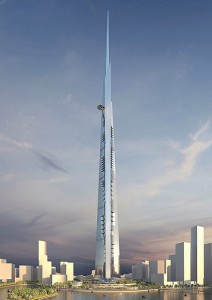
Kingdom Tower Jeddah copyright Adrian Smith+Gordon Gill Architecture

Kingdom Tower Jeddah copyright Adrian Smith+Gordon Gill Architecture

The Council on Tall Buildings and Urban Habitat (CTBUH) has released a study on the world’s 20 tallest buildings projected to be built by 2020. The Council introduced the term ‘megatall’ to describe buildings over 600 meters (1,968 feet) tall, which is twice the height of the previous superlative ’supertall’ buildings. Buildings that have been stalled and do not have a predictable completion date have been excluded from the study.

The 20 tallest megatall buildings, nicely lined up in the CTBUH’s infographic below, are:
1. Kingdom Tower, Jeddah: 1,000+ meters (3,280+ feet)
2. Burj Khalifa, Dubai: 828 meters (2,717 feet)
3. Ping An Finance Center, Shenzen: 660 meters (2,165 feet)
4. Seoul Light DMC Tower: 640 meters (2,101 feet)
5. Signature Tower, Jakarta: 638 meters (2,093 feet)
6. Shanghai Tower, Shanghai: 632 meters (2,073 feet)
7. Wuhan Greenland Center, Wuhan: 606 meters (1,988 feet)
8. Makkah Royal Clock Tower Hotel, Makkah: 601 meters (1,972 feet)
9. Goldin Finance 117, Tian Jin: 597 meters (1,957 feet)
10. Lotte World Tower, Seoul: 555 meters (1,819 feet)
11. Doha Convention Center and Tower, Doha: 551 meters (1,808 feet)
12. One World Trade Center, New York City: 541 meters (1,776 feet)
13. Chow Tai Fook Guangzhou, Guangzhou: 530 meters (1,739 feet)
14. Tianjin Chow Tai Fook Binhai Center, Tian Jin: 530 meters (1,739 feet)
15. Dalian Greenland Center, Dalian: 518 meters (1,699 feet)
16. Pentominium, Dubai: 516 meters (1,693 feet)
17. Busan Lotte Town Tower, Busan: 510 meters (1,674 feet)
18. Taipei 101, Taipei: 508 meters (1,667 feet)
19. Kaisa Feng Long Centre, Kaisa: 500 meters (1,640 feet)
20. Shanghai WFC, Shanghai: 492 meters (1,614 feet)

Interesting but not surprising to see that half of the projects are in China and that 70 percent of the buildings are in Asian countries that are low in available area and high in population density.

Even more interesting would be to see where the highest occupiable/usable floors land in the buildings.

As the study points out:

With every increase in height, there are energy implications in the construction, maintenance, and occupation of a building. Additionally, with added height comes less space efficiency, as structural members and service cores increase to service the increased height of the building. At what point are the significant benefits of increased density provided by building tall overtaken by the energy repercussions of height?

Image: copyright CTBUH

Start your week smarter with our weekly e-mail newsletter. It's your cheat sheet for good ideas. Get it.

Sun Joo Kim

About Sun Joo Kim

Sun Joo Kim was a contributing editor for SmartPlanet from 2011 to 2012.

Sun Joo Kim

Sun Joo Kim

Contributing Editor

Sun Joo Kim is an architect and creative consultant based in Boston. Her projects include design and master planning of museums, public institutions, hospitals, and university buildings across the U.S. She holds a degree from Carnegie Mellon University and is a member of the U.S. Green Building Council.

Follow her on Twitter.

Sun Joo Kim

Sun Joo Kim

Sun Joo is an independent architectural designer who contracts with design firms. She does not hold any investments in the companies she covers.

She writes for SmartPlanet and is not an employee of CBS.

If you liked this, don't miss...
2
Comments

Join the conversation!

Follow via:
RSS
+1 Vote
+ -
m
Ridiculous. All these "megatalls" would surface in countries with dwarf social / human profile. You are not counted tall by raising tall buildings but grooming tall people - intelectually , morally & socially.
Posted by maqbool.ilahi
5th Oct
+1 Vote
+ -
Infographic: The world's tallest buildings by 2020

Structural members and service cores reduce the space efficiency in tall buildings, specially, I'll assume, at the lower floors, to support all that weight.

I remember being in apartments at the Hancock building and the Lake Point Tower, both in Chicago, and the feeling of isolation up there (72 stories high the one in the Hancock and 27 at the Lake Point, that I knew) is so overwhelming that if you could open the windows you'll gladly jump to get rid of that feeling. Now imagine 300 floors... Awful.

Another thing, and most important, is the lack of natural light, specially when there are other tall buildings around.
But natural sunlight being such a primordial need and rental or purchase prices going up every so many floors, it's mind boggling to imagine the price of a penthouse (the only place to live in a tall building) in any of those buildings, and the monthly expenses!!

In a crowded environment the first 20 stories are in total darkness, with artificial light all the time.
Anyhow, there's nothing like a house with a swimming pool in the country.
Posted by David Traversa
Updated - 9th Oct
Join the conversation
Formatting +
BB Codes - Note: HTML is not supported in forums
  • [b] Bold [/b]
  • [i] Italic [/i]
  • [u] Underline [/u]
  • [s] Strikethrough [/s]
  • [q] "Quote" [/q]
  • [ol][*] 1. Ordered List [/ol]
  • [ul][*] · Unordered List [/ul]
  • [pre] Preformat [/pre]
  • [quote] "Blockquote" [/quote]

Join the SmartPlanet community and join the conversation! Signing up is fast and free. Don't wait -- we want to hear your opinion!