Follow this blog:
RSS

Using nuclear waste, PRISM reactor could power UK for 500 years

By | July 11, 2012, 5:30 PM PDT

The question of what to do with spent nuclear fuel has never been answered concisely. In spite of a number of creative ideas — including shooting radioactive material into space, sinking it in the ocean, or burying it beneath Nevada’s Yucca Mountain — there’s never been a surefire proposal that stuck.

A next-generation reactor, however, could pave the way. According to the Guardian, GE-Hitachi submitted plans to the UK’s Nuclear Decommissioning Authority Monday for a next-generation PRISM reactor that could run on nuclear waste.
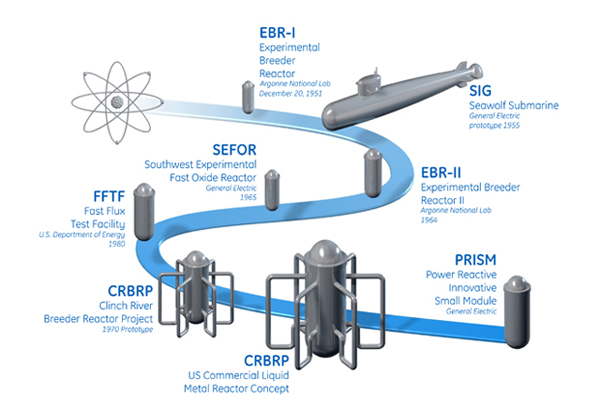
Photo via GE Energy

The evolution of nuclear energy. (Photo via GE Energy)

For Great Britain, a country whose stockpile of spent nuclear fuel now includes 110 tons of spent plutonium and 38,581 tons of spent uranium, the project has certain allure. According to David MacKay, the chief scientific advisor of the UK’s Department of Energy and Climate Change (DECC), this stockpile could be enough to provide the country with 500 years of low-carbon electricity.

For a nation roiling from an “unprecedented” fifth flood of the summer, and their potential link to climate change, it’s difficult not to imagine the benefits of a low-carbon solution. Producing 622 MW of electricity each year, the PRISM reactor could reduce Britain’s carbon footprint by an amount equivalent to the emissions of 700,000 automobiles. Yet, as analysis of the Fukushima Disaster reminded us, nuclear reactors — and the humans that regulate them — are far from flawless.

Even if the PRISM reactor is approved, it won’t be the first foray into nuclear fuel repurposing. In 2008, the UK spent $734 million on a “mixed oxide” (MOX) plant that failed to work. “It was a deeply embarrassing moment for the Government,” wrote Geoffrey Lean of the Independent.

The GE-Hitachi PRISM reactor hopes to avoid previous pitfalls by offering a completely different design and a unique funding structure. Rather than risking public funds to build the reactor, as happened with the failed 2008 venture, GE would have a private company build and run the facility.

While still in the proposal stages, the plan submitted by GE-Hitachi Monday offers a glimpse of what the future of nuclear energy might look like. By running on nuclear waste, the PRISM reactor deflates many of the criticisms, including waste and cost, lobbied by opponents like Ralph Nader’s nonprofit Public Citizen.

Whether it can defray safety, security, and reliability concerns, however, is yet to be seen.

[The Guardian]

Interested in Nuclear? Check out these recent articles by Mark Halper, SmartPlanet Contributing Editor on Energy and author of Emerging Nuclear Innovations: Picking global winners in a race to reinvent nuclear energy:

Start your week smarter with our weekly e-mail newsletter. It's your cheat sheet for good ideas. Get it.

Claire Lambrecht

About Claire Lambrecht

Claire Lambrecht is a contributing editor for SmartPlanet.

Claire Lambrecht

Claire Lambrecht

Contributing Editor

Claire Lambrecht is a freelance journalist based in Brooklyn, New York. She has written for the New York Times, Slate, Salon, Guernica and CBS MoneyWatch. Previously, she served as a Fulbright ETA and Teach For America corps member. She holds degrees from Cornell University and the University of Hawaii and is pursuing another from New York University.

Follow her on Twitter.

Claire Lambrecht

Claire Lambrecht

Claire does not have financial holdings that would influence how or what she covers.

She writes for SmartPlanet and is not an employee of CBS.

If you liked this, don't miss...
19
Comments

Join the conversation!

Follow via:
RSS
-1 Votes
+ -
Missing Something
Maybe I am missing something here but wouldn't you think if this idea was even close to reality, it would be cause for the whole world to celebrate not just the UK. I think it's just someones wishful thinking. I also think sending waste into space or burying it are not what I would call creative ideas.
Posted by man-rescue
12th Jul
+1 Vote
+ -
Yes, you are missing something
If you think this is wishful thinking, think again. This is well-proven technology, otherwise GE wouldn't be willing to build a first-of-a-kind power plant on their own dime. And yes, it is cause for the whole world to celebrate, because these reactors can produce all the energy humanity needs for hundreds of years with fuel that's already out of the ground.
Posted by Tom Blees
12th Jul
0 Votes
+ -
nuclear waste
Spent nuclear fuel still gives off heat, so is this how they intend to use it? Sellafield nuclear power station had a fuel reprocessing facility, which has now been closed down, I understand.
There is no mention in this article about the use of thorium, a safer alternative to uranium. However, due to man's incompetence, or unpredictable Nature, nuclear power is still a highly dangerous activity, whatever type is finally utilised.
Fusion power is probably still 30 years in the future. It has been in this situation for the last 50 years. An absolute fortune has been spent by various governments during this time, to try and achieve fusion: a so-called over-unity device! No wonder it hasn't happened.
Posted by kitemanmusic
12th Jul
0 Votes
+ -
Unedited Editor?
In one paragraph you link to Public Citizen's criticisms of nuclear energy and say that PRISM deflates those concerns, but in the very next paragraph you admit (while using the odd construction "defray") that PRISM has yet to prove that it can address precisely those concerns.

In the future you might want to edit your articles before you publish them.
Posted by msbook
12th Jul
0 Votes
+ -
Many vs.
Editing is important. That's why I used the word "many" in the first paragraph. Glad you have such an attentive eye though!
Posted by Claire_MN
12th Jul
0 Votes
+ -
More, please
In the past, there were concerns about breeder reactors because they transformed uranium into plutonium - the stuff bombs are made of. Although the plutonium is consumed as fuel, plant security would be an even bigger issue than it normally is. Does PRISM get around that? Or is security already as big an issue as it possibly can be, post 9/11?
Posted by theotherwill
12th Jul
+1 Vote
+ -
Security concerns
The PRISM reactors are intended to be used with a small fuel recycling facility on-site to service every cluster of PRISMs. Once uranium or plutonium enters the site, it would never come out, but would all be fissioned to create electricity. At no point in the entire fuel cycle is plutonium ever isolated. All materials with even the remote potential of being used in fission weaponry is always contaminated with sufficient highly radioactive material as to be not only useless for weapons but also too radioactive to handle except with remote handling equipment. Proliferation resistance is built in to the PRISM's design. You can read all about it in my book, Prescription for the Planet.
Posted by Tom Blees
12th Jul
0 Votes
+ -
This has been talked about for decades.
Nice to see someone actually trying it for a change.
Posted by JohnMcGrew@...
12th Jul
0 Votes
+ -
You can't win if you don't enter
I think the idea is a valid one and would like to see at least a working prototype. If it does work, then that could be the answer to a number of nuclear waste problems. I always did wonder why reactors didn't continue to use the rods until they're simply non-radioactive. That's a lot of energy going to waste in those storage pools.
Posted by Vulpinemac
12th Jul
0 Votes
+ -
Real or mischaracterized "nuclear waste"
The water-moderated reactors used today are incapable of fissioning all the long-half-life elements. PRISMs, though, can do that handily, enabling them to extract all the energy in uranium rather than the 0.6% now recovered in today's reactors (or 0.8% with the sort of reprocessing done in France, which is NOT a solution). But even with fast reactors there will be nuclear waste, because some of the elements you get from fission reactions are radioactive but not fissionable. Their half-lives, though, are far shorter. So the waste you'll get from a PRISM will only be radioactive beyond the levels of natural uranium ore for a few hundred years, and entombed in non-leaching glass or ceramic, thus solving the "million-year problem".

Several countries are working on this type of reactor and its all-important metal fuel system. The question is which country will be the first to demonstrate it. GE is making it easy for the UK to say yes with their risk-free proposal. Let's hope the country recognizes and grasps the opportunity to take the lead in this truly transformative technology.
Posted by Tom Blees
12th Jul
0 Votes
+ -
Rods in the pool are a small issue
60 to 80 % of all energy used on Earth is rejected or thrown away in effect. Gas coal electric utility nuclear depend for the most part on thermal cycles. The limiting factor is temperature and materials of construction. Check this out from Breeder reactor wiki "Breeder reactors could in principle extract almost all of the energy contained in uranium or thorium, decreasing fuel requirements by a factor of 100 compared to traditional once-through light water reactors. Conventional Light Water Reactors extract less than 1% of the energy in the uranium mined from the earth.[3] The high fuel efficiency of breeder reactors could greatly dampen concerns about fuel supply or energy used in mining. In fact, with seawater uranium extraction, there would be enough fuel for breeder reactors to satisfy our energy needs for as long as the current relationship between the sun and Earth persists, about 5 billion years at the current energy consumption rate (thus making nuclear energy as sustainable in fuel availability terms as solar or wind renewable energy)."
Posted by Altotus
19th Mar
-1 Votes
+ -
What about the Japanese experience?
Since Japan has had an experimental breeder reactor that has been in operation since the 1970s (Joyo), to say nothing about its troubled fast breeder reactor (Monju), this article seems more than a bit ethnocentric, especially since GE-Hitachi is the bidding entity.
Posted by hfw10027
13th Jul
0 Votes
+ -
Ethnocentric?
That's a rather bizarre charge to fling. Whatever Japan's experience with breeders, the PRISM is a different animal. Its use of metal fuel makes it unique among fast reactors built elsewhere, and is a crucial factor in its safety, fuel cycle simplicity, etc. No need to be PC here. Metal fuel has tremendous advantages over oxide fuel, making the PRISM superior to other breeders--including Japan's. That's not ethnocentric, it's just the way it is.
Posted by Tom Blees
Updated - 13th Jul
0 Votes
+ -
not many
you used "many" when you meant "two", and one of those (cost) was not clearly addressed in the article; also, to be more blunt this time, "defray" is simply the wrong word to use in that sentence. Otherwise a nice restatement of the Guardian article.
Posted by msbook
13th Jul
0 Votes
+ -
UK Closed down Successful FGast Breeder Programme in 1990's
Tony Blair eventually closed down the UK's successful Fast Breeder Reactor programme at the Dounreay Research Facility in Scotland.

20 years of engineering excellence and know-how has been wasted, all to appease environmentalists, and pursue a 'dash for gas' power stations.

https://en.wikipedia.org/wiki/Breeder_reactor
Posted by neil.postlethwaite@...
19th Jul
0 Votes
+ -
Is green really green?
Interestingly the environmentalist involvement is not consistent coal an oil are worse environmental problems.
Posted by Altotus
19th Mar
0 Votes
+ -
A pattern
Is this not what is going on around the world for some time now? Read wiki on breeder reactors.
Posted by Altotus
19th Mar
0 Votes
+ -
Thorium Reactors vs Uranium reactors
The US had a functioning thorium reactor at the Oak Ridge facility in 1968. This was shut down by the Nixon administration shortly after he took office.. What a shame. We had a 50 year lead on the future and blew it for political reasons, not for the good of our national energy interests.
Posted by Danhsays
7th Aug
0 Votes
+ -
Yes
Not just thorium but breeder reactors as well and the coal liquefaction plant was disassembled and its components sold by Regan. There is a clear bias in government about needed things the short answer could be energy interests but the possibility exists that it could be other like before WWII.
Posted by Altotus
19th Mar
Join the conversation
Formatting +
BB Codes - Note: HTML is not supported in forums
  • [b] Bold [/b]
  • [i] Italic [/i]
  • [u] Underline [/u]
  • [s] Strikethrough [/s]
  • [q] "Quote" [/q]
  • [ol][*] 1. Ordered List [/ol]
  • [ul][*] · Unordered List [/ul]
  • [pre] Preformat [/pre]
  • [quote] "Blockquote" [/quote]

Join the SmartPlanet community and join the conversation! Signing up is fast and free. Don't wait -- we want to hear your opinion!