Follow this blog:
RSS

The world’s largest urban farm, or not?

By | July 8, 2012, 3:45 PM PDT

Whether a manifest dream, a land grab, or a prophetic act, when John Hantz saw swaths of vacant land in inner-city Detroit he thought big. Really big.

He proposed paying a tenth of what the city wanted per acre to plant the world’s largest for-profit urban farm.

The controversy has been rocking Detroit ever since. Land sale needs formal approval from the city council and mayor - and urban farming policy needs a thorough re-articulation in general.

Finding uses for Detroit’s vacant land has been on top of the agenda for city government, residents, entrepreneurs, and community organizers for a long time.

Matthew Dolan of The Wall Street Journal writes, “This summer, a city commission plans public hearings on a zoning ordinance that would permit for-profit farming. That process will force Detroiters to confront awkward questions about their city’s development prospects. Among them: Is the abundance of vacant land an asset or a liability?”

The over 200,000 vacant parcels generate no significant tax revenue.

Mr. Hantz says,  Detroit “cannot create value until we create scarcity. Large-scale farming could begin to take land out of circulation in a positive way.”

But there are reasons long-time urban farming advocates question Mr. Hantz’s motivation.

“Hantz Farms officials acknowledge their self-funded venture would create few new jobs in the short term, and only modest revenue for Detroit,” writes Dolan.

Kwamena Mensah, who manages the seven acre nonprofit D-Town organic farm, says Detroit’s land should not be measured solely on its profit potential, but on “community-building, green spaces and places like this.”

The future of Hantz Farm is yet to be seen, but one thing is clear: community organizing is powerful.

Mr. Hantz did not approach the project using a community development model. Is that why his original proposal of 10,000 acres has dwindled to a mere 200 acres?

Let SmartPlanet know what you think. Should Hantz Farm be granted 10,000 acres, or will a more community minded solution be possible within Detroit’s politically fractured system?

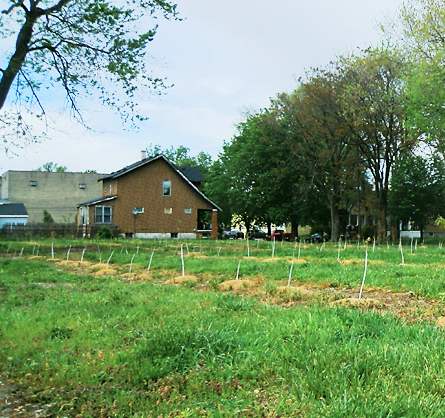
Hantz Farm three acre demonstration project

Images: Hantz Farm; hoklife

Via: Planetizen

Start your week smarter with our weekly e-mail newsletter. It's your cheat sheet for good ideas. Get it.

Rachel James

About Rachel James

Rachel James is a contributing editor for SmartPlanet.

Rachel James

Rachel James

Contributing Editor

Rachel James is a radio documentary producer and multimedia journalist based in Brooklyn, New York. She has worked with Radiolab and This American Life, contributed to WNYC's Talk To Me, Down East Magazine, KALW's Crosscurrents and the Third Coast International Audio Festival. She holds a degree from the University of Toronto and is a graduate of the radio program at the Salt Institute for Documentary Studies.

Follow her on Twitter.

Rachel James

Rachel James

Rachel does not have financial holdings that would influence how or what she covers.

She writes for SmartPlanet and is not an employee of CBS.

If you liked this, don't miss...
20
Comments

Join the conversation!

Follow via:
RSS
+2 Votes
+ -
Detroit Urban Farm
Perhaps one reason Detroit is in the position it is, is that they pay too much attention to community organizers. This proposal seems unique; are there others based on "community building" models? It seems there are no communities on vacant land. I must be missing something.
Posted by CadillacCatDave
9th Jul
+3 Votes
+ -
Depends
Since this farm will be in the middle of a residential area, I would guess that it depends on what type of farming is to be done. All fruits and veggies would seem OK, but if they are planning a hog farm or raising any other type of animals, I can see the neighbors not so happy about it. I live in suburban Detroit and some in the city are upset about an apple orchard being planted across the street from them!!
Posted by k8 br
9th Jul
0 Votes
+ -
Actually, it's oak trees
His first crop is oak trees, which would take about 10 years to get to the point where the wood could be harvested. Eventually, he might also plant fruit orchards and hydroponic vegetables. IMHO, planting fruit orchards is probably a reach, I don't think many varieties of fruit can mature each year in Detroit's relatively short growing season.

The Wall Street Journal had a good article on him at http://online.wsj.com/article/SB10001424052702304898704577479090390757800.html (paywall).
Posted by zackers
9th Jul
+2 Votes
+ -
short growing season?
Where did you get that idea? South east Michigan has a perfectly adequate growing season. Our growing season starts in April and continues well into october. This area is known to grow everything from corn to soybeans to pumkins, pickles and sugar beets. As well as several different types of melons including the very best cantalope you will ever have. We have MULTIPLE cuts of hay and straw during the spring summer and fall. Michigan is second only to Washington state in apples and is first in the nation for cherries.
Posted by roselaurel
16th Jul
+8 Votes
+ -
Time for a change.
The efforts of agenda driven community organizers supporting corrupt politicians helped put Detroit in the mess it finds itself today. Detroit is the apex of the politics of poverty.

Detroit is the crowning glory of President Johnsons Great Society plan. Community organizers fighting this proposal are like ticks dug into a dogs hide fighting removal. Simply parasites fighting to preserve their way of life.

This is a great time for Detroit to reinvent its self. The adults in the room need to step forward. There is so much vacant land in the city that it is time to throw out the old zoning map with its politics driven city plan and rebuild from scratch.

Even if they are not built for another 20 years, now is the time to place the train stations, bus stations, police, fire, schools and playgrounds to support future growth so that they can fix the mistakes of the past. Small neighborhood schools with minimal busing required, community police stations so everyone feels safe, local retail and commercial spaces setup around planned public transportation that takes the emphasis off cars. In general, a much better way of life.

The majority of the relative handful of salvageable homes and business buildings can relocated into consolidated Old Detroit neighborhoods to open up large tracks of vacant land while preserving the better parts of Detroits history.

At this point in the game it would be better to plant crops or trees instead of having vast tracks of urban wasteland. Long term the improved environment would drive up property values and allow for the gradual redevelopment of designated areas.

Under a realistic phased in plan you could be looking at an unrecognizable Detroit in just 20 years.

I say, give the 200 acres a shot and see what happens. It cannot be worse than what they have now.
Posted by Hates Idiots
Updated - 23rd Jul
0 Votes
+ -
Those are all good ideas...
...but first, the ticks need to be removed. The only question is whether the ticks can be starved or poisoned off the dog, or if we'll just have to wait for the dog to finish dying so that they'll finally jump off and go elsewhere.
Posted by JohnMcGrew@...
9th Jul
-3 Votes
+ -
Hates Idiots is a Troll
Please search articles on SmartPlanet and realize that "Hates Idiots" is a troll who always posits right/libertarian positions as a matter of politics, rather than talking about the science of the position presented. He/She also has a group that clicks "+" for his comments, so that they appear as the most accepted comments. His opinions are easily countered, but it's not useful to argue with him. Please simply note that he is a "smartplanet troll". If he, or his minions, appear again in other forms, please consider posting messages such as mine to subvert the propaganda of the right/libertarian, and force them to make sincere comments.
Posted by msbook
9th Jul
0 Votes
+ -
Yes, do that.
Ad hominem requires so much less effort than refuting such obviously bad arguments. I expect to see much of that in the coming months.

But I can sympathize with your frustration, considering what a failure the Progressive agenda has been for Detroit. It's not like you have much to work with.

Awaiting the negative vote, and the "troll" label.
Posted by JohnMcGrew@...
Updated - 9th Jul
+2 Votes
+ -
That the best you have to say? Calling me a troll.
You say my opinions are easily countered, yet you failed to counter a single one with anything more intelligent than name calling.

You make irrelevant political remarks about solutions offered to address real world problems while having no constructive alternatives to my thoughts.

Attacking people seems to be your only reason for coming to smartplanet. You appear to be the one trolling for a fight.

Apparently you are incapable of holding up your end of an intelligent discussion on the topic at hand. I will proceed alone.

While I have not always agreed with some people here, I have learned a great deal from many of them. I like to research quoted facts and dig to the root of an issue. I am open to learning new truths and adjusting my opinions to dynamic situations that often revolve around a constant learning curve.

Some people have made convincing arguments as to sway my opinion on some matters. I hope I have brought others to reassess a situation based on new information I have provided. When facts are exchanged, people learn. By studying a larger pool of facts, and weeding out the ideological drivel, mature people can usually find common ground on many topics.

The key is being able to acknowledge when the other persons facts are in fact correct.

In many situations BOTH of you can have your facts right.

As such it comes down to being able to accept that reality and figure out what it means in the big picture. Through it all it has become fairly easy to spot people making an honest argument based on the facts they have at hand compared to people sprouting propaganda and blind ideology. Honest people will review additional facts presented and present counter points where applicable. I have even found supporting evidence for the opposing view in an honest bid for the truth.

Intellectual and political pawns will simply discard facts in the course of a baseless, pointless counterattack.

You have proven yourself to be just another mindless drone incapable of independent thought. Lacking self thought, you find yourself fighting others solutions when your ideology lacks factual answers to a challenge. If I had to guess I would say you attack in a blind frenzy to support a system of corruption you likely benefit from. My guess is you are a tick in this discussion.

I have spent the better part of 30 years dealing with urban renewal issues and people like you. Be they transportation issues, loss of affordable retail or food stores, urban pollution, failing schools, or broken streetlights, I have always worked for appropriate long term solutions, politics aside.

Say what you wish, but in the end, people like you are part of the problem.
Posted by Hates Idiots
11th Jul
+1 Vote
+ -
MSBook is a Troll
Which of his comments above are not sincere? You are more of a troll than he is by not backing up your accusations with any evidence.
Posted by stevechri@...
14th Jul
+1 Vote
+ -
Are you sure?
I just read the post by Hates Idiots and I voted it up on its merits. I've never heard of Hates Idiots, this is my first visit here in a long time, and I was only the seventh up vote anyway. It doesn't sound to me like he marshalls some vast group of followers.
Posted by jeanmarietodd
17th Jan
+4 Votes
+ -
Non-problem
All over the country - publicly owned unused lands are leased on a season to season or five year lease basis to private farmers. Why is Detroit's problem any different? Leases allow the public owner short term income and long term options to change land use policy as the need arises. Incomes are probably lower than residential tax rates, but apparently Detroit's political leadership has yet to adapt to the reality of their political economics and related failure to sustain an economically viable community of business and the residents those businesses support. Perhaps it's not the land use income that's too low, but the bureaucratic expense that is too high?
Posted by dduggerbiocepts
9th Jul
-2 Votes
+ -
Mr. Idiots has it figured out...
"The efforts of agenda driven community organizers supporting corrupt politicians helped put Detroit in the mess it finds itself today."

Community organizers destroyed Detroit's industry by bringing better, more affordable cars from overseas.

Thanks for making me smarter....
Posted by Wallace Bob
9th Jul
+5 Votes
+ -
There was a time not so long ago...
...when most Americans wouldn't even consider a car from overseas. Most weren't any cheaper either. But since Detroit became complacent selling mediocre cars that people didn't want anymore those attitudes changed. If that foreign competition never existed, I'd shudder to think what we've be driving today.

Detroit did it to themselves.
Posted by JohnMcGrew@...
Updated - 9th Jul
+1 Vote
+ -
Key words Bob. helped put Detroit in the mess it finds itself.
There are a multitude of economic and political reasons for the failed industry in Detroit.

Ranging from the failure of the big three to produce a competitive product to unions who refused profit sharing plans while pushing for unsustainable pay scales to company management that were dumb enough to go along with them in the heady days of Detroits dominance of the auto industry.

Any reasonable person participating in an honest discussion on the topic of Detroit knows the complexity of the situation.

To say Community organizers destroyed Detroit's industry by bringing better, more affordable cars from overseas, in such a sarcastic manner, is simply idiotic and exposes you for what you are.

The point in this discussion is that community organizers are now opposing a proposal that would, in a noticeable manner, improve life in Detroit. They are the worst kind of hypocrites. In many cases their own actions over the past 3 decades failed to help the city manage the multitude of problems brought on by factors outside the city.

I have dealt with professional community organizers and for a brief period of time, I was a community organizer. Calling them ticks is a very accurate, yet polite way to describe them. Parasites is a broader, but some feel a cruder description.

They live off the misery of others. Honest long term solutions to urban problems would put professional community organizers out of work. That is why they oppose ideas like this. They support the politics of poverty that promote dependence on a corrupt system that includes them.

You have proven yourself to be yet another attack drone with no constructive comments for the discussion.
Posted by Hates Idiots
Updated - 12th Jul
+3 Votes
+ -
It's not that simple...
There is water, gas, sewer, and electricity going to each and every one of those vacant homes and vacant lots... Turning it into farm land requires removing that entire infrastructure as well as possibly replacing the bulk of the soil (most of it is contaminated by being buried under houses and streets)... So turning old neighborhoods into farmland may seem simple to the clueless, but it's not that simple, and would require a lot of destruction to an existing public infrastructure... Once said infrastructure has been destroyed, it would take public money to rebuild that public infrastructure in order to redevelop the land back into residential use. And where is the proposed new farm going to get water for irrigation? How will this impact the surrounding neighborhoods? Will this introduce breeding areas for new pests? Do the surrounding neighborhoods have mice, rats, roaches, etc that would migrate to farmland and breed while crops are planted and re-infest the surrounding neighborhoods once the crops are harvested? How much traffic would be generated by farm equipment? How would heavy semi trucks do on existing roads and how quickly would those big trucks destroy existing roads? There are a lot of things to consider and I just do see that happening in inner-city Detroit.
Posted by i8thecat4
9th Jul
+1 Vote
+ -
Why remove infrastructure?
Can't the water and gas lines be turned off or capped in some way if not used, without tearing anything out? And why are you so sure that farms have no need for water and gas lines? Not having to build out that kind of infrastructure would be a boon to a farmer. There are many ways to farm, by the way. You seem to be imagining row crops on the model of the rest of the Midwest. There are so many more ways to farm than that. Even 10,000 acres, if divided into smaller parcels, could use that kind of infrastructure because I doubt it would be simply turned over to range land or prairie. Hydroponics, greenhouses, aquaponics, milking parlors, cheesemaking or sausagemaking facilities, all kinds of farm buildings and operations could use power and water. Poultry can free-range on small plots if rotated. Raised beds with drip irrigation are pretty darned compact and productive, especially if combined with other smart permaculture practices such as composting and mulching and keeping animals to improve the soil. If you wonder where water for irrigation will come from, why would you want to tear out existing water pipes? Drip irrigation can be used with residential water systems. Let the farmer make these kinds of decisions, perhaps in consultation with the city.

I also don't know why the residential public must be segregated from farms, if the farms are well-run. That means no factory farming, no industrial-scale or approach to urban farming. Doesn't that go without saying? I'd love to live near a permaculture-type of urban farm. Farmers markets would be a big draw.

Rodents are a plague if you're storing a lot of grain, but that isn't a given. Again, depends on the type of farm.
Posted by jeanmarietodd
Updated - 17th Jan
-1 Votes
+ -
Why urban farms instead of real ones?
Mr. Hantz never makes a case for why his farms must be put inside of Detroit instead of farmland available elsewhere. Have property values in Detroit sunk to such low levels that urban land there is cheaper than good farmland?

Anyway, running large acreage over many small, widely separately plots of land is not going to be economical. And just try using fertilizers, herbicides, and pesticides in an urban environment next door to occupied houses.
Posted by zackers
9th Jul
+3 Votes
+ -
farming technology has improved
Don't assume the only viable way to farm is with the use of toxic fertilizer, herbicides and pesticides. Organic, biodynamic, permaculture and other farming systems build soil and air quality and improve habitat for wildlife as well as humans. Oh, and produce quality food, too. Small plots can be managed productively.
Posted by jeanmarietodd
17th Jan
+2 Votes
+ -
Technology has improved.
And Detroit has an opportunity to reinvent its self in a more sustainable image. Detroit could become the first major US city with more than half of its food grown locally. Farms with year round greenhouses could eliminate the need for much of the cities trucked in vegetables.

They have an opportunity to literally redesign huge parts of the city creating more parks and breaking up the urban sprawl with farm land.

Why are people like these community organizers so desperate to cling to the failed gritty urban image of Detroit? It failed.

Lets face it, the city is trashed. Why not start with a clean slate?
Posted by Hates Idiots
21st Jan
Join the conversation
Formatting +
BB Codes - Note: HTML is not supported in forums
  • [b] Bold [/b]
  • [i] Italic [/i]
  • [u] Underline [/u]
  • [s] Strikethrough [/s]
  • [q] "Quote" [/q]
  • [ol][*] 1. Ordered List [/ol]
  • [ul][*] · Unordered List [/ul]
  • [pre] Preformat [/pre]
  • [quote] "Blockquote" [/quote]

Join the SmartPlanet community and join the conversation! Signing up is fast and free. Don't wait -- we want to hear your opinion!