Follow this blog:
RSS

Are architects ruining cities?

By | September 23, 2012, 4:39 PM PDT

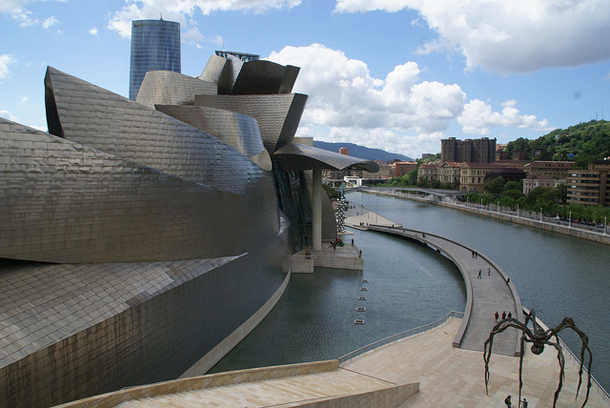
The Guggenheim in Bilbao, Spain. (David Baron/Flickr)

The Guggenheim Museum in Bilbao, Spain, was designed by Canadian-American architect Frank Gehry. (David Baron/Flickr)

It wouldn’t be a stretch to say that we live in an age of architecture. In our time, architects like Bjarke Ingels inhabit a space akin to movie stars — and more and more they’re being played by them. It’s difficult to watch a mainstream movie these days — Inception, (500) Days of Summer, or It’s Complicated — without being slightly enchanted by a sensitive architect.

This infatuation with urban design isn’t unexpected. As Alan Ehrenhalt pointed out in his recent book The Great Inversion, we’re living in a moment where the suburban values of the Baby Boom generation are being supplanted by a revived interest in urban life. In this dialectic between world views, the architect arrives as the patron saint of the suburban kid born again as an urban resident.

According to Jonathan Meades, however, this needs to stop.

Meades, a British writer who covers food, architecture, and culture, for The Guardian charged in his Sept. 18 column that architects shouldn’t be the ones defining cities at all:

“Architecture, the most public of endeavours, is practised by people who inhabit a smugly hermetic milieu which is cultish. If this sounds far-fetched just consider the way initiates of this cult describe outsiders as the lay public, lay writers and so on: it’s the language of the priesthood. And like all cults its primary interest is its own interests, that is to say its survival, and the triumph of its values – which means building.”

This attitude, Meades writes, instills in architects a lack of empathy for regular people — the ones who end up living and working inside Art Nouveau or Modernist buildings long after the architect has moved on to better climes.

Meades’ other complaint against architects involves the architect’s relentless pursuit of perfection:

“Another cause of failure is their bent towards aesthetic totalitarianism – a trait Nikolaus Pevsner approved of, incidentally. There was no work he admired more than St Catherine’s College, Oxford: a perfect piece of architecture. And it is indeed impressive in an understated way. But it is equally an example of nothing less than micro-level totalitarianism. Arne Jacobson designed not only the building, but every piece of furniture and every item of cutlery.”

While this pursuit of perfection results in visually-stunning spaces, Meades, for one, would much prefer the wasteland of the Lea Valley in East London to the Lea Valley Regeneration Strategy that turned the area into a playground for the 2012 Summer Olympic Games.

“The human ideal is to revel in urbanistic richness,” Meades said, “in layers of imperfection.”

Far from stifling human imagination, imperfection emboldens it, Meades argues. Nor is Meades alone in this perspective. Canadian writer Margaret Atwood voiced a similar affection for the moments when suburban perfection gives way to disorder in her 1998 poem “The City Planners”:

“the smell of spilt oil a faint
sickness lingering in the garages,
a splash of paint on brick surprising as a bruise,
a plastic hose poised in a vicious
coil; even the too-fixed stare of the wide-windows
give momentary access to
the landscape behind or under
the future cracks in the plaster
when the houses, capsize, will slide
obliquely into clay seas, gradual as glaciers
that right now nobody notices.”

Where does that leave us? Somewhere, it seems, between the untamed wild of the subway system and the flicker of the Chrysler building, winking on the horizon.

[The Guardian]

What’s your view? Are architects an elite guild bringing order to our cities, or perfectionists curbing serendipity? Join the conversation below:

Start your week smarter with our weekly e-mail newsletter. It's your cheat sheet for good ideas. Get it.

Claire Lambrecht

About Claire Lambrecht

Claire Lambrecht is a contributing editor for SmartPlanet.

Claire Lambrecht

Claire Lambrecht

Contributing Editor

Claire Lambrecht is a freelance journalist based in Brooklyn, New York. She has written for the New York Times, Slate, Salon, Guernica and CBS MoneyWatch. Previously, she served as a Fulbright ETA and Teach For America corps member. She holds degrees from Cornell University and the University of Hawaii and is pursuing another from New York University.

Follow her on Twitter.

Claire Lambrecht

Claire Lambrecht

Claire does not have financial holdings that would influence how or what she covers.

She writes for SmartPlanet and is not an employee of CBS.

If you liked this, don't miss...
2
Comments

Join the conversation!

Follow via:
RSS
0 Votes
+ -
What about those who hire the architects?
Don't they bear any responsibility? The architect can't do a thing if his/her project does not get approved and funded.
Posted by JohnMcGrew@...
24th Sep
0 Votes
+ -
The perils of the omnipresent potato...
Though I am not in total disagreement with the author, having endured the cult of architectural reason myself for three decades now, the true argument here is the inappropriate application of Modern principles in the overtly historical culture of Britain.

Architecture is a profession and all professions have their own language. What is challenging about architecture is the people inhabit the results as opposed to merely gazing upon it and casting judgements. Architecture is both an object and a cloak and as such, it necessarily asserts itself into the lives of its contemporaries super-saturated with the values and the best skills and understanding of the designer.

Historians have often been told that they have no product, merely a forked tongue and a biased pen! To create a space that appeals to the clients subjective and functional needs as well addresses the ideal solution for a city is incredibly difficult. The integration of structure and services and maintaining the design intentions though to the maiden voyage is even more difficult. The most notable architects have abandoned seeking to do so and are hired for their own language rather than what the clients wants. In my many years in this profession, I can tell you that clients rarely have any cohesive idea what they want, and, they rarely admit that!

Lastly and more to the point, an era of 'special' architecture is now about 25 years old and it borrows from a true literary cult known as Deconstruction. This persists as a reaction to the bindings of history because there are people in this world who recognize that historical continuity is not mandatory and not always desired. The character of stonewalled spaces is compartmentalization that was liberated by the I-beam and plate glass and from this point forward, history was an option sustained only by cultural preference. I am not surprised by this author's discomfort though as my late aunty from Essex said when I asked her why the Brits have potatoes with every meal, looking rather confused and concerned she said, "What else is there?" If you gotta ask aunty, you are not a Modernist.

British Modernism is an oxymoron! The American venue champions blatant individualism. Dare anyone step forward and claim which is, um, better! A culture without much of their own history must express themselves too!
Posted by BLINKdesign
Updated - 24th Sep
Join the conversation
Formatting +
BB Codes - Note: HTML is not supported in forums
  • [b] Bold [/b]
  • [i] Italic [/i]
  • [u] Underline [/u]
  • [s] Strikethrough [/s]
  • [q] "Quote" [/q]
  • [ol][*] 1. Ordered List [/ol]
  • [ul][*] · Unordered List [/ul]
  • [pre] Preformat [/pre]
  • [quote] "Blockquote" [/quote]

Join the SmartPlanet community and join the conversation! Signing up is fast and free. Don't wait -- we want to hear your opinion!