Caribou Coffee pioneer swaps espresso for pizza

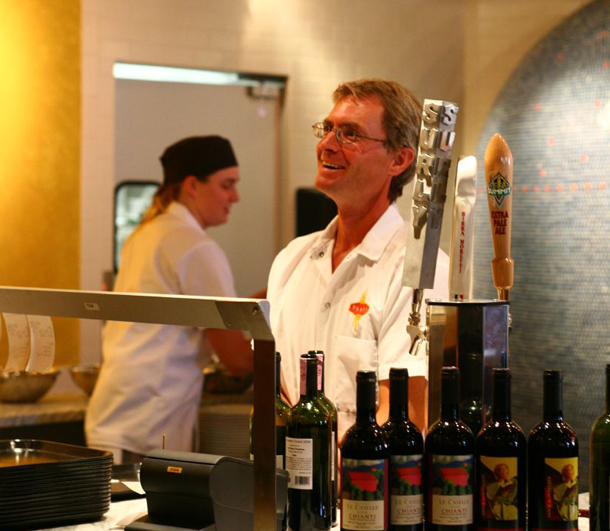
John Puckett’s advice to budding entrepreneurs is simple. “Do it,” he says, from across the table at Punch Pizza, one of the newer additions to “Nordeast” Minneapolis, originally a blue-collar neighborhood known for a Grain Belt Beer brewery, Kramarczuk’s Deli, and a 62-year-old polka bar.
Bespeckled with an unassuming air, one wouldn’t automatically expect that Puckett was part of the founding duo behind Caribou Coffee Company (NASDAQ CBOU). Caribou, the nation’s second-largest coffee chain, will celebrate its 20th anniversary in December. Contrary to the business leaders who steal headlines, Puckett carries himself like the family doctor he might have become had he not launched an enterprise with sales that now exceed $330 million.
“I’d tell someone that’s young or old, entrepreneurs aren’t crazy people that jump out of airplanes and want risk,” Puckett said, echoing the “margin of safety” wisdom of Benjamin Graham’s Security Analysis. “Actually, the successful ones are very risk averse. They do their homework. They do their analysis. They make sure that the odds are stacked in their favor.”
Puckett and his wife Kim, both graduates of the Tuck School of Business at Dartmouth, clearly did their homework with Caribou. Tired of corporate life at Bain and General Mills respectively, the pair tossed around ideas for a bagel bakery, a brewery, and a fish farming operation before opening the first Caribou Coffee store in Edina, Minnesota, in 1992.
Building a coffee company was far from easy. Few people thought swapping steady jobs for a coffee press made practical sense, Puckett explains, especially with players like Starbucks and The Coffee Connection (purchased by Starbucks in 1994) already in the space.
What’s more, even though he and his wife selected the Minnesota market to avoid competing with Starbucks, it wasn’t long before the twin-tailed mermaid arrived. “Everybody thinks of Starbucks as this wonderful company, and they really are, but they’re tough as nails too,” Puckett said, offering praise of Starbucks founder Howard Schultz.
For the entrepreneurial pair, however, competition with a major coffee brand required extra effort. When Starbucks snatched the lease to the IDS Tower Crystal Court, what Puckett called the “crown jewel” of rental property in Minneapolis, Caribou responded in kind. “A lot of the war gets fought in real estate,” Puckett said. When negotiating new deals, the Pucketts emphasized their local roots, telling owners, “Hey we’re a local husband and wife and they’re coming from out of town.”
Dominating the local market was integral to Caribou’s success, Puckett said. “If you’re going to build a significant business, you have to dominate your home turf.” That effort is still visible in the Twin Cities: one of the few metro areas in the world that bests Starbucks in terms of unit count.
After a successful run, the Pucketts exited their share of Caribou in 2000 for $83.8 million. Shortly thereafter, the pair changed courses – figuratively and literally – swapping espresso for pizza.
While espresso and pizza appear to be totally different industries, the pair share a Neapolitan pedigree. “They’re deadly serious in Naples about their espresso,” said Puckett, “They’re deadly serious about pizza too.”
To get started, Puckett and his wife purchased a 50 percent stake in a local upstart Punch Pizza: a growing business producing authentic Neapolitan pizzas that Meryl Streep once described as the “best pizza” she ever ate.
“When we looked at things to do after we sold Caribou coffee, this kind of pizza that was homegrown in St. Paul, Minnesota, looked like it was a great thing to bring to more people,” Puckett said.
Punch Pizza is far from a novelty project. Opening a single store requires building a pizza oven that will heat to over 800° F, per the standard set by the Associazione Vera Pizza Napoletana, of which Punch is a member. Training a pizza chef, known as a pizzaoli, is perhaps the greater challenge. “Punch is a much more difficult operation than coffee,” Puckett said. “It takes several years for a pizza cook to get good. We realized we couldn’t grow faster than our ability to train people internally.”
Yet for the Puckett’s, the high standards of Neapolitan pizza weren’t just a challenge; they’re also provided Punch with a competitive edge. “Big companies get stale, they get bureaucratic, they lose their edge,” said Puckett. “The bean counters and the marketing people at Domino’s, Papa John’s, Pizza Hut: now they’re in a price war and it’s a delivery business, not a quality business.”
Rather than building a national brand, Puckett said he was much more interested in getting the fundamentals of the business correct. “My model companies are more like In-and-Out Burger on the west coast: family-owned, slow and steady growth, grow through cash flow, open new stores not by leveraging your company to the hilt or raising equity,” he said.
Punch’s take on high-quality food made quickly – what the industry calls “fast casual” – is in line with consumer demand. As Wall Street Journal reporter Julie Jargon noted Oct. 10, restaurant chains that exemplify this trend such as Chipotle Mexican Grille or Panera Bread not only weathered the economic downturn; they’re also maintaining market share better than traditional fast food chains. According to The NPD Group, a market research company, visits to fast-casual restaurants increased by seven percent in the year ending in Sept. 2012 compared with an industry average of one percent growth in visits.
“Fast casual concepts are in an excellent position for growth relative to the overall industry,” says Bonnie Riggs of The NPD Group. “Successful fast casual concepts are meeting the needs of today’s restaurant consumers by offering fresh, high-quality food at a price consumers consider a value. The segment is benefiting from fast food consumers trading up and full service consumers trading down.”
Seriousness about quality doesn’t mean a serious price tag. “People are still spending money,” said Puckett. “But instead of spending $100 to go out, they’re spending $20 to go out. I don’t think Americans are cooking more, necessarily. They’re just making different choices.”
Fortunately, for Puckett, those choices increasingly include basil, mozzarella di bufala, and San Marzano tomatoes cooked, for just 90 seconds, at 800° F.
This post was originally published on Smartplanet.com