Follow this blog:
RSS

Solar farm providing only intermittent power? Add a small nuke!

By | December 13, 2012, 4:30 AM PST

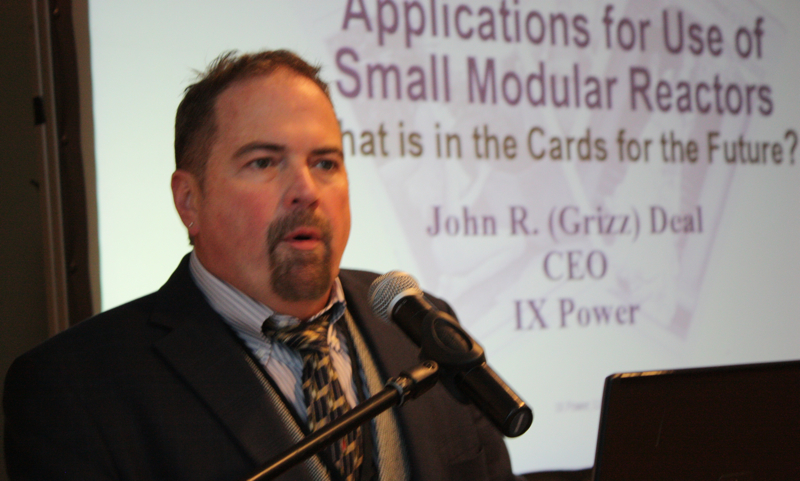
Small talk. Grizz Deal outlines benefits of small reactors. Among them: cohabitation on renewable energy sites, to provide 'baseload' power.

WARSAW - Many energy experts believe there’s a big future for small nuclear reactors. By shrinking today’s behemoths, manufacturers could inexpensively produce them in assembly line style and transport them on trucks. Utilities could add capacity in smaller, affordable fragments. Remote areas could deploy them in place of CO2-intense diesel generators. Industry could use them as carbon-free industrial heat sources.

At a nuclear conference in Warsaw this week, Colorado-based small modular reactor (SMR) proponent John Grizz Deal added another benefit: SMRs could cohabit on renewable energy farms where they would provide steady round-the-clock electricity, filling the supply gaps associated with intermittent wind and solar power.

“I think that small reactors can provide baseload for so-called renewables,” Deal said in a presentation at the World Nuclear Power Briefing Europe 2012, noting that at least two U.S. utilities are investigating the possibility of putting small reactor on renewable energy sites.

SUNSHINE AND NUCLEAR

“There’s actually a couple studies being done, one by Pacific Gas and Electric in California, and one by Florida Power & Light, as a way to beef up their renewable program,” said Deal, who is the co-founder of Denver-based SMR pioneer Hyperion Power Generation - now called Gen4 Energy -  which is developing an SMR based on technology from the U.S. Department of Energy’s Los Alamos National Laboratory.

Conventional, large nuclear power plants have a capacity of over 1,000 megawatts. Small reactors in principle have a wide range from around 10 megawatts to around 300. Solar farms range from tens of megawatts to hundreds; a few are planned at over 1,000 megawatts.

“Obviously, putting a smaller, modular reactor on an existing nuclear site makes a lot more sense than starting from scratch. We’ll have to see how that goes.”

Deal left Hyperion about two years ago and is now CEO of IX Power, a Denver-based clean water company. While at Hyperion, he advocated using SMRs to help power water desalination.

The U.S. DOE is providing $450 million in matching funds to SMR developers. It recently made its first grant in that program, to a consortium led by Babcock & Wilcox.

Nuclear combined with renewables could offer a potent low-carbon energy tandem. Leaders of the nuclear and renewables industries recently joined forces (along with the head of a carbon capture and storage group) in the UK to encourage Energy Secretary Ed Davey to legislate low carbon measures.

Photo of Grizz Deal by Mark Halper.

Story updated around 7:20 p.m. PST to add information about British nuclear/renewable team.

More from the small world of nuclear, on SmartPlanet:

Another nuclear/renewable combo:

Start your week smarter with our weekly e-mail newsletter. It's your cheat sheet for good ideas. Get it.

Mark Halper

About Mark Halper

Mark Halper is a contributing editor for SmartPlanet.

Mark Halper

Mark Halper

Contributing Editor

Mark Halper has written for TIME, Fortune, Financial Times, the UK's Independent on Sunday, Forbes, New York Times, Wired, Variety and The Guardian. He is based in Bristol, U.K.

Follow him on Twitter.

Mark Halper

Mark Halper

Mark has no financial holdings in the companies he writes about. He occasionally travels at the expense of companies or their press relations agencies in order to report on a company or industry event related to it; Mark will prominently disclose this information when appropriate. This relationship will have no influence on his coverage. Companies he covers do not get to review columns in advance, or select or reject topics.

He writes for SmartPlanet and is not an employee of CBS.

If you liked this, don't miss...
9
Comments

Join the conversation!

Follow via:
RSS
0 Votes
+ -
Small, modular nuclear is an option to be looked at.
But cost effective power storage methods to help balance the supply between peak production and peak usage, which are not always the same times, is probably the safest long term option compared to nuclear.

I have seen a few proposals to produce ammonia with excess power at hydro dams, but I am not aware of it going into production anywhere. The ammonia is supposed to be easier and more energy efficient to produce than pure hydrogen. Supposedly it burns nearly as cleanly to produce power during low water or peak power demand times.

Wind farms at sea, like Cape Wind off Massachusetts, might be able to do something like it at a shore based facility where the power would come ashore.

Someone should consider doing a proof of concept in Scotland.

They have a grid problem where over a dozen coastal wind farms are paid by the taxpayers NOT to produce power on the best days they can produce power on. It is insane they are shutdown at the exact time when they should be producing peak power output.

It seems it might be more cost effective for the taxpayers if the government took some of that money to fund an on site ammonia/hydrogen plant to be powered on those peak days. The energy and the taxpayers money would not be wasted paying wind farms not to produce power.

It would also help improve the ROI on wind farms.

http://www.bbc.co.uk/news/uk-scotland-13253876
Posted by Hates Idiots
Updated - 13th Dec
+4 Votes
+ -
Expensive small nukes to supplant expensive solar?
Seems to me that if you need to go to the expense and trouble of investing in a "small nuke" to make up for the deficiencies of solar, you might as well just rely upon the nuke and dispense with the solar! Most of the cost of running a nuke isn't the fuel, but the investment and maintenance of the hardware. If you are already making that investment and it's capable of providing reliable power running 24/7, why bother with solar at all?

Again, if we're going to invest in anything, it needs to be the storage technology. Otherwise, we'll keep getting inefficient and silly solutions like this.
Posted by JohnMcGrew@...
Updated - 13th Dec
+2 Votes
+ -
Nukes + Green Energy?
Since large scale solar and wind energy installations are normally in remote places due to their scale and are ideally unattended due to their locations, placing a small nuclear device in their vicinity will surely mean that they then will need security precautions in place too? That will add cost to their maintenance, not to mention to their future de-comissioning at some point.
Posted by peter.bessey@...
13th Dec
+2 Votes
+ -
Small nukes
The words small NUKES tends to put people on the guard from the beginning. Are we talking Thorium plants, or the older type plants? How expensive will this be? If thorium can be proven then it 'might' work out. I have wondered if thorium reactors could be teamed with wind in reclamation projects for old strip mine sites, such as in W.Va.. These sites have some infrastructure already, such as roads, rail lines, and high power lines. Instead of just ripping them out or letting them rust in place, use them for a profit. The money has already been spent, getmore retun on it. Investors would like that, and it would lead to some jobs for the surrounding population. The power generation would pay for the maintenance of the remaining infrastructure. Also, the reactors could power coal to gas conversion projects to support the coal industry instead of just letting it wither and die. The Chinese have already floated the idea of using thorium plants to do this to make coal a clean fuel, I think we could do it more cheaply by doing it in the same area were it's mined with what we have already built.
Posted by garyfizer@...
13th Dec
0 Votes
+ -
two bad words
Nuclear and Uranium are two words I no longer use when discussing Thorium Energy. I realize that U-233 is the fission energy, but I just say thorium is a replacement for uranium mining and waste disposal and molten salt reactor is a replacement for today's large reactor facilities. SMR doesn't explain the type of reactor it is. Also, I agree with others that it makes no sense to invest in SMR and renewable at the same location.
Posted by kralspaces
Updated - 16th Dec
0 Votes
+ -
what a bad idea!
what a bad deal, Grizz.
what's next a mini-nuke to back up the car battery?
Posted by affordablecomputerguy@...
13th Dec
+1 Vote
+ -
I think this line of thinking is a good indication...
...of how out-of-whack the anti-carbon agenda has become. They're so invested in the idea of "free" energy like solar, they they'll go to amazingly absurd lengths to make it work. The upside is that they might actually stumble upon a better solution on the way that will make solar panels by themselves look like a total waste of resources and time.
Posted by JohnMcGrew@...
14th Dec
+1 Vote
+ -
Wind turbines...
have been around since the 1970's in CA and they still don't have a load balancing grid. I see that Germany has the same problem as Scotland with their turbines off the coast.
Posted by kralspaces
16th Dec
+1 Vote
+ -
Mixing reliables and unreliables
As John McGrew points out, it's ridiculous to mix the two and throttle back the nuclear plant when the sun shines. What's the point? If gas or coal is being used to provide power, then there is some fuel saving to be considered by teaming it up with solar or wind, though since such cycling causes them to run more inefficiently the supposed fuel savings are often overstated. But with nuclear the fuel isn't an issue, even less so once fast reactors are burning waste, which has a negative cost aside from the small cost of converting it into fuel bundles. Replacing coal and gas-fired power plants with nuclear won't just make those fossil fuels obsolete. It'll make wind and solar obsolete as well, because we'd have sufficient mainly nuclear generating capacity to meet peak demand (as we do today primarily with fossil fuels). But peak demand is 2-3 times average demand, meaning we'd have as much (or up to twice as much) excess power as is required to power our entire grid. Since fuel cost is trivial, we can let them run at full power 24/7 and use the excess to make hydrogen (and, from that, ammonia), desalinate water, or produce process heat for various purposes. By the way, Hates Idiots, ammonia isn't cheaper to produce than pure hydrogen. You first produce the hydrogen via electrolysis of water, then you mix it with nitrogen from the air to make ammonia (NH3). This process, by the way, requires temperatures of 450 C. Fast reactors have outlet temperatures of about 500-550 C, so they would be ideal for this purpose. You also wrote: "I have seen a few proposals to produce ammonia with excess power at hydro dams, but I am not aware of it going into production anywhere." It has indeed been done. The Vemork hydroelectric power plant in Norway used to produce most of Europe's ammonia. By the way, ammonia doesn't burn "nearly as cleanly" as pure hydrogen. If you keep the combustion temperature below 1,300C, the only products are atmospheric nitrogen (N2) and water. Clean as a whistle.
Posted by Tom Blees
Updated - 18th Dec
Join the conversation
Formatting +
BB Codes - Note: HTML is not supported in forums
  • [b] Bold [/b]
  • [i] Italic [/i]
  • [u] Underline [/u]
  • [s] Strikethrough [/s]
  • [q] "Quote" [/q]
  • [ol][*] 1. Ordered List [/ol]
  • [ul][*] · Unordered List [/ul]
  • [pre] Preformat [/pre]
  • [quote] "Blockquote" [/quote]

Join the SmartPlanet community and join the conversation! Signing up is fast and free. Don't wait -- we want to hear your opinion!