Follow this blog:
RSS

Nuclear: Less CO2 than solar, hydro, biomass

By | February 19, 2013, 6:31 AM PST

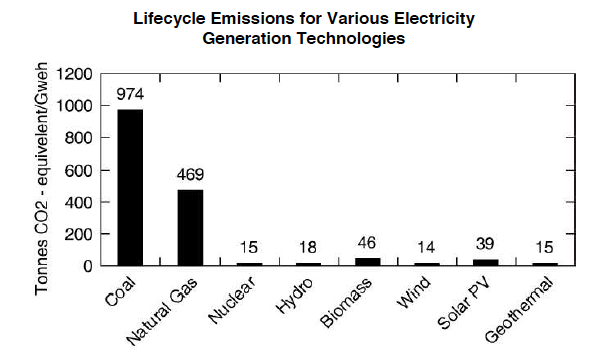
Bottom of the chart. In a life cycle analysis, nuclear power is among the lowest of all forms of electricity generation in CO2 emissions.

There is no such thing as completely “green” energy. All forms of electricity generation have some detrimental environmental impact - some relatively little, some enormous.

One of the most closely watched effects is emissions of carbon dioxide - the sort of thing that makes fossil fuels like coal and natural gas notorious.

Levels of CO2 in the atmosphere are linked to rises in Earth’s temperature, and thus to global warming, climate change and all that. Fossil fuels belch plenty, as the chart above shows. It illustrates how many tonnes of CO2 are emitted per gigawatt hour of electricity generated by different generating technologies.

The chart is a “lifecycle” analysis that takes into account CO2 emitted not only during electricity generation, but also by the mining, manufacturing, construction and other processes it takes to get a power plant up and keep it running.

Richter scale. Nobel physicist Burton Richter points out that nuclear power is well down the list of CO2 emitters, below biomass, solar and hydro, and on a par with wind and geothermal.

It’s no surprise that coal and natural gas tower above the others. But some of the other marks might raise a few eyebrows. “Renewable” power sources solar PV and biomass are both more CO2-intense than nuclear, as is hydro. Nuclear is on a par with geothermal, and virtually the same as wind.

The chart was presented earlier this month by Nobel-winning Stanford University physicist Burton Richter, at a “Science Day” hosted by French utility EDF in Sausalito, Calif. It’s not new - it was first put together by a group of PhDs from the University of Wisconsin in 2002. But its findings still hold true (note, however, that it does not include “tidal” or “solar thermal” - I’d be interested to see those and others added to the comparison).

Alex Cannara, an independent energy and environment analyst based in Menlo Park, Calif, wrote an articulate comment after a recent Bloomberg story about nuclear power, in which he explains the spirit and to a large extent the letter of what Richter’s presentation shows. Bloomberg had written that nuclear power is all but finished in Europe, quoting a Paris-based consultant saying that nuclear is “too capital intensive, too time-consuming and simply too risky.” Here’s Cannara’s rebuttal:

Hope they didn’t pay this ‘consultant’ much for:  “Nuclear is too capital intensive, too time-consuming and simply too risky.”

Germany thinks it’s ok to emit tens of mega-tons more of CO2 because they like coal & ligniite better than nuclear?  Remind us how many Germans have died from nuclear-power radiation.  What about Americans?  English?  French?  Oh yes, all zero.

Whoever wrote the advice above seems ok with the deaths and disease from combustion, mining, etc. — all things needed for windmills, by the way.

So when we see German coal & gas burning costing ~180 years of human life per TW-hour, we should say that’s ok, despite German nuclear costing less than 1/6 those years of life?  Really?

Remember, making 1 large Siemens windmill requires processing about 2000 tons of materials via fossil fuels — steel needs coal and iron ore, etc.  Concrete needs kilned limestone & mined/crushed aggregate., etc.  So the emissioins burden of wind is higher than nuclear.  And we’re not even talking about the vast tracts of land/sea taken for wind.  Nor are we talking about species threats, maintenance emissions, worker dangers, and even maritime dangers for offshore windmills.

And here we thought the Germans the smartest — must have been some PR, or the beer.
;]

Cannara’s valid points hold up even more when you take into account the alternative nuclear technologies that could replace the conventional variety that has been operating for 50 some years. Reactor designs like molten salt, pebble beds and fast reactors augur a number of advantages including the conversion of nuclear “waste” into fuel, the reduction of long lived dangerous waste, failsafe meltdown-proof opeations and others. So could the use of thorium fuel instead of uranium. And the dream of fusion power is achievable.

Safe nuclear power, as well as other sustainable energy technologies, all belong in the future of a CO2-light economy.

Images: Chart is from Burton Richter via University of Wisconsin. Photo from Burton Richter/NSF via Wikimedia.

A chain of nuclear links on SmartPlanet:

Want more? Click here

Start your week smarter with our weekly e-mail newsletter. It's your cheat sheet for good ideas. Get it.

Mark Halper

About Mark Halper

Mark Halper is a contributing editor for SmartPlanet.

Mark Halper

Mark Halper

Contributing Editor

Mark Halper has written for TIME, Fortune, Financial Times, the UK's Independent on Sunday, Forbes, New York Times, Wired, Variety and The Guardian. He is based in Bristol, U.K.

Follow him on Twitter.

Mark Halper

Mark Halper

Mark has no financial holdings in the companies he writes about. He occasionally travels at the expense of companies or their press relations agencies in order to report on a company or industry event related to it; Mark will prominently disclose this information when appropriate. This relationship will have no influence on his coverage. Companies he covers do not get to review columns in advance, or select or reject topics.

He writes for SmartPlanet and is not an employee of CBS.

If you liked this, don't miss...
29
Comments

Join the conversation!

Follow via:
RSS
-2 Votes
+ -
Oxymoron
"Safe nuclear power" is as much an oxymoron as "clean coal technology". While it's possible that both are within the capabilities of present human technology, we are no where near either, and until we are, it's a mistake to use such methods!
Posted by omb00900@...
19th Feb
+1 Vote
+ -
Safe Nuclear
Safe nuclear is achievable, and orders of magnitude cheaper than fixing the problem of arresting and turning back CO2 emissions. Clean Coal is not, as Industrial Carbon and Storage is ferociously expensive, unproven bonkers hokum.

However, to achieve the aspired goal goal of Carbon Capture and storage, I would propose a UN Treaty to plant 1natures carbon capture engine of 10 trillion tree's, by 2050, or support other initiatives like the Sahara Forest Project.
Posted by neil.postlethwaite@...
19th Feb
+3 Votes
+ -
It all depends on your point of view.
The current political consensus is that it's carbon, and not radiation that is the big evil, despoiler and ultimate threat to the environment. If that is indeed the case, then nuclear is the superior technology. Sorry.

I don't think people clearly appreciate the resources that will be required to cover every building in the country with "green" solar panels. The raw materials have to come from somewhere, as well as the energy required to transport and process it all, deliver it and then install it. And then, how long will they last in actual use before being again replaced?

There is no free lunch.
Posted by JohnMcGrew@...
Updated - 19th Feb
-1 Votes
+ -
Scientific Consensus
I think you mean weight of scientific consensus, is that Carbon emissions are a primary likely source, though nature is adaptable and has been through turmoil before.

Frugality, energy security and conserving natural resources for the good of future generations should be the goal of all and not burning gas/petrol at 10MPG because you can in a giant SUV/Truck - swelling the wallets of many brutal regimes or greedy corporations/commodity traders/banks around the world - where a 2.0L Turbo Diesel powered station Wagon or small SUV/Truck is more than anyone ever really needs.
Posted by neil.postlethwaite@...
19th Feb
-1 Votes
+ -
Perhaps...
...but then again, the "solar vs nuclear" debate has absolutely nothing to do with what we drive, now does it?

And no, I meant what I said: As long as the those within the "scientific community" continue to behave politically, I won't call what they've achieved a "scientific consensus".
Posted by JohnMcGrew@...
Updated - 19th Feb
-1 Votes
+ -
Nature is adaptable in the long run
But how adaptable to accelerated change key holocene ecosystems, and large semi-civilized human populations, might be is a matter of some debate. Agreed with the rest though.
Posted by AJ523
21st Feb
0 Votes
+ -
Not Just Carbon
Even if global warming were completely ignored, fossil fuels are orders of magnitude worse than nuclear (near-universal scientific consensus). Their (non-CO2) pollutants cause hundreds of thousands of deaths per year, versus no measurable impact from nuclear. Even in terms of radiation, coal plants have emitted far more into the environment than nuclear.

It is clear that "radiation" associated with nuclear power is not a major bad actor (or "evil") in the grand scheme of things. As I've stated above, there aren't even any measurable health impacts, even from severe accidents. Also, overall (collective) public radiation exposure from the world nuclear power industry is an absolutely negligible fraction of what people are getting from various other sources (natural, medical, radon, air travel, etc...). Even for people living right next to plants, the increase is less than 0.1%.
Posted by JimHopf
20th Feb
0 Votes
+ -
That's the point I've been trying to make for years...
...China, being our current best example; It isn't the massive amount of carbon they are spewing that is going to hurt us and and the planet as much as the toxic soot and other effluent they are emitting daily. Ironically, much of this toxicity is being created to build "green" stuff for us.
Posted by JohnMcGrew@...
21st Feb
-1 Votes
+ -
Safe by Any Rational Definition
Any suggestion that nuclear is not safe is demonstrably false, based on a 40+ year operating record.

Non-Soviet nuclear has never killed a member of the public, or had any measurable public health impact. No governments or respected scientific bodies recognize any health impact from nuclear power plants under normal operation. Even Fukushima, the only significant release (accident) in non-Soviet nuclear's entire history, has caused no deaths and is not projected to have any measurable public health impact.

In stark contrast, worldwide fossil fueled power generation causes hundreds of thouands of deaths every single year (~1000 every singel day) and is the leading single cause of global warming.

Studies actually show nuclear to be the safest form of power generation (deaths per TW/year), even safer than wind and solar.
Posted by JimHopf
20th Feb
+2 Votes
+ -
Don't forget the water consumption of nuclear
Nuclear reactors of the conventional design waste a lot of water in their closed-loop wet cooling systems. This part of the design is a major constraint on deployment, particularly where fresh water is scarce. CO2 and radiation are not the only considerations.
Posted by Wilmot McCutchen
19th Feb
-1 Votes
+ -
???
It will be infinitesimally minor, compared to water consumption by solar evaporation, or human endeavor.

I'm curious where you think the wasted water water in "waste a lot of water in their closed-loop wet cooling systems" goes.....


...Closed loop, kind of means closed, without requiring exchange of matter outside of the system.
Posted by neil.postlethwaite@...
19th Feb
+3 Votes
+ -
Evaporative cooling
Not leaks. I mean the fact that thermal power plants are designed to evaporate water into the atmosphere. Which makes them the largest consumer of fresh water, worse than agriculture, to say nothing of lawns in the desert, which is relatively tiny.
Heat rejection is the key to power generation from a heat source because heat flux is the energy flow that turns a dynamo to make electricity. For heat flux you need a heat sink, which is the atmosphere. Evaporation of cooling water dripping through a cooling tower sends latent heat and water into the atmosphere, which sounds like exactly what we should not be doing. The purpose of this wasteful design is to reject heat from the cooling water circuit, which is closed loop. The cooling water runs through a heat exchanger. The heat exchanger condenses exhaust steam from the turbine that generates electricity. The alternative is an open loop cooling system, which withdraws water and returns it, heated, to the environment. In both the open and closed loop cooling systems, water evaporates into the atmosphere.
Posted by Wilmot McCutchen
19th Feb
0 Votes
+ -
water vapor and not CO2 is the biggest cause of greenhouse effect.
Large scale evaporation impact greenhouse effect, mainly around the nuclear power region, that is usually near cities.
Posted by georgeslacombe@...
20th Feb
-1 Votes
+ -
Water vapor is an amplifier, not a cause
Merely pumping WV into the atmosphere isn't a climate forcing (except for small relatively persistent amounts in the stratosphere). How much is "dissolved" in the atmosphere at any given moment depends on large-scale temperature influences (like CO2 accumulation). Estimates of "waste heat" (including that involved in power plant evaporation) are nowhere near the energy level of the globally CO2-enhanced greenhouse effect.
Posted by AJ523
Updated - 22nd Feb
+1 Vote
+ -
Absolute safety
(Absolutely) safe anything is oxymoron. But nukes are (more than) reasonably safe. Till now (50y+), exactly zero deaths of radiation in West nuke accidents, and zero deaths in purely civil facilities in the world overall (Chernobyl was, properly speaking, tailored to military needs, that made it unsafe). Nukes produce about 16% of world electricity. In meantime windmills, producing less than 1%, killed at least 133 people just by flying apart. The humbug of antinuke Ludites: absolute safety for nukes, only realistic for everything else.
Posted by praoss
19th Feb
+2 Votes
+ -
Greenpeace/FOE and Nuclear
One day, the penny will drop and Greenpeace, Friends of the Earth and other enviro-groups and lobbyists, will support nuclear.

I think your 0 deaths from Nuclear, ad a bit wide of the mark, but would suggest it is order's of magnitude lower than other sources, esp. if you factor in per Mega/Giga/Tera/Peta-watt/hour generated.
Posted by neil.postlethwaite@...
19th Feb
0 Votes
+ -
Nuclear power
This article conveniently ignores the present nuclear waste situation and instead references some hopeful future solution. However, dangerous nuclear waste with half-lives of thousands of years has to be moved, stored, guarded and then monitored for thousands of years. This presents lots of potential risk and certainly has massive costs that are often ignored. There is also the troubling Price-Anderson Act in which the federal government protects the nuclear industry against liability claims above a certain amount that result from nuclear incidents. If nuclear power is so safe (incidents at Chernobyl and Japan certainly cast doubt on that) then let the market insure it without the federal government. It should be noted that the liability limit under the Price-Anderson Act wouldn't have even come remotely close to covering the costs of the Japan nuclear incident. Finally, I have never heard of an emergency evacuation plan for solar and wind power, but one sure is needed for nuclear.
Posted by southsidebobby
19th Feb
-2 Votes
+ -
Nuclear Has Smallest Waste "Problem"
The nuclear waste problem is purely political, and hasn't been a real technical problem for some time. It is largely a fabrication. How many people have been harmed by (safely and completely) stored nuclear waste? Versus the millions killed by fossil fuel pollution?

It is millions of times smaller in volume, and is the only waste stream for which demonstration of complete containment for as long as it remains hazardous is required. Many, if not most, other waste streams actually pose a far greater hazard over the ultra-long term. Nuclear waste being unique in terms of long-term hazard is a myth. Also, once the repository is sealed, it will NOT require any long-term monitoring or guarding, no more than any other waste site.

Any nuclear subsidy from Price Anderson is 100 times less than the effective subsidy that fossil fuels get by allowing to pollute the environment for free. BTW, if you divide the ~$100 billion cost of Fukushima by the ~100 trillion kW-hrs nuclear power has generated over the last few decades, you get an "accident cost" of only ~0.1 cents/kW-hr.

Based on what we've learned from Fukushima (i.e., lack of significant exposure or health impact despite problems/delays with evacuation), it is questionable that (rapid) emergency evaluation plans are necessary.
Posted by JimHopf
20th Feb
-1 Votes
+ -
Nuclear Energy...
Safe, reliable, and cheap. Only a complete fool would believe that. Nuclear energy is like a child, playing with a loaded handgun.
Posted by blackjack861@...
19th Feb
0 Votes
+ -
oh Mark you sooo the Nuke guy.
It's too bad because a full spectrum review of nuclear tells us it's never safe never affordable.
Posted by affordablecomputerguy@...
19th Feb
+1 Vote
+ -
And the Germans are paying for it
The big switch in Germany from nuclear to other sources including coal is costing Germans plenty. Until last fall, every German paid 3.6 euro cents (or 4.8 US cents) per KWH to subsidize the switch to alternative fuels (so much for the myth how green power pays for itself or is cheaper than coal and natural gas). Then in January this surcharge was raised to 5.3 euro cents (or 7.1 US cents) per KWH to also pay to close all the nukes and switch to something else. The outcry in Germany was so large that Chancellor Merkel is planning to introduce a cap and move more of the costs to industry.

See http://online.wsj.com/article_email/SB10001424127887323375204578269934082438240-lMyQjAxMTAzMDEwOTExNDkyWj.html?mod=wsj_valettop_email .
Posted by zackers
19th Feb
-1 Votes
+ -
No Nuclear Is Not Lower Carbon
This conveniently lacks any real citation to back it up. Nuclear is far from low carbon. The carbon required to mine uranium, transport it to far off factories, produce it into pellets. Then transport those to be assembled into fuel that is then transported somewhere to be used. This process leaves behind considerable uranium waste that is both radioactive and toxic. Then there is the massive nuclear fuel waste problem that has yet to be solved. Nuclear heats up the water and it uses massive amounts causing massive die offs to local rivers and estuaries.

As for Germany, their large socialized costs are because the people bought back the grid from private sector companies and they are completely modernizing their entire power grid plus laying long haul lines across Europe and even some down to Africa. The majority of the renewable energy in Germany is owned by the people, not private companies. The higher contribution costs are because many huge industrial users lobbied to get their contribution waived. That is being changed and the additional cost was only about $200 a year or less per household. I would gladly pay that to wrest the power system out of corporate monopoly and move to more renewables.

BTW, the "expert" cited in this, Burton. He is a long time nuclear industry cheerleader. You might as well quote the CEO of a nuclear company.
Posted by usernameistaken99
20th Feb
+1 Vote
+ -
Uh - Yes It Is......
The factors you discuss are why nuclear's net CO2 emissions are 15 tons per GW-hr, and not zero. You're making qualitative arguments against a quantitative analysis. Most net CO2 studies I've read show that nuclear's net CO2 emissions are tiny compared to coal and gas, and similar to renewables. Do you have any studies that show other wise (other than the thoroughly discredited Storm-Smith analyses)?

Renewables like solar and wind require over 20 times the steel and concrete, and over 100 times the land area than nuclear does, per kW-hr produced. This leads to equal or higher net CO2 emisisons, and an overall environmental impact that is far from benign.
Posted by JimHopf
20th Feb
+1 Vote
+ -
"clean"power .... but when ?
If the past is any indication of the future, it takes about 20 years from start to finish before a nuclear power plant actually produces any energy .In that amount of time any new plant will probably be obsolete . Then there is the incredible $$$ spent, not to mention continual cost overruns ,oh yea, and constant security issues, I could go on ......
Posted by joejoe14
21st Feb
-1 Votes
+ -
Super duper nuclear??
I, like many others, love the concept of clean nuclear power. Unfortunately nuclear power plants are somewhat like a baby, they create waste and someone has to clean up the poop. Then what do you do with that waste. More people/countries a getting upset with burying it. Some countries like Japan have located their reactors on unstable ground or locations not well thought out as to future disasters like the one that happened at Fukushima. I know of at least one nuclear facility in California built on a fault and a hydro dam in Canada built on a fault and it's located above a city. Bad choices, I'd say. This does not say nuclear is a bad way to go but does illustrate that humans are fallible and more over-site of projects may be called for. Thorium reactors were recently in the news as a great possibility for safer nuclear power but then the news about all of that seems to have dissipated. Not sure why except maybe a cost/benefit analysis was done and maybe it did not come out in a positive light. Providers always look at their bottom line and use that as their model for decision making. To heck with humanity, make more money for the stock holders. Isn't that the corporate logo?
Posted by radiodog4@...
21st Feb
0 Votes
+ -
Yes
I recall reading something about how thorium was pretty much abandoned for reasons of economics/practicality. The article seems to go off a bit into the ether when referring to that and the (ever present) dream of fusion. Eventually the economics might make sense, but those technologies don't seem to help support the case for nuclear in the near term. And the near term is when we need to be making wholesale transitions to the lower carbon technologies that will be in place for the next several decades.
Posted by AJ523
Updated - 21st Feb
-1 Votes
+ -
Biomass
Although it may be limited in capacity, the carbon footprint of biomass depends a lot on the source, no? In some cases, it should be nearly carbon neutral (and 'potentially' C negative), assuming the rate of regrowth (carbon uptake) offsets combustion.
Posted by AJ523
21st Feb
-1 Votes
+ -
Oxymoron? More like moronic statement!
In the case of "Safe nuclear power" being an oxymoron is completely false. In fact, among other energy sources it is by far the safest. As indicated by the data provided in the link below.

http://www.forbes.com/sites/jamesconca/2012/06/10/energys-deathprint-a-price-always-paid/
Posted by gasface
21st Feb
0 Votes
+ -
Alternative energy
Alternative energy or "green" energy is a good choice for all countries to save resources and reduce the cost. Solar power is just one of alternative power,we can also use the wind or the water to produce a low-cost power.
russian women
Posted by aflemo
16th Mar
Join the conversation
Formatting +
BB Codes - Note: HTML is not supported in forums
  • [b] Bold [/b]
  • [i] Italic [/i]
  • [u] Underline [/u]
  • [s] Strikethrough [/s]
  • [q] "Quote" [/q]
  • [ol][*] 1. Ordered List [/ol]
  • [ul][*] · Unordered List [/ul]
  • [pre] Preformat [/pre]
  • [quote] "Blockquote" [/quote]

Join the SmartPlanet community and join the conversation! Signing up is fast and free. Don't wait -- we want to hear your opinion!