Follow this blog:
RSS

How Greenland will prop up the world economy

By | January 23, 2013, 5:46 AM PST

There's rare earths in them thar hills! Or somewhere else in Greenland.

By land mass Greenland is one of the largest countries in the world. Yet only 57,695 people live there, roughly the population of Dearborn Heights, a town in Michigan.  And its historically massive ice sheet is melting.

That all adds up to one thing: easier access to vast reserves of minerals for the rest of the world.

The country and its 2.2 million square kilometers is full of subterranean riches, including rare earth metals that are crucial to products ranging from missiles to cars to smartphones and computers, and that many companies struggle to obtain. Today, China controls well over 90 percent of the international rare earth market, drawing a World Trade Organization probe prompted by U.S, European and Japanese complaints of unfair practices.

Companies outside China have been looking for ways around Beijing’s control, and one place they are eyeing is Greenland, which has the world’s second largest deposit of rare earths outside of China, according to the Epoch Times (Greenland has 9.16 percent of the global rare earth potential, the EU says).

RARE FINANCIAL POTENTIAL

Many people believe the chilly North Atlantic nation would gain enormous economic benefits by allowing more mining operations, just as it stands to profit from its expanding hydrocarbon explorations. Its economy is currently overly dependent on exporting fish and shrimp.

But as Jorgen T. Hammeken-Holm of Greenland’s Bureau of Mineral and Petroleum notes in the Epoch Times story, the country’s rare earths occur with uranium, “and with our current zero-tolerance policy (against uranium mining), it means that this deposit cannot be exploited.”

That could change this year.

“The Greenlandic Parliament is divided on the issue,” the paper reports. “Legislation relating to the country’s mining industry will likely figure largely in 2013’s parliamentary elections.”

It feels like the country is swinging to more permissive mining.

“All are welcome if they meet our conditions and our requirements to operate in Greenland,” Prime Minister Kuupik Kleist said in a BBC story last week.

NUCLEAR NOURISHMENT

More openness could also free up uranium for supply to the world’s nuclear reactors, helping to feed the nuclear resurgence that has been slowly building as countries including China and Russia step up their nuclear plans, and as Japan’s new prime minister puts nuclear back on the agenda. New nuclear will include alternative reactor designs, such as molten salt reactors that can operate at much higher temperatures and thus more efficiently than today’s solid fuel reactors.

Likewise, a more actively mined Greenland could also yield an alternative nuclear fuel: thorium, the widespread element that trumps uranium’s performance in many ways. Greenland has two percent of the world’s thorium reserves, according to the World Nuclear Association (thorium exists all over the world, and no country has more than 16 percent of deposits, the WNA figures show).

Thorium commonly occurs in monazite, a mineral that is also rich in rare earth elements (I’m not sure whether Greenland’s rare earths come from monazite or other rocks).

Greenland is one of several areas outside of China that holds promise as a supply of rare earths. As I noted last week, Japanese researchers believe they have found a healthy supply of the metals in Jamaica.

For those of you who are regular readers of this blog, yes, Greenland is the place I mentioned that is the “opposite” of Jamaica. No matter what the climate at the source - hot or cold - it certainly does seem that things are heating up on rare earth liberation front.

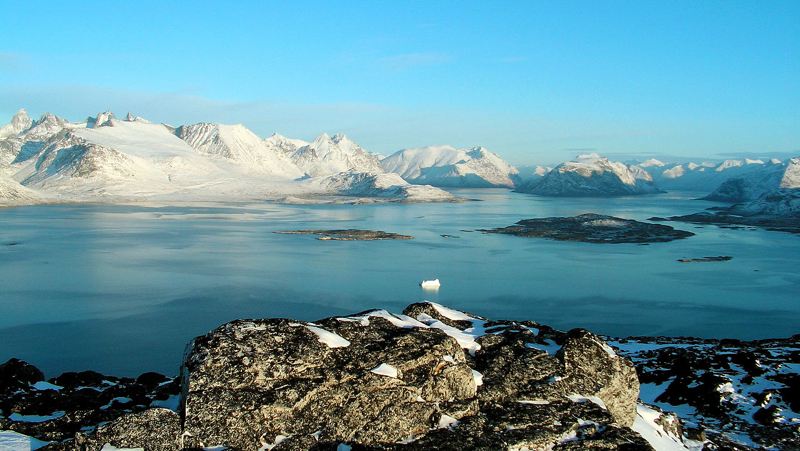
Photo of Ravnefjeldet (Raven Mountain) in the south of Greenland, by Jensbn via Wikimedia

More rare earth wanderings on SmartPlanet:

Greenland and other northerly climes:

Start your week smarter with our weekly e-mail newsletter. It's your cheat sheet for good ideas. Get it.

Mark Halper

About Mark Halper

Mark Halper is a contributing editor for SmartPlanet.

Mark Halper

Mark Halper

Contributing Editor

Mark Halper has written for TIME, Fortune, Financial Times, the UK's Independent on Sunday, Forbes, New York Times, Wired, Variety and The Guardian. He is based in Bristol, U.K.

Follow him on Twitter.

Mark Halper

Mark Halper

Mark has no financial holdings in the companies he writes about. He occasionally travels at the expense of companies or their press relations agencies in order to report on a company or industry event related to it; Mark will prominently disclose this information when appropriate. This relationship will have no influence on his coverage. Companies he covers do not get to review columns in advance, or select or reject topics.

He writes for SmartPlanet and is not an employee of CBS.

If you liked this, don't miss...
15
Comments

Join the conversation!

Follow via:
RSS
+2 Votes
+ -
Greenland melting
It is worth pointing out that if Greenland's icesheet melts we will all be a serious trouble with climate change, rising sea water levels, extreme weather events, etc. So perhaps Mark Halper should be a bit more cautious in his hope for more rare metals, uranium, etc. We have to recycle the rare metals as much as possible, consume less and become more energy efficient so we do not need to build nuclear power stations.
Posted by Finn Jensen
23rd Jan
0 Votes
+ -
Lantern rubbings
Well, the genie's out, so you might as well scrape all those valuable nuggets from the bottom of the bottle.
Posted by markhalper
23rd Jan
0 Votes
+ -
$$$$$ brings good thing to my life.
Where there is money to be made the top will not care if the environment goes south, profit before all else. Then again I do get it, enjoy the trip either way we are going south wether you have capital or not.
Posted by Kiljoy616
18th Mar
+1 Vote
+ -
7m sea level rise
And the complete submersion of many large countries would more than offset any temporary economic benefits for greenland
Posted by dimonic
23rd Jan
0 Votes
+ -
Oh yes because we don't have enough.
Cool can't wait for some major conflicts do with who gets and owns the right to it. Yes please put a rosy spin on a problem that is going to get much worse either way a few billion less people could be a good thing. As long as its not me.
Posted by Kiljoy616
Updated - 23rd Jan
0 Votes
+ -
Stakes in the ground
Yes, it will be interesting to watch different nations arrive on Greenland's shores. Australia is making moves. So, supposedly, is Canada. I don't doubt that China and the U.S. are interested. And so on. In the BBC story I cite in my post, Greenland's prime minister welcomes all comers....Oh, and good luck to you in the hunger games, Kiljoy616!..
Posted by markhalper
23rd Jan
0 Votes
+ -
Smiles all around
What fun its going to be watching that cluster F happen.
Posted by Kiljoy616
18th Mar
0 Votes
+ -
Molten salt reactors
Drawing a contrast between molten salt reactors and solid fuel reactors could be read to imply that molten salt reactors do not use solid fuel. This is not the case. We need rare earths to make the magnets in wind turbines and hybrid motors. The minerals that contain high levels of the rare earth elements also contain high levels of actinide elements like uranium and thorium due to their crystal structure. There is no solid reason to throw away the potential energy benefit of one while getting the energy benefit of the other. The discovered rare earth deposits are not, generally under the Inland Icecap, but at its edges, so melting of the Ice is not necessary, except insofar as it might expose additional resources.
Posted by JeremyBoak
23rd Jan
0 Votes
+ -
50 shades of molten (well, 2 anyway)
Thanks Jeremy. Picking up on your "molten salt" point, there are molten cooled reactor which, as you say, use solid fuel. And then there are molten fueled reactors, in which the fuel is a liquid...And thanks for mentioning wind turbines and hybrid motors. They do indeed use rare earths, as do so, so, many other products that ostensibly save energy, CO2 emissions and/or the environment (and many that don't). I try to keep the list short to keep the blog itself at a reasonable length, and it's always somewhat arbitrary but exemplary of a range... The melting discussion aside, the point is, these minerals are there, and await some political decisions to support their exploitation.
Posted by markhalper
23rd Jan
-3 Votes
+ -
An extension of the problem
At fist i thought this headline was a joke "Greenland can prop up the worlds economy".Yep so we can continue on our binge a bit longer and turn a 7metre rise from total melt of the Arctic and Greenland ice sheets into something we can into which truly drown ourselves.But hey after a 100m rise from the Arctic ice sheet melt and 4 degrees rise in temperature theres EVEN MORE "riches" there!
Posted by mjoldis
23rd Jan
+1 Vote
+ -
'Taint gonna happen, but, if Greenland does melt,
the biggest benefit would come from the availability of a huge new mass of arable land, which could be used for the production of something the world needs more, and that is, food.
Posted by adornoe
23rd Jan
0 Votes
+ -
Think a little deeper
adornoe, You need to think that through a little. If all of Greenland's ice does melt it would raise sea level around 20 feet so you'd probably lose as much land to that if not more as you gain in Greenland. And that doesn't even consider what happens in Antarctica too. Anything that affects Greenland that much is unlikely to leave Antarctica alone.

Also, a large part of central Greenland is below (current) sea level anyway due to the weight of 2 miles of ice pressing it down. Once the ice melts it will start to rebound but that's a process that takes thousands of years.

Finally, nearly all of Greenland is above the Arctic Circle so while it may get fairly warm in the summers it's still going to get bitterly cold in the winters. That limits severely the kinds of crops you can grow. And the soil is bound to be poor quality too. So your glib assumption that we can just grow food there is unrealistic on any short or medium term time scale.
Posted by riverat1
24th Jan
-1 Votes
+ -
Actully, it's you that needs to think a lot deeper...
since, if more land becomes available for agriculture in Greenland, and that land mass is huge, then, there is a net gain from all of the land that is opened, up to all the world.

Then, there is the net benefit to the rest of the world from the rising sea levels, which would make more lands more fertile, simple because of the net gain to the more inland areas, which might have been arid and unproductive, like the Sahara desert. More water instead of ice, means more habitable land, and more productive land.

And, food can be grown with just a little bit of water, anywhere. The cold regions of the world aren't available for productive purposes, but the warmer climates are more easily used for productive purposes. Heck, think of all the land that is available in the Antarctic, but can't be used because it's too "dam" cold and icy.
Posted by adornoe
26th Jan
0 Votes
+ -
A lot of assumptions without any backup
You've obviously never done any farming, I have. Growing crops requires far more than a little water. The soil under the ice sheets of Greenland and Antarctica has been mostly gouged out from glacial reaction and it will take hundreds of years to rebuild the soil. Being above the Arctic (or below the Antarctic) Circle means you still have a period of total darkness for part of the year so it's still going to get very cold because of no sunlight. Your assumption that rising sea levels will make "more lands more fertile" needs far more evidence than just your word that it's true (unless you are God and can simply make it so).
Posted by riverat1
28th Jan
0 Votes
+ -
Greenland Rare Earths the green pathway
If the Danish Colonial powers that currently dictate Greenland's resource policy allow Greenland to develop the world's largest rare earth resource at Kvanefjeld, the specter of the world not being able to develop its low carbon - electron economy due to heavy and light REE resource constraints will likely dissolve. That the Danes may hold up the development of the Kvanefjeld resource by Australia's Greenland Energy and Minerals (ASX:GGG) could still occur... with the Danes justifying the delay using anti-uranium mining rhetoric. However the Danes' motives are somewhat suspect as they have recently said that they wouldn't want to upset China by making the REE market far less China centric.
Posted by Sparty33
23rd Jan
Join the conversation
Formatting +
BB Codes - Note: HTML is not supported in forums
  • [b] Bold [/b]
  • [i] Italic [/i]
  • [u] Underline [/u]
  • [s] Strikethrough [/s]
  • [q] "Quote" [/q]
  • [ol][*] 1. Ordered List [/ol]
  • [ul][*] · Unordered List [/ul]
  • [pre] Preformat [/pre]
  • [quote] "Blockquote" [/quote]

Join the SmartPlanet community and join the conversation! Signing up is fast and free. Don't wait -- we want to hear your opinion!