Follow this blog:
RSS

Goodbye LEDs, hello plastic bulbs?

By | December 3, 2012, 3:43 AM PST

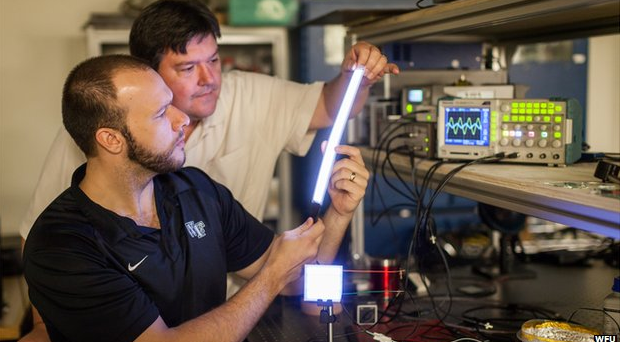
Prof David Carroll, at top, could be saying just one word to his colleague (unidentified) regarding the future of lighting: "Plastics."

Just when LED light bulbs seemed to be gaining traction, along comes a technology that researchers insinuate could trump them: Plastic.

Meet the Fipel - the field-induced polymer electroluminescent light source. According to physicists at Wake Forest University in North Carolina and Trinity College, Dublin, a Fipel requires less energy than a fluorescent bulb does, the BBC reports.

Thus, a Fipel would also be more energy efficient than an LED bulb, since LEDs and fluorescents require about the same amount of electricity. As I wrote last week, LED vendors are struggling in the vast market for commercial office lighting, where buyers are not willing to pay the higher price that manufacturers charge for LEDs, even though LEDs last longer and have other advantages.

The BBC story does not mention any prices for Fipels. But if Fipels represent a significant energy saving over fluorescents, that might induce buyers to spring for them.

Inventor David Carroll, a professor at Wake Forest, says a corporate partner will start producing them next year.  Fipels use “three layers of white-emitting polymer that contain a small volume of nanomaterials that glow when electric current is passed through them,” according to the BBC.

The Wake Forest team originally wrote about its developments in the journal Organic Lighting.

WARMING

The BBC explains that Fipel light is warmer than fluorescents. The story does not compare the light quality to LEDs’ quality, which many people regard as superior to fluorescent and inferior to the warm but inefficient incandescent bulbs still common in homes.

Carroll notes that whereas “curly cue” fluorescent bulbs emit a harsh bluish light that can cause headaches, the light from his bulb accommodates the human eye because it “can match the solar spectrum perfectly.”

That sounds potentially better than LED light quality.

Carroll claims at least four other advantages for Fipels over fluorescents:

    • they’re brighter
    • it’s easy to adjust their tint
    • they do not contain environmentally hazardous mercury
    • they are malleable into different shapes

Their bendiness would threaten another emerging light technology: OLEDs, or organic light emitting diodes, which are natural materials that emit light in response to an electric current. They are supposed to transform lighting by allowing designers to build them into things like building fabric, support structures, furniture and fashion. Electronics makers also want to use them to create foldable  phones, gadgets and TVs.

A DECADE AND COUNTING

But OLEDs “don’t last very long and they’re not very bright,” Carroll claims. “There’s a limit to how much brightness you can get out of them. If you run too much current through them they melt.”

What about longevity compared to LEDs? Light emitting diodes are supposed to last for 25 years or longer (although LED bulb makers provide warranties of only about 7 years). There seems to be no hard figure for the life expectancy of a Fipel, but Carroll says he’s had one working in his lab for about 10 years.

Of course, as LED bulb makers know, it’s a long way from lab triumphs to market success. It’s too early to tell whether people will flip for Fipels. At the least, Prof Carroll is putting pressure on LED companies to continue to improve and lower prices. That should help light the way to a more energy efficient future, regardless of which technology wins.

Photo: Wake Forest University via the BBC.

Watch for my second installment soon on the myth of LED energy savings.

More LEDS and OLEDS on SmartPlanet:

Start your week smarter with our weekly e-mail newsletter. It's your cheat sheet for good ideas. Get it.

Mark Halper

About Mark Halper

Mark Halper is a contributing editor for SmartPlanet.

Mark Halper

Mark Halper

Contributing Editor

Mark Halper has written for TIME, Fortune, Financial Times, the UK's Independent on Sunday, Forbes, New York Times, Wired, Variety and The Guardian. He is based in Bristol, U.K.

Follow him on Twitter.

Mark Halper

Mark Halper

Mark has no financial holdings in the companies he writes about. He occasionally travels at the expense of companies or their press relations agencies in order to report on a company or industry event related to it; Mark will prominently disclose this information when appropriate. This relationship will have no influence on his coverage. Companies he covers do not get to review columns in advance, or select or reject topics.

He writes for SmartPlanet and is not an employee of CBS.

If you liked this, don't miss...
14
Comments

Join the conversation!

Follow via:
RSS
+1 Vote
+ -
Plastic bulbs v LEDs
Great to see that new innovations continue - where this goes depends largely on the costs of both acquiring and using it. One hopes that commerce will see the value of volume with a modest profit compared to lower volume and high mark up.

Does Prof Carrol care to say how many lamps he has had that lasted less than the 10 years of his one specimen.

Tim Williams - U Georgia
Posted by jhtimwill
3rd Dec
0 Votes
+ -
LEDs
The few LEDs I bought lasted 2 to 3 months, then died. I could live with the Fipel, if it really lasted. Till then I have my draw full of 100 watt bulbs plus fluorescent bulbs.
Posted by philwhite42@...
3rd Dec
+5 Votes
+ -
LED life
I have several LED bulbs in use around the house. 2 are outside lamp housings that run a few hours every day. They are surviving just fine in the hot summer and cold winters. I just bought my first 60w replacement LED bulb (800 lumens) to use in the living room. It was $15 at Costco. It is the type that has a warmer color and fires both up and down making it better for a table lamp.

The major problem with LED replacement bulbs is that every one has its own power supply in the base increasing the heat and electronic complexity of the bulb. If a house was designed for LED lighting from the ground up, the house would be wired for 12v DC for lighting and the bulbs would be cheap and last virtually forever.
Posted by KitKimes
3rd Dec
+2 Votes
+ -
LEDs and fluorescent energy usage
The statement that LEDs and fluorescents require about the same amount of electricity is much different than I remember reading. As I recall, a Compact Florescent is 5 times more efficent than an incandescent bulb. and an LED is 20 times as efficent.
That is not to say that this new plastic technology could well be as low in draw as an LED too.
Posted by Rick_hayward99037
3rd Dec
Posted by Hates Idiots
3rd Dec
+1 Vote
+ -
Cool! I mean warm, I mean neat
What a fascinating technology with tremendous potential. Obviously it would be interesting to know how difficult and expensive the product would be to produce.
Posted by ajrmd
3rd Dec
+2 Votes
+ -
Right off the bat...
"...Since LEDs and fluorescents require about the same amount of electricity".
Wrong!
Only the cheap "superbrights" and other Chinese versions are in the 60 lumen per watt (LPW) stereotype. Some are even lower than that (which are presumably soooo old, that they are now sold for very cheap).
If you look up Cree, look for Xlamp, specifically, XP-G, XT-E and expecially XM-L (and check out the specs) you'll see that the led is now TWICE as efficient than florescent technology. They only require 3.2v and a heatsink according to amount of current (up to 3A each). This is most perfect for solar powered and 12v situations.
In fact, the entire household (except for fridge and heater) can be run on 12v DC, now that smart pads and phones, and class D amplifiers are now common place.

There are other competent led companies too (just might not be "thee" most efficient) such as Luxeon...

Some complain about leds burning out. That is ONLY because they are over currented for their rating (I know, stoplights do this, Hmmm cheap ones too?). My Cree (and solar) light experiments have lasted for YEARS, so this fipel had better beat at least 160 LPW (And I just searched, Cree has achieved a 170 LPW bulb at 90 CRI!).
Now, I must read on because I hope the fipel can improve by that factor of 3, too.
Posted by fireofenergy
3rd Dec
+1 Vote
+ -
Mark is not a good journalist.
http://www.reddit.com/r/energy/comments/148h9d/goodbye_leds_hello_plastic_bulbs/c7ayasi

I heard an interview from the BBC on NPR this afternoon, and SmartPlanet got a few things wrong.

>The BBC explains that Fipel light is warmer than fluorescents.

Now, the interviewee didn't specifically compare the two, but he did say that FIPEL lights are cool to the touch and added that they will be room-temperature. As we have all experienced, any type of fluorescent lamp produces heat and can become hot to the touch after extended use. Further, the BBC article says nothing about heat production. Thus, it's wrong to say that FIPEL produces more heat than fluorescent lamps, especially when the comment was completely unprompted. No one said that FIPELs produce ANY heat, let alone more than fluorescent lamps (which would not be an accurate statement).

> nanomaterials that glow when electric current is passed through them

FIPEL, as described in the actual BBC interview, as well as in the [paper](http://www.sciencedirect.com/science/article/pii/S1566119912004831), do not have current pass through them. Although this is a quote from the BBC article, Mark Halper from SmartPlanet clearly regurgitated an already simplified article from the original source. His summary adds nothing and is of the same length, so I'm not sure why he wrote it if not for page views (which is bad journalism). For those interested, FIPEL emits light when subject to an AC-induced electric field, polarizing the cells.

>The [BBC story](http://www.bbc.co.uk/news/science-environment-20553143) does not mention any prices for Fipels

This is the least incriminating way to say "I didn't do any independent research. I basically reprised the information from another article the way an introductory journalism professor would want me to do." The spokesperson I heard interviewed on NPR said that because of the way FIPEL lights operate (glow when exposed to an electric field), they have much better tolerance for imperfection compared to LEDs, which significantly lower costs. While "significant" is a subjective term, I can say that the spokesperson whose interview inspired the original BBC article, claims that FIPEL will be cheaper to manufacture, distribute, and operate than LEDs.

>Its too early to tell whether people will flip for Fipels
Get the **** out of here...
Posted by IOnlyJoinedToCriticizeJournalisticQuality
Updated - 4th Dec
0 Votes
+ -
That's one heck of a handle.
But thanks for joining!
Posted by andrew.nusca
5th Dec
0 Votes
+ -
Fipel light is warmer than fluorescents
This statement appears to be referring to the "color temperature" (http://en.wikipedia.org/wiki/Color_temperature) of the light produced by Fipels compared with the light produced by fluorescents. I.e., Fipel light is more yellow-red in color. It does not have anything to do with the heat generation of the device.
Posted by Matt Heffron
12th Dec
+1 Vote
+ -
LED Bulbs Sound Good, But...
I have purchased LED bulbs for my home and the technology has a ways to go. They are not as bright as incandescent and CFLs, and they are expensive.
As far as longevity, that's spotty at best. Some bulbs ( a small percentage at that) have lasted a while, and failures have abounded
Posted by tjsobieski@...
11th Dec
0 Votes
+ -
"since LEDs and fluorescents require about the same amount of electricity."
Hello.

The writer should have mentioned that LED efficiency varies very widely, and can be far worse, and also far better than that of fluorescent bulbs.

Fluorescent bulbs usually produce 50-75 lumens of light per watt of power they draw (multiply that by the wattage of the bulb), and LEDs produce between 5 and 136 lumens of light per watt of power they draw.

That wide variation needs to be mentioned.

The LEDs I see are usually 40-60 lumens per watt.
Posted by Kompulsa - GE
14th Dec
0 Votes
+ -
Fipel
A plastic strip has got to be a lot cheaper to produce than an LED element. There will also be a better spread of light, and presumably can be made in any size. I have several LED bulbs in use: 60 W equivalent and 75 W equivalent (7 W and 10 W respectively) they give a very satisfactory warm light, and of course, come on instantly.
As far as the heat given out from the old incandescent lamps, this is potentially useful if you live in a cold house. It is not waste heat. It is only a minor waste in the summer.
Posted by kitemanmusic
18th Dec
0 Votes
+ -
LED Versus Plastic
The plastic bulb -What a bright idea. Will there ever be a brighter idea than this? Not likely in the near future. This will certainly be a blessing for humanity specially for those in developing and under developed countries. Hope this will be available in Sri Lanka soon.
Ariya Subasingha - Sri lanka
Posted by Malliks
26th Dec
Join the conversation
Formatting +
BB Codes - Note: HTML is not supported in forums
  • [b] Bold [/b]
  • [i] Italic [/i]
  • [u] Underline [/u]
  • [s] Strikethrough [/s]
  • [q] "Quote" [/q]
  • [ol][*] 1. Ordered List [/ol]
  • [ul][*] · Unordered List [/ul]
  • [pre] Preformat [/pre]
  • [quote] "Blockquote" [/quote]

Join the SmartPlanet community and join the conversation! Signing up is fast and free. Don't wait -- we want to hear your opinion!