Foreign suitors including China eye only U.S. rare earth operator

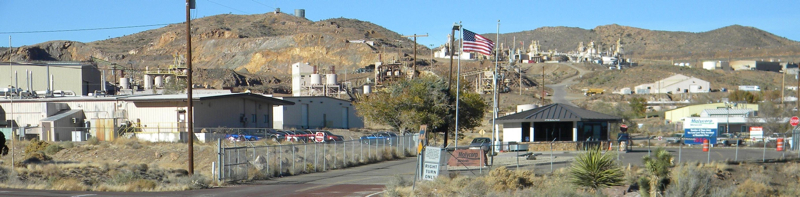
Colorado-based Molycorp Inc. has had nothing but trouble since it reopened the only U.S. rare earth mine a year ago.
Sinking prices have shafted its market value, its CEO Mark Smith departed last month, it's the subject of an investigation by the U.S. Securities and Exchange Commission, and it faces a lawsuit alleging citing engineering deficiencies at its Mountain Pass, Calif. mine, which Molycorp opened, after years of dormancy, to patriotic cheers last February.
With the plunge in its stock, various industrial companies may now be trying to acquire it at a bargain price to assure themselves a source of the vital metals currently controlled by China, which has a grip on 95 percent of the world's supply. Manufacturers build rare earths into smartphones, computers, cars, hybrid and electric vehicles, wind turbines, missiles, light bulbs and many other products.
Suitors include German industrial giant Siemens as well as Japanese and South Korean car makers Nissan and Hyundai, according to a Bloomberg story early this month that cited several industry analysts.
"At this point, Molycorp is definitely in play," Toronto-based Luisa Moreno of Euro Pacific Capital Inc. told Bloomberg. "It would be a very good target for companies that are interested in being in this space if they recognize the rare earth space is important and they have the cash to take Molycorp and make it a real producing company."
GOIN' DOWN DOWN DOWN
Molycorp's difficulties socked investors with a 61 percent loss in 2012, Bloomberg noted. A stock that had traded as high as $77.54 in May 2011 had tanked to $9.44 on Dec. 31, 2012. Shares have been rising recently on takeover rumors.
One rare earth expert doesn't believe that Siemens, Nissan and Hyundai stand a chance. Rather, China would be the most likely acquirer, further cementing its hold on the market.
"Molycorp has no value outside of Chinese control," says Jim Kennedy, president of St. Louis-based rare earth and thorium consulting firm ThREEM3, which also owns right to rare-earth byproducts from Missouri's Pea Ridge iron ore mine. China's ability to influence supply and prices means that any other acquirer would struggle to survive, he said. "Why would any corporation buy Molycorp when 83 percent of its production will sell at a loss?" Kennedy wondered in an email exchange with me.
MEET ME IN THE MOJAVE
Adding legs to his assertion: According to one source, Chinese government officials recently toured Molycorp's Mountain Pass facilities in Mojave Desert, near Nevada. They are not interested in the deposit so much as the company's refining techniques, the source said.
The Chinese government owns many rare earth companies including giant Baotou Steel Rare-Earth. China has recently imposed production and export cuts in an effort to drive up the price of rare earths. It has also undertaken a massive industry consolidation.
One reason that rare earth prices - and thus Molycorp's share value - tumbled is that manufacturers have been finding ways around their reliance on rare earths.
They have also been scrambling to circumvent China's control. (Molycorp faced heavy domestic criticism earlier this year when it became obvious that it was selling much of its U.S.-mined rare earths to China.)
An acquisition of Molycorp would echo a similar move from earlier this year, when an affiliate of Toyota bought half a Canadian rare earth deposit.
Rare earth users have also been casting about for sources of rare earths outside of China. As I noted yesterday, Japan thinks it might have landed a gold mine, so to speak, in Jamaica.
Also as I said yesterday, there's another country that holds great promise as a future source. It's a country that you might say is the opposite of Jamaica. Stay tuned to SmartPlanet.
Images: Mountain Pass by AlanM1 via Wikimedia. Jim Kennedy shot is a screen grab from Gordon McDowell's Thorium Remix video, via YouTube.
Rare earth trotting on SmartPlanet:
- Reggae, reefer and rare earths: Welcome to Jamaica!
- China snubs Western complaints, restricts rare earth exports again
- Need rare earths? Try the Idaho-Montana border
- Toyota affiliate buys half a Canadian rare earth deposit
- Japanese manufacturers to China: We don’t need your rare earths
- Your next refrigerator could be a magnet
- Solve the energy AND rare earth crisis: Join the thorium bank
- China cuts off rare earths. World War ensues. It’s Call of Duty, the video game.
- The two-timing white knight of U.S. rare earth metals
- Philips developing rare earth substitute for LEDs, says CEO
- Why safe nuclear will rely on rare earth minerals
This post was originally published on Smartplanet.com