Follow this blog:
RSS

Disruption by the book: the days of $400 college textbooks may soon be over

By | December 26, 2012, 9:15 AM PST

Are the days of $400 college textbooks coming to an end? Initiatives from Open Educational Resources proponents, and now publishers, may mean more course content from low or no-cost online resources.
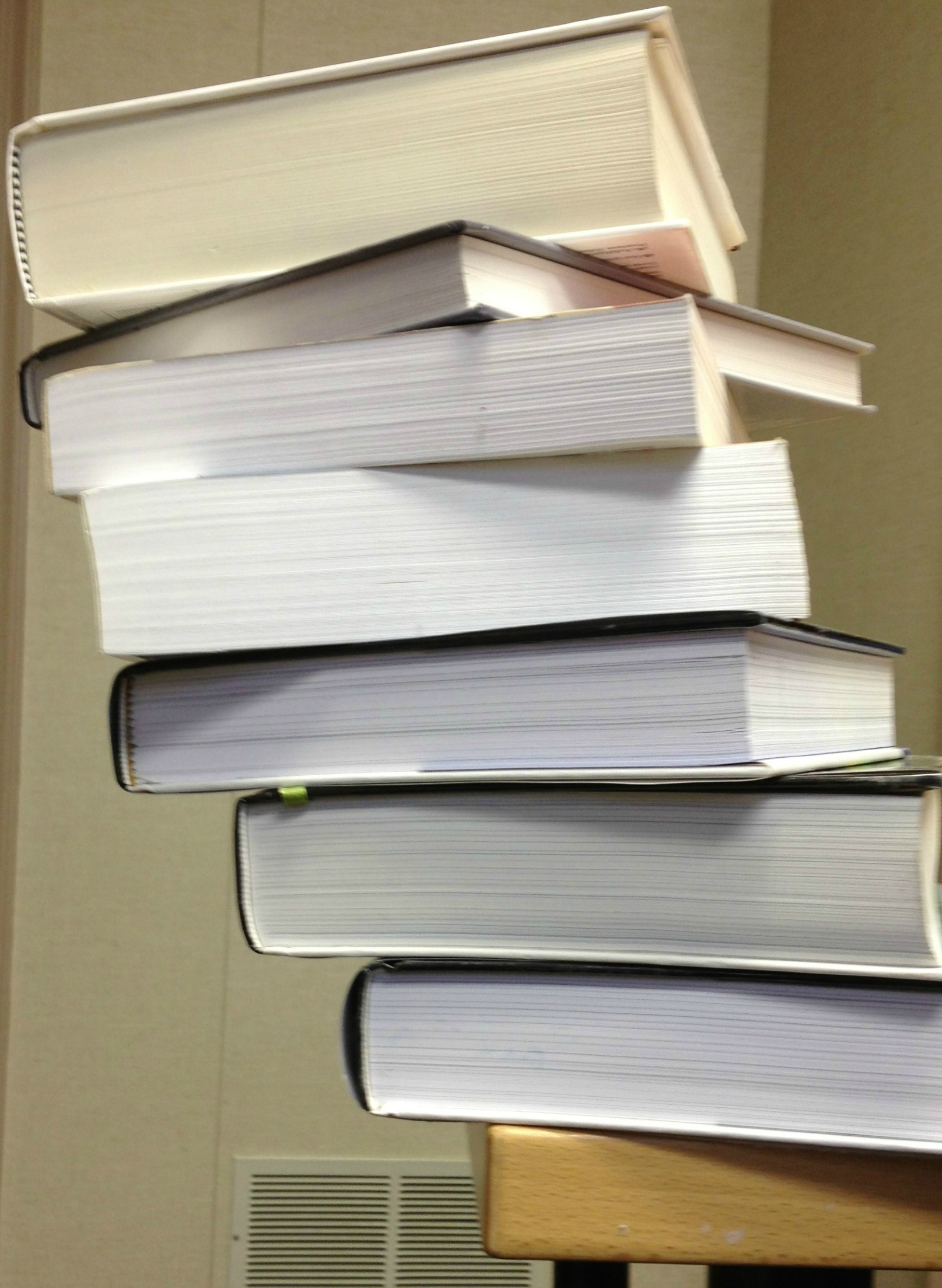
Tipping point for expensive college textbooks? Photo by Joe McKendrick.

Tipping point for expensive college textbooks? Photo by Joe McKendrick.

In previous posts, we’ve talked about the disruption of higher education, through initiatives such as massive open online courses (MOOCs) that deliver world-class education to students of all ages across the globe, at little or no charge. We’ve also talked about the disruption of the publishing industry, and the movement from print to digital. In between those two worlds has been the college textbook industry, which also now appears ripe for disruption.

That’s the observation of Slate’s Kevin Carey, who provides details on  the emerging “Open Educational Resources” movement, responsible in recent years for the provisioning of “high-quality texts, videos, charts, problem sets, and other useful content in a huge array of subjects,” contributed by advocates of open education as well as college professors themselves. A new site, Boundless.com, has been launched to help curate the large database of items now available online to students, learners and educators.

College textbook publishers are not taking this new online competition lying down, however. Earlier in 2012, three publishers sued Boundless, claiming the startup has “has stolen the creative expression of their authors and editors, violating their intellectual-property rights.”

However, likely in recognition of the inevitability of the coming wave of disruption that is beginning to sweep the textbook industry, one of the litigants in the suit, Pearson, announced in November a new venture, Project Blue Sky, which, as Carey describes it, will “use a search engine developed by a company called Gooru specifically for online education, allowing people to ’search, select and seamlessly integrate Open Education Resources.’”

The Gooru search engine was developed by a nonprofit organization to maintain and offer rich collections of multimedia resources, digital textbooks, videos, games and quizzes created by educators in the Gooru community.

There’s been plenty of discussion and efforts in recent times as to how college textbook content will be delivered in the digital age. Apple, for one, has promised major disruption via delivery of all textbooks over iPads. There has even been some controversy over whether students can as readily absorb material delivered digitally. But OER proponents seek to make content delivery more componentized and cost effective.

Start your week smarter with our weekly e-mail newsletter. It's your cheat sheet for good ideas. Get it.

Joe McKendrick

About Joe McKendrick

Joe McKendrick is a contributing editor for SmartPlanet.

Joe McKendrick

Joe McKendrick

Contributing Editor

Joe McKendrick is an independent analyst who tracks the impact of information technology on management and markets. He is the author of the SOA Manifesto and has written for Forbes, ZDNet and Database Trends & Applications. He holds a degree from Temple University. He is based in Pennsylvania.

Follow him on Twitter.

Joe McKendrick

Joe McKendrick

Joe McKendrick is an independent consultant and editor. Joe has performed project work for the following companies in the IT marketspace: IBM, Systinet/HP, Teradata. He has performed project work for the following organizations in partnership with Unisphere Research (Unisphere Media): IBM, Oracle Corp., International Oracle Users Group, Oracle Applications Users Group, Professional Association for SQL Server, International DB2 Users Group, International Sybase Users Group.

He writes for SmartPlanet and is not an employee of CBS.

If you liked this, don't miss...
11
Comments

Join the conversation!

Follow via:
RSS
+2 Votes
+ -
I see a new front in the online copyright war.
For years authors have been fighting a mostly losing battle to retain intellectual rights over their works that end up in the wild and downloadable for free.

For some reason we as a society have created the aura that the Internet magically voids all copyright laws and anything posted on the Internet MUST be free. It is one thing when a person post something for free. It is quite another thing when it is stolen and given away.

Now that you are predicting that tens of thousands of professors are being threatened with losing textbook royalties, I expect to see a massive backlash against this effort unless authors are finally given the royalties they are legally entitled to for all copies of their works sold or stolen. Regardless of medium.

As any college student can attest to, these royalties have driven textbook prices to insane heights.

Way back in 1984 I paid the outrageous sum of $85 for a paperback workbook that was no bigger than a edition of Life Magazine. It was co-written by 4 professors on the campus and was a mandatory requirement for all of their courses. By design you could not resell the book because it contained the quizzes for the semester. Making the book a shredded mess after tearing out a dozen quizzes.

This piece is from 2000, but the percentages textbook authors get have not changed much. Professors will not allow the golden goose to be killed on this billion dollar a year racket.

http://mountainplains.org/articles/2000/opinion/writing_a_textbook.html

Student groups like to blame publishers, but the fact is they refuse to admit their beloved professors are complicit in the scheme.

http://www.studentpirgs.org/campaigns/sp/make-textbooks-affordable
Posted by Hates Idiots
Updated - 26th Dec
+1 Vote
+ -
Maybe it depends on the subject matter?
I know a few college textbook authors and the most they've received in a year has been a couple of thousand dollars. Granted, they're on multi-authored, social sciences books, but even with all of their royalty checks together, they don't make it into the tens of thousands per book. The few thousand a piece is nice of course but it doesn't begin to cover the hours spent writing and editing.
Posted by alywindsor
Updated - 27th Dec
+4 Votes
+ -
But there are other monetary rewards
Having authored a textbook in your field sure helps when you're arguing for tenure, or for a grant, or for a promotion.
Let's face it, most courses can be taught well using existing textbooks (and it need not be the latest edition) or using free stuff.
Posted by dmm99
27th Dec
+1 Vote
+ -
Absolutely
For the authors I know, each textbook amounts to another line on their curriculum vitae. I would argue that that's more the point than the meager royalties they receive.

Most 101 classes might be taught well using existing textbooks but upper level course materials really should include the latest data and research and that can only be accomplished currently by continually updating textbooks.
Posted by alywindsor
27th Dec
0 Votes
+ -
Interesting article
It sounds like textbook writing is sort of like buying a lottery ticket (except that the ticket cost is very high, so only a few people buy one).
Posted by dmm99
Updated - 27th Dec
+3 Votes
+ -
We already pay their salaries
Textbooks written by faculty at public universities, or those whose work is funded by public grants, or those at universities whose tax exempt status means we are subsidizing their salaries, might consider whether the parents of their students have already paid for their time spent writing textbooks. Besides which vast majority of textbook authors don't make $1/hr writing text books, while we have in effect already paid them vastly more than for their time. This argument is not about fairness to authors, it is about textbook publishers efforts to churn the market to keep their profit margins up. Textbooks should be very inexpensive, and until that is the case, offshore sites will continue to spring up that make them available for free, which is a vital service to students in the 3rd world.
Posted by SantaCruzRed
27th Dec
+1 Vote
+ -
Keeping Education Unaffordable
The greed of the publishers and the excessive royalty payments have caused absurdly expensive course materials to become unaffordable, necessitating even more student loans. Even in K through 12 schools, textbook editions change almost yearly, requiring new purchases by the already struggling school systems, in the pretense of keeping "up-to-date", when annual supplements of a few pages would accomplish the same purpose. In this electronic age, the annual updates could be delivered as e-books, home-printed for a nominal charge. As far as college textbooks, considering the outrageous tuition and profit-making housing fees, course materials ought be included, just as they are in K-12. It won't happen, because this country deems it more important to build new unnecessary $Billion-dollar$ sports palaces and guarantee athletes ridiculous pay packages. Perhaps if more were spent on supporting education instead of season tickets, this country might have a chance of surviving. Don't hold your breath. Ancient Rome, redux.
Posted by lodavesf
27th Dec
+1 Vote
+ -
text books
I wonder if an important point is being missed here and elsewhere. The traditional institutions are causing our future students to go into debt (or limit what they can afford) in the long run. The nations with weak or non existent IP laws can churn out trained, educated (true, not Ivy league educated) doctors and engineers for much less. Sometimes shear volume is better than perceived quality. Part of the rise of the US in the '50s-'60s was how many college trained people we churned out thanks to the GI bill. I'm a vet. and I can't afford to go to a top school now. I CAN learn online ( Coursera, and the like.). The old way of teaching got turned into too much of a business model. Some of it was a good idea, but not all of it.
Posted by garyfizer@...
27th Dec
0 Votes
+ -
Well said.
The point on post WW II vets is so true.
Posted by Hates Idiots
28th Dec
0 Votes
+ -
I have said for decades that text books are a scam.
Students are forced to buy the 9th Edition of Algebra for $60, (used) only to find they cannot sell it back to the bookstore because the 10th edition is being used the following semester. Why? Algebra doesn't change!

A student cannot teach themselves algebra from the book. (The explanations are too vague and the examples do not cover all the variations in the chapter questions. Professors don't want to make themselves obsolete!) The books cannot replace the lectures, (and tutors,) but these books are still required by professors that are paid anyway. Why can't the professors write their own chapter questions like High school teachers do? They only have to do it once, and then they can ride on it until retirement. But somehow, that is an unreasonable demand?
Posted by michaellashinsky@...
31st Dec
0 Votes
+ -
Textbooks aren't a scam but publishers can do some shady things
I agree with the above poster's evaluation. It is terrible that there are so many editions printed with the same material inside with a different ISBN. It makes students go further into debt and it is pointless. Algebra shouldn't need that many editions. I can see one coming out every 5-10 years but every year is excessive. Then when you try to sell the books back to the campus bookstores you never get a good price. Thank goodness there are online options like http://bookquoter.com it is a useful tool when you want to find the highest paying payouts from the online buyback sites. Hopefully eventually they will stop with all of the editions. I wonder when it turns into a e-textbook dominated market if they will continue with the edition updates. I'm sure the answer is yes
Posted by Gaman156
25th Feb
Join the conversation
Formatting +
BB Codes - Note: HTML is not supported in forums
  • [b] Bold [/b]
  • [i] Italic [/i]
  • [u] Underline [/u]
  • [s] Strikethrough [/s]
  • [q] "Quote" [/q]
  • [ol][*] 1. Ordered List [/ol]
  • [ul][*] · Unordered List [/ul]
  • [pre] Preformat [/pre]
  • [quote] "Blockquote" [/quote]

Join the SmartPlanet community and join the conversation! Signing up is fast and free. Don't wait -- we want to hear your opinion!