Follow this blog:
RSS

China mulls nuclear ships for polar routes

By | February 22, 2013, 5:44 AM PST

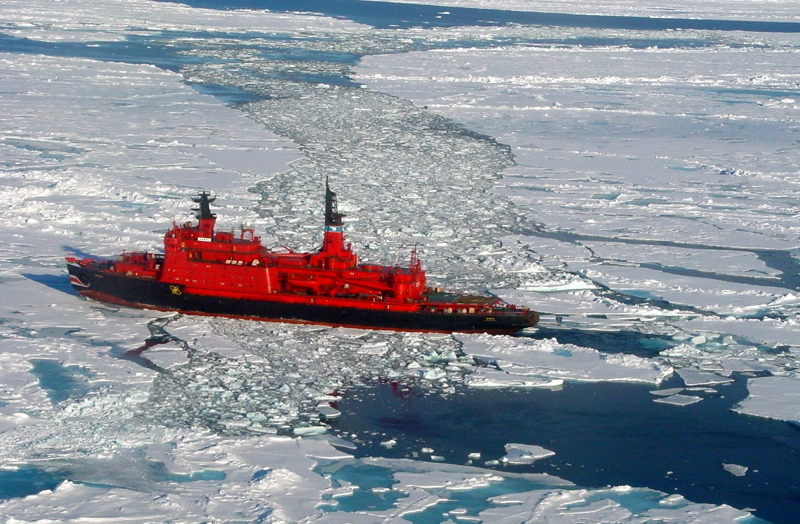
The nuclear icebreaker club currently has only one member: Russia, which has a fleet of them. Above, the "Yamal" nuclear-powered vessel on its way to the North Pole.

China is considering using nuclear-powered ships for polar exploration according to a military official quoted by China Daily.

“Compared with ships that use conventional propulsion, nuclear-powered ships can travel farther and are more reliable, factors that make the ships a reasonable choice for polar expeditionary missions,” said Du Wenlong, a senior researcher at the People’s Liberation Army’s Academy of Military Science.

Du’s remarks came after state-owned China Shipbuilding Industry Corp. said it had received funding to develop nuclear-powered ships.

The story did not provide details of the polar missions. Pure conjecture: You have to get to that Arctic oil somehow!

Presumably the ships would be icebreakers. China would then join Russia as the only country with a fleet of nuclear icebreakers.

As Arctic ice melts, it also becoming more feasible to use the Arctic Ocean to shorten transportation routes, as Russia has done in shipping natural gas to Japan via nuclear vessels - ironically to replace nuclear power in that country.

China made its first Arctic crossing last summer, when the ship Xuelong travelled 90 days from Qingdao on the Pacific Ocean to Iceland in the Atlantic. Expedition leader Huigen Yang, head of the Polar Research Institute of China, said at the time that he had expected to encounter more ice than he did.

The China Daily article points out that China could use the nuclear technology to power aircraft carriers. That’s no huge surprise, since China has already indicated its intentions to build such a craft by 2020. Currently only the United States and France operate nuclear-powered carriers - the U.S. has 10, and France has one.

China is also planning a nuclear powered, hotel-like, ocean floor mining station.

Photo from Wofratz via Wikimedia.

Break through to more nuclear transportation stories on SmartPlanet:

Start your week smarter with our weekly e-mail newsletter. It's your cheat sheet for good ideas. Get it.

Mark Halper

About Mark Halper

Mark Halper is a contributing editor for SmartPlanet.

Mark Halper

Mark Halper

Contributing Editor

Mark Halper has written for TIME, Fortune, Financial Times, the UK's Independent on Sunday, Forbes, New York Times, Wired, Variety and The Guardian. He is based in Bristol, U.K.

Follow him on Twitter.

Mark Halper

Mark Halper

Mark has no financial holdings in the companies he writes about. He occasionally travels at the expense of companies or their press relations agencies in order to report on a company or industry event related to it; Mark will prominently disclose this information when appropriate. This relationship will have no influence on his coverage. Companies he covers do not get to review columns in advance, or select or reject topics.

He writes for SmartPlanet and is not an employee of CBS.

If you liked this, don't miss...
2
Comments

Join the conversation!

Follow via:
RSS
0 Votes
+ -
Building the unnecessary...
Taking a look at the 'worst case' predictions for Arctic sea ice, we're on route to witness the first summer melt-out in 2015 +/- 2 years. (Yes, low probability, but possible this year. Likely by 2015.)

Some researchers have calculated that roughly ten years after the first melt-out we could the Arctic ice free year round.

By the time the Chinese get a nuclear powered ice breaker launched it might no longer be needed.
Posted by Wallace Bob
22nd Feb
0 Votes
+ -
Simple question.
If so much of the Arctic has been frozen over year round for so long, how did British sailing ships prowl much of the Lincoln Sea year round and find Ward Hunt Island in 1876?

http://en.wikipedia.org/wiki/Ward_Hunt_Lake

Or lets go back farther. How did the HMS Investigator become trapped by windblown sea ice in Mercy Bay, another area purported by global warming alarmists to have been frozen solid for millennia.

http://www.cbc.ca/news/technology/story/2010/07/28/hms-investigator-arctic.html

The crew survived 2 years on shore until rescued by other ships sailing into the bay.

Or let us go back even farther and deeper into the Arctic. If the Arctic has been this vast year long frozen wasteland for so long how did explorers find Melville Island Canada in 1819 and the crew wintered over?

http://en.wikipedia.org/wiki/Melville_Island_(Northwest_Territories_and_Nunavut)

Slow and difficult to maneuver wooden sailing ships with no modern tools like sonar picked their way through uncharted waters and nearly navigated the Northwest passage numerous times in the 1800s.

The first ship to complete the journey was powered which proved invaluable when navigating largely uncharted waters in 1903.

Please do not believe the fantasy stories that this part of the world has been frozen forever. They are flat out lies.
Posted by Hates Idiots
25th Feb
Join the conversation
Formatting +
BB Codes - Note: HTML is not supported in forums
  • [b] Bold [/b]
  • [i] Italic [/i]
  • [u] Underline [/u]
  • [s] Strikethrough [/s]
  • [q] "Quote" [/q]
  • [ol][*] 1. Ordered List [/ol]
  • [ul][*] · Unordered List [/ul]
  • [pre] Preformat [/pre]
  • [quote] "Blockquote" [/quote]

Join the SmartPlanet community and join the conversation! Signing up is fast and free. Don't wait -- we want to hear your opinion!