Follow this blog:
RSS

Another myth of LED energy savings

By | December 5, 2012, 4:14 AM PST

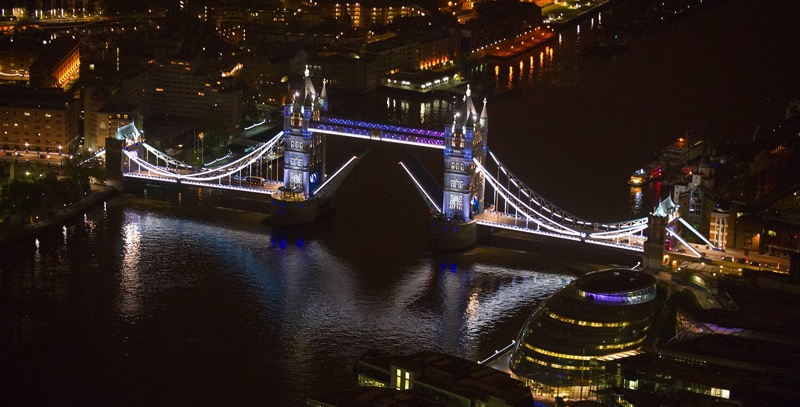
LEDs could become the bridge to an energy efficient lighting future. One potential paradox: Pervasive use could wipe out gains. Above, London's Tower Bridge, with LEDs from GE.

There is little doubt that light bulbs built from light emitting diodes - LEDs - burn only about 20 percent of the energy of the infamously inefficient, century-old incandescent bulbs common in homes.

Thus, the thinking goes, LEDs will help drastically shrink the world’s carbon footprint, given that according to the Earth Policy Institute, lighting consumes about 19 percent of the world’s electricity, spewing an amount of carbon equal to 70 percent of the emissions from the planet’s cars.

But beware unintended consequences! Or, as environmentalist Jonathon Porritt recently called it, “the rebound effect.”

Jonathon Porritt: Beware "the rebound."

Not only are LEDs super efficient (although as I said last week, they are no more efficient than much less expensive fluorescent lights). They also open up enormous new lighting opportunities. They make it easier than ever to illuminate bridges and facades in ever changing, dazzling, controllable multiple colors. Just look at the top of the Empire State Building. Or have you been past London’s Tower Bridge recently? Poland’s Poznan City soccer stadium? Did you see those fiery rings descend from the sky at last summer’s Olympics?

And designers can build them into the structure of everything from buildings to furniture to fashion.

As lighting grows more varied and ubiquitous, the sum total of energy consumption could wipe out all the energy saved by switching to more efficient sources in the first place.

“However good your energy efficiency gain, there is a danger people will then take that gain and use it on additional services that they didn’t have available to them before,” Porritt said in a keynote presentation at the LuxLive 2012 lighting exhibition in London.

“If you look at the whole history of lighting, it’s clear that efficiencies are increasing all the time,”  said Porritt, who is co-founder of sustainability group Forum for the Future.

In response to a question from the audience, he added, “We are beginning to move into a whole suite of lighting technologies where lighting will be used as much for mood enhancement - or as you say, ‘vanity projects’ … You can see the rebound effect gather in the wings here.

“What if all that (efficiency gain) gets gobbled up as we decide there are other uses of lighting that we can really take advantage of. That’s a really big dilemma. I don’t think the industry is hugely aware of that as of yet.”

Actually, the industry is aware of it. One executive from a leading international lighting vendor who asked not to be named told me that Porritt’s “rebound” effect, “Does raise the question of how much energy do you really save. Where is the energy saving - that is a question.”

This is not an unsolvable puzzle. Your answers welcomed below.

Photos: Tower Bridge by Jason Hawkes via GE/Reformer Films. Jonathon Porritt by Slowlife Symposium via Flickr Creative Commons.

More LED myths, legends and realities on SmartPlanet:

Start your week smarter with our weekly e-mail newsletter. It's your cheat sheet for good ideas. Get it.

Mark Halper

About Mark Halper

Mark Halper is a contributing editor for SmartPlanet.

Mark Halper

Mark Halper

Contributing Editor

Mark Halper has written for TIME, Fortune, Financial Times, the UK's Independent on Sunday, Forbes, New York Times, Wired, Variety and The Guardian. He is based in Bristol, U.K.

Follow him on Twitter.

Mark Halper

Mark Halper

Mark has no financial holdings in the companies he writes about. He occasionally travels at the expense of companies or their press relations agencies in order to report on a company or industry event related to it; Mark will prominently disclose this information when appropriate. This relationship will have no influence on his coverage. Companies he covers do not get to review columns in advance, or select or reject topics.

He writes for SmartPlanet and is not an employee of CBS.

If you liked this, don't miss...
85
Comments

Join the conversation!

Follow via:
RSS
+4 Votes
+ -
Not surprised!
There are more and more buildings and other structures being "lit-up" that we're previously either dark or lit only with a few large lamps. When something becomes easier to do, we do it!

Every year, on one day, the lights in downtowns all over the U.S. are turned off at night to demonstrate how much electricity could be saved. Why don't they do that 365 days? I'll admit that downtown Houston is beautiful from every freeway at night, but you would think that the building owners would be interested in saving money.
Posted by AlanLaRue
5th Dec
+3 Votes
+ -
Does anyone remember the late 70s...
...in the wake of the oil embargoes and what-not? For a time, outdoor lighting was practically eliminated. Local and national landmarks that had been lit for decades went dark in the name of "conservation". By the 'early to mid 80s, the lights eventually all came back on, and by the 90s, we were lighting everything like with a vengeance.

Fast forward to the 2000s. I recall flying into Los Angeles during the artificial energy crisis and "rolling blackouts". Even amid a supposed energy crisis, the entire city was lit up like a Christmas tree! "What crisis?" I thought.

Of course, the answer for this was simple: Electrical rates did not reflect the state of the supposed crisis. Since there was no immediate consequence to the individual consumer, why not have everything lit up? Rates were regulated artificially low, this creating a "tragedy of the commons" scenario.

So this article is right-on. Cheap lighting tech is going to encourage illumination in forms never before contemplated. It's not necessarily a bad thing. But this tech certainly will not automatically mean that overall energy consumption will go down. I could be the exact opposite, just as CAFE standards actually encourage more gasoline consumption.
Posted by JohnMcGrew@...
5th Dec
+2 Votes
+ -
re: Does anyone remember the late 70s...
Yes, I remember the mid to late '70's. I remember tripping in public buildings where 2/3 of the overhead fluorescent tubes had been removed. I also remember being able to look north from the Chicago suburbs and see the Aurora Borealis. Today from the same location I'm lucky to see stars on a clear night. The orange glow on the horizon, the result of too many shopping centers illuminating the sky instead of their parking lots (and by design - it's marketing) greatly exceeds the glow I'd have seen from the Great Chicago Fire, had I been around to do so.

Unfortunately, if you give a governing body the choice between the long-term good of the environment (as well as their own bottom line) and making an architectural fashion statement... Call me a cynic, but I'll believe it when I see it.
Posted by BaapidMakwa
5th Dec
+2 Votes
+ -
Yup, just has hyper-efficient automobiles...
...will encourage people to keep driving without a second thought, and will actually increase the demand for energy.
Posted by JohnMcGrew@...
5th Dec
+2 Votes
+ -
So plan accordingly.
Efficient automobiles are much more justified than higher fuel prices. The transport of people, goods, and services (?) will not be reduced - but the cost of doing so must.
Posted by Havokmon
5th Dec
-2 Votes
+ -
Not if...
...the goal is to reduce fuel consumption. As backwards as it sounds, if the CAFE standards worked in reverse, we'd be using less oil today on transportation than we did in the 1970s.

The only way to reduce energy consumption is to have energy cost more, which is politically impossible.
Posted by JohnMcGrew@...
5th Dec
+2 Votes
+ -
That doesn't work either...
Making energy cost more does little to curb most people's consumption. Maybe the day of untamed herds of Hummer H1s straying across California's highways is gone, but the roads are still choked with huge SUVs with one person in them. Just as my kids will never be able to remember to turn off a light when they leave a room, Americans have a very short memory after the energy bill is paid.
Posted by PrimeRisk
Updated - 5th Dec
-1 Votes
+ -
How could it not?
I assure you there'd be far fewer cars on the road today if gas was $6/gallon, and average fuel economy was somewhere around 10 MPG, like it was in the '70s. People on the lower end of the spectrum simply could not afford it.

Remember when gas topped $4/gallon a few years ago? The nightly news was respite with stories of poor "middle class" folk who could no longer afford groceries because of it.

Of course, we did have a different President back then, so that might have had something to do with the coverage.
Posted by JohnMcGrew@...
Updated - 5th Dec
+2 Votes
+ -
You've made my point...
You said it all. When gas topped $4/gallon (guess you're in Cali as it never hit $4 where I'm at) people didn't stop driving, they stopped eating. They kept consuming the energy.

You may have hit on a great solution to a different problem. Force the energy prices up and American's will lose weight!
Posted by PrimeRisk
Updated - 6th Dec
+2 Votes
+ -
Transit usage soared until it was axed
As a daily train rider I witnessed double digit gains in rail ridership in 2008 when gas prices first crossed $4 per gallon. So here in New Jersey where we have transit available people DID get out of their cars. But then later in 2008 just as people were getting on the trains in droves, NJ Transit cut 30% of our Hoboken trains. Over 150 cities cut their Transit frequencies after 2008, ironically for many systems to pay the banksters interest rate swaps. After these cuts rail ridership receded, especially at my stop which suffered initial 40% cuts. IF we just ran the Green Transit we have already people will take it. But it has to be frequent, reliable and timely service.
Posted by orbit7er
6th Dec
-1 Votes
+ -
Hardly.
They'll skimp on food for fuel for only for a short period of time. Logically, given the choice between eating and buying gasoline, eating is going to have to win out. Higher energy prices will ultimately change behavior.
Posted by JohnMcGrew@...
6th Dec
+6 Votes
+ -
Silly
The whole point of this article is silly.

What do you suggest, stop improving anything because people will use it.

Like stop biulding planes because people will only travel.

Stop making medicines because people will live.

Maybe an article on new strategies to manage new technogies would be a better idea.

Perhaps, carbon tax, lighting laws etc.
Posted by Joe Green
5th Dec
+1 Vote
+ -
Not silly
They are talking about _forcing_ us all to use LEDs because of the "energy crisis." The point of this article is that mandating efficiency does not necessarily save energy. And if not, then the justification for the mandate is bogus.
It's like the "water-saving" toilets that have been mandated. If you have to flush them 4x to get rid of your solid waste, then where is the savings?
Or "water-saving" shower heads. If you install one, but take longer and/or more frequent showers, then the savings disappear.
People will economize on water, energy, etc. ONLY if they want to do so. They will want to do so for only a very few reasons, the chief of which are 1) save money, 2) forced rationing, and 3) morality (help environment, help mankind, etc.).
Posted by dmm99
5th Dec
+4 Votes
+ -
90% Savings
LEDs use 90% less power than incandesent bulbs and 50% less than CFLs. So if we replaces Thomas Edison's bulbs with LEDs we would need to add ten times as many LEDs as we replaced. How many people would increase the bulbs by a factor of 10? Anything less than 10 times is a energy saver.

LEDs would need to double over CFL's. Maybe?
Posted by Joe Green
5th Dec
+2 Votes
+ -
Good point - you never see 'lumens' on incandescent bulb packs.
There's a reason for it. To get the same light from an LED compared with an incandescent, you have to crank up the wattage. LEDs are, however, much more manageable. They put the light right where you want it with low scatter effect.
Posted by GuntherGump
Updated - 6th Dec
-1 Votes
+ -
Lumens Needed on LEDs!
Nearly all incandescent Edison-type bulbs have lumens listed on their packaging! Exactly the opposite is true of LEDs, and it is very difficult to choose LED fixtures because of that lack. Often one can find "Equivalent to ## Watt Bulb" (24, 40, 60, etc.) but that is not nearly as useful as an actual maximum lumens rating!
Posted by lodavesf
10th Dec
+4 Votes
+ -
It seems the author has something against LEDs
Your point is funny and the logic is flawless.
I would add that fluorescents are NOT as energy efficient as LEDs. The typical fluorescent burns about twice as much energy as an LED of the same light output.
It seems like the author has something against fluorescents.
Posted by darudmon@...
5th Dec
0 Votes
+ -
His opinion is on the Efficiencies of LED's vs CFL's.
Sure LED's use less power per lumen than a fluorescent bulb, but to cover the same area, you need a bank of LED lights to provide replacement illumination for a fluorescent bulb.

I think what the author is trying to say is that no matter how much we engineer energy saving devices, we just end up using way more of them because of scale of economy for new applications, thus nullify any energy savings that were initially intended. This is a vicious circle for any "new" invention that replaces older. Newer invention does more, so we want more of them to use...

Heck, we just finished Reno's and I have several LED lights installed. Before, I used to turn off all lights at night almost religiously, but now, didn't bother because I (had) thought that I was saving money with them in. But because I left them on all the bloody time, there was in effect no savings.

With each generation of new tech, we also have to learn to curb our own foibles and follies so as to not read too much into this "save vast amounts of money" B.S. The best way to save money is not (only) new tech, but also using those devices/lights/appliances wisely and shutting them off (completely) when not needed.
Posted by Edouin
Updated - 5th Dec
+1 Vote
+ -
That's ok, a lot of the writers here have an axe to grind...
... regarding humanity in general. Some of it is founded, the majority of the angst is not.
Posted by GuntherGump
6th Dec
-1 Votes
+ -
Very silly! This is the crowd that will purpose a solar tax in 15 years
When solar panels are cheap and widely available to run everything you can dream of, the new discussion will be on solar tariffs to 'keep the people from using too much solar' as the new absorbtion will "cause" climate change. Ironically, that may coincide with the next cooling trend.
Posted by GuntherGump
6th Dec
+1 Vote
+ -
Just where do you depart reality, Gump?
Solar CANNOT put carbon into the air, which is what CAUSES Global Warming.

The "absorption" of light into the panel will not do it. That light WOULD have been absorbed by the ground, buildings, plants etc, that WOULD have been there if the panels had not gone in.

Try Science. It's the "other" Faith...
Posted by Lightning Joe
8th Dec
0 Votes
+ -
lightning joe!
.
Posted by RHambeau
13th Dec
+1 Vote
+ -
It is tongue in cheek, but I think his point is this.
The absorption of solar energy by panels will result in a decrease in the amount of solar energy being absorbed by the planet.

Resulting in a cooling of the planet. So the owners of solar panels will be punished for hurting the planet with a punitive tax on solar panels.

There have already been studies on large solar farms altering the local climate, specificly under them, in such a manner.

As with any shaded area, the temperatures are lower out of the sun. Now multiply that effect by 1,000 panels and you have a local climate shift.

A quick search of solar trees on Bing images brings back dozens of examples of built and proposed projects that take advantage of this effect.

http://www.bing.com/images/search?q=solar+trees&id=E44F27824A75FD4E32B101915A00D8096CCA9118&FORM=IQFRBA

Many large scale proposals include statements to the effect that the project will dramatically cool the area as if a forest had been planted.'
Posted by Hates Idiots
14th Dec
+2 Votes
+ -
Inefficiency of incandescents is exaggerated
Here's why:
In fall, winter, and spring, the "waste" heat is not wasted -- it heats your house! (At least, north of Wash.DC.'s latitude, which includes a lot of population.) Yeah, sure, there are less expensive ways to heat your house, but that doesn't change my point. You can't simply say that the heat is wasted when it is not.
Ah, but what about summer? Yes, the heat is wasted. And actually, since the AC is probably on, the waste heat during summer is EXTRA bad. However, during the summer the daylight lasts much longer, so the lights are not on as long.
These real-life effects must be taken into account when determining the inefficiency of incandescent bulbs. I have never seen an honest study. Therefore, I conclude that I am being railroaded by special interests, which certainly don't care about MY best interest, and may not even care about OUR best interests.
Posted by dmm99
5th Dec
+2 Votes
+ -
Problem is...
...that it costs twice as much to get rid of that heat in the summer.

I replaced most of the bulbs that run more than a few minutes a day in my house with LED lights, simply because I resent having to pay for the heat twice.
Posted by JohnMcGrew@...
5th Dec
0 Votes
+ -
Inefficiency of incandescents is exaggerated
Unless you live in the tropics like us, in a hyper efficient house and all that hear gets trapped inside the insulation... A properly designed/built house shouldn't need much heating, even in a very cold climate.
Posted by Damnthematrix
5th Dec
0 Votes
+ -
Really?
Then you've never lived in the Arctic! 6" and 8" insulated walls would be the best, but you still have to heat, and continue heating if you don't want your water pipes to freeze in the winter. Heat doesn't get trapped in the insulation - the cold does. Insulation provides a "neutral" barrier between the indoor (heated) portion of the home to the outdoor (unheated) portion of the home. Typically, an attic is considered the "unheated" portion of the home, and the insulation is on THAT side of the vapour barrier - thus, cold.

If I open up my attic right now, it will be -12C in there right now, even though my home temp is +19C right now. My home is programmed to vary between 16 and 20 C depending on time of day. My attic only varies with the outside temperature.

Unfortunately, because so many of our newer homes are so "airtight" due to vapour barriers, tight fitting doors and air-tight 2 and 3 pane windows, manual fresh-air inlets for both the home and for the furnace (combustion air) are mandatory, so cold air is always infiltrating the home, and warm air leaving (bathroom vents, kitchen vents, etc).

Not everyone has a 6-digit income to afford these "hyper efficient" houses that you mention, and I believe that many studies have shown that the money spent on making such "hyper-efficient" homes would not be recouped or realize any energy-savings for several decades, usually longer than the home owner lives there, removing incentives for home-owners to build such homes in the first place.

As well, these over-engineered homes have a back-end price tag: the technologies that control the home's climate cost a lot of money, and require expensive tech-maint/support/care that is above and beyond normal home costs. Where are the $$$ savings?

People would rather have a less-efficient home and money in the pocket for their SUV's gas tank.
Posted by Edouin
5th Dec
+1 Vote
+ -
Combustion air
Just a note that at least for gas furnaces, 95% efficient units use PVC pipe for supply and exhaust combustion air [no chimney] and are surprisingly affordable. I know, I just installed one.
Posted by ProfQuill
5th Dec
+1 Vote
+ -
Yes, but...
Few people live in the Arctic.
Posted by Greenknight_z
6th Dec
0 Votes
+ -
But a lot of greenies should be moving there soon.
I hear the planet is warming. Arctic real estate could be the next boom! (tongue in cheek)
Posted by GuntherGump
6th Dec
+2 Votes
+ -
with fossil fuels you can do anything
The only reason you are able to live somewhere that cold is entirely due to fossil fuels. It's unsustainable, and one day you will have to leave.
Posted by Damnthematrix
6th Dec
+1 Vote
+ -
Try an envelope, hyper-insulated home.
A double-envelope, or so-called "half-envelope" home, with a 10 to 12-inch layer of good insulation in the OUTER layer (only) is a fantastically energy-saving (and COMFORTABLE) building that can heat itself in any climate save the hard arctic (you know, the land where the sun never rises for half the year).

But of course such a building must have dedicated attention to ventilation, as its heat savings are purchased by cutting off ALL unintended ventilation whatsoever.

For that, we need heat-exchanging ventilation systems, which CAN be designed to operate with no energy input from fans or whatever. A solar chimney could drive them, as well.

Properly constructed, such a building can be heated entirely with solar incidence through a south window face, and by the incidental heat of bodies, cooking, and lights.
Posted by Lightning Joe
8th Dec
0 Votes
+ -
a 440W home?
if you could design a home for four people sufficiently insulated that it can be heated by a 400-440W heater, you'd never need to turn the heater on while everyone was home. People run at about 100W apiece...
Posted by RHambeau
13th Dec
0 Votes
+ -
Air Condintioning Savings
Every 100 watt bulb saved saves 300 watt in air conditioning. So eliminating 100 watts saves a total of 400 watt when in air conditioning mode.

You are correct about the heat of a bulb displacing heat from your furnace. However, many bulbs are used for outdoor lighting, this heat is wasted.
So if a security light is on all night every night, replacing this bulb would probably payback within 12 months.
Posted by Joe Green
5th Dec
0 Votes
+ -
Got the AC thing backwards. 30W not 300W
Got that backwards 100 watts of heat is removed with about 30 watts of air conditioning. That's how a heat pump works at least until the air temp out side is to low and the evaporator will not work. Geothermal does not have that problem to my knowledge.
Posted by Altotus
5th Dec
0 Votes
+ -
Corrected
Thanks for the education. I was using ratios I had heard in the past without checking them myself. After checking, the original estimate of "double " is closer to reality. This would depend on efficiency of AC unit, duct loss, and outside temp. Either way it is extra important to turn lights off or use LEDs when using the AC.
Posted by Joe Green
5th Dec
0 Votes
+ -
Oh yea
Heat in the winter is not a biggie but you pay to pump the heat out in the summer. The HSPF and SEER are in mixed units of Btu and Watts the COP or coefficient of performance is the energy removed over the energy used. A heat pump gives the heat moved and the heat used so the COP heating is higher than the COP to cool in the same device. When the evaporator is too cold the output is only the energy input. So when energy is dissipated in a cooled environment you are paying to remove the heat from the room like refrigerators stoves lights TV etc. Leds are a good thing.
Posted by Altotus
8th Dec
0 Votes
+ -
Nature abhors a vacuum...
We will always use what is produced. The strange thing about electricity is that there really is no way of "saving" it for later use. Use it now or loose it.
So power producers "create" the amount of electricity needed/demanded on a minute by minute basis.
How do we "save" energy and reduce the carbon footprint? Simple answer is eliminate production capabilities. You can't use what you don't produce. There is no footprint for non-production (at least that's the argument).
That leads to brown-outs, rationing, and eventually to lower overall usage. If we follow the logical end of the green movement, electricity will be produced only on an individual basis, eliminating the need for power transmission lines, large scale energy production, and all other forms of mass energy distribution.
Of course, the downside of that is that mass production is always more efficient than individual production. Even if 50% of the people in the US could afford a totally zero footprint home, how do you deal with everyone else? The effect would be: The cities die. No power, no high rises, no stadiums, nothing that requires more power than can be produced within that entity.

I doubt that anyone really wants that type of tradeoff.
Posted by dar1p
5th Dec
0 Votes
+ -
Not really so...
"Of course, the downside of that is that mass production is always more efficient than individual production."

This is NOT always true. In fact, for LOW-DENSITY, dispersed energy regimes, like (oh...) Solar Heating, it is DECIDEDLY not true.

Note that this would subsume your proposal of cutting centralized power generation facilities, because all that power would not even be needed.

Every home could have its own power needs mainly met by solar influx, an inherently local power use enabled by the MOST centralized source available in this solar system: Sol itself.
Posted by Lightning Joe
8th Dec
+5 Votes
+ -
Energy Saving vs More Lights
I think people, at least those that are trying to economize on their energy consumption, will substitute with the more efficient LEDs.

Green-minded people are not likely see energy efficient LEDs an opportunity to maintain or increase their power consumption by adding more light.
Posted by jrcrewe
5th Dec
0 Votes
+ -
I confess...
...to thinking differently about LED lighting, one example -- I have an LED lamp providing background light in my living room, that obviously does not need to be on during the day. I can switch it on and off as I come and go, but then the room may be dark when I enter. I can put it on a timer, but do the math -- the lamp is about 4 watts, a timer consumes 2 watts. With the lamp always on, that's 4x24 or (rounded) 100wh/day. With a timer running 50%, that's 2x24+4x12=(rounded) 100wh/day. Break-even, plus the cost of the timer and the annoyance of resetting it due to the earth's inconvenient tilt. Or, I could do photoelectric, again those things aren't real cheap.

Were it incandescent, or I was controlling a number of lamps, or opting for less 'on' time, the math changes, but for one LED lamp, not a lot of difference.
Posted by ProfQuill
5th Dec
+8 Votes
+ -
What's Mark Halper's Problem?
This is the third article inferring that LEDs are not what they seem. Well, they are what they seem to be, namely, more energy efficient than most flourescent lamp sources, providing better color temperature and rendering than most flourescent sources, better beam control than almost any light source except laser, and an important lighting innovation for the present, with more improvements coming every day. So why does SmartPlant keep beating this drum?
Posted by stan@...
5th Dec
+2 Votes
+ -
What is Mark Halper's issue here??
Mark, how you can you blame a technology for the behaviour of its users?? I also take issue with your assertion that LEDs are no more efficient than Fluorescents. Most LEDs ARE more efficient than the majority of compact fluorescent lamps on the market. They are unidirectional and can therefore provide the working plane with the same amount of light at usually 50-60% LESS wattage than their CFL opponents. LEDs are the way of the future and as usual any technology has its detractors...Mark wake up and smell the roses mate!
Posted by trimbojd
5th Dec
-1 Votes
+ -
Until I read this article, I was just replacing the bulbs in my home...
... Now, I think I'll add 3X as many - heck, by bill will still go down!
Posted by GuntherGump
6th Dec
-2 Votes
+ -
One man's ceiling is another man's floor
THIS IS A REPLY TO "WHAT'S MARK HALPER'S PROBLEM?": Thanks Stan. It's a "discussion" not a "problem". As I've said many times in my posts, I like LEDs and I think they'll do a lot of good as a lighting source. I agree with most of the advantages that you point out, and I'd add one: they don't contain hazardous mercury, whereas fluorescent lights do. I disagree with your point about efficiency: they are generally no more efficient than fluorescent bulbs. I have several sources on this, not the least of which are a) LED vendor executives, and b) the energy features printed on the packaging of LED and fluorescent bulbs. Manufacturers are making impressive strides, and in the long run an honest, broad-minded dialogue will serve them well. That shouldn't be a problem!
Posted by markhalper
Updated - 5th Dec
+4 Votes
+ -
not true
I replaced most of the 11W CFLs in our house with 5W LED globes.... for the SAME light output!

You forgot to say they will also last 25 years......
Posted by Damnthematrix
5th Dec
0 Votes
+ -
Well, if it's a discussion, why not just accept the rebound effect?
Why not discuss trends and estimates of how long the rebound effect will occur and how it is being planned for (by energy producers), and actually how much the rebound effect benefits us all? How say? If the Brits are buying millions to light up tourist attractions, that benefits everyone there by increased revenue. By purchasing so many of these, the makers ramps up production which lowers the cost of each bulb as production efficiency improves, which then helps the rest of us.

If the rebound effect didn't happen with Edison's bulb, the CFL, and LEDs, we'd all still be in the dark.
Posted by GuntherGump
6th Dec
0 Votes
+ -
I would say Henry Ford new about this.
.
Posted by GuntherGump
6th Dec
0 Votes
+ -
Because...
"Why not discuss trends and estimates of how long the rebound effect will occur and how it is being planned for (by energy producers), and actually how much the rebound effect benefits us all?"

Because THAT is the SECOND stage of the discussion. The NECESSARY first stage is recognition of the problem/situation that the emergence of the technology puts us in.

The SECOND stage of the discussion is what you proposed.

But note that without the FIRST stage, the SECOND stage will be either useless, or commonly misunderstood. We FIRST need to examine an emerging problem. THEN, when we UNDERSTAND it, it will become relevant to think of the solutions in depth.

Other wise we get what the Reich have done to Global Warming: an almost UNIVERSAL level of misunderstanding of both the science and its conclusions, that will hamper the discussion for years to come.

THIS article is dealing with the UNDERSTANDING part of the change equation.
Posted by Lightning Joe
Updated - 8th Dec
0 Votes
+ -
Yeah.. Except one thing Mark Halper
Your argument is based on the assumption that we will be using fossil fuel based energy to power these extra lighting applications. By the time LED is everywhere so will be renewable energy generation. Likely LED will be used very heavily in algae biomass cultivation, which could be used to power the lights continuously off grid. If LED are being used more heavily but being used in a way that is off grid sustainable them who cares how much more LED is used. Coal plants will eventuall switch from burning coal to burning algae and other form of biomass.
Posted by AlageMan
Updated - 5th Dec
Join the conversation
Formatting +
BB Codes - Note: HTML is not supported in forums
  • [b] Bold [/b]
  • [i] Italic [/i]
  • [u] Underline [/u]
  • [s] Strikethrough [/s]
  • [q] "Quote" [/q]
  • [ol][*] 1. Ordered List [/ol]
  • [ul][*] · Unordered List [/ul]
  • [pre] Preformat [/pre]
  • [quote] "Blockquote" [/quote]

Join the SmartPlanet community and join the conversation! Signing up is fast and free. Don't wait -- we want to hear your opinion!