Hip-hop architecture goes global

I like Phaidon, but they were more than merely stretching the truth.
The publisher's promotional blog had the recent item excitedly titled "World's first building inspired by hip hop" -- and though it's a catchy headline, it's not even remotely true.
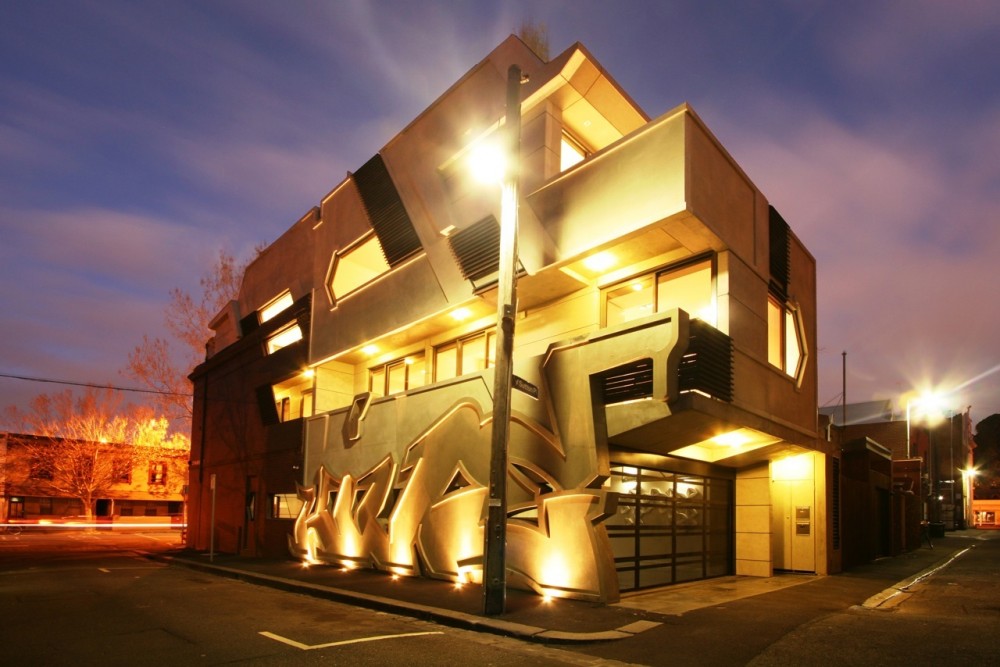
The post was referring to a new house in Melbourne, Australia, with a graffiti-like tag made of concrete on one facade. The Hive apartment, as the tag says and the house is named, is a progressive, capably designed bachelor pad by ITN Architects.
But the fact is that architects around the globe are at least a decade, maybe more, into a valuable experiment in architectural design built on hip-hop, the urban cultural movement that emerged in American cities almost 35 years ago.
Hip hop design scene
The audacious Earl S. Bell in New York is among the best known of today's practitioner hip-hop architects, though there are many others. Dr. Craig Wilkins at the University of Michigan's Taubman College, author of The Aesthetics of Equity: Notes on race, space, architecture and music (University of Minnesota Press, 2007), is certainly the movement's most articulate thinker.
Musical artists are involved, like Kanye West, who established a design shop this year called DONDA, tweeting, "I am assembling a team of architects, graphic designers, directors musicians, producers" and more. Leading cultural critics, notably the "Media Assassin" Harry Allen, offer a serious take on architecture today, too.
We're deep into it. But so are architects like Mokena Makeka of South Africa and King Kong Architects of Bordeaux, France.
Yes, that Bordeaux. Yes, this is an international movement, and while these designers don't build a ton, they do build.
So what's hip-hop building design?
Architecture related to hip-hop is about built ideas inspired of music and dance, drawing in part from artistic ideas like sampling and rapping. Even more to the point, it's mainly an urban form, one meant to be highly inventive while also addressing issues like poverty and blight -- but also the material desires we associate with aspiring DJs and emcees.
Like the musical forms of the same name, it has some clear references to African culture. But we also see vibrant palettes, material innovation and clever juxtapositions. Some of it is gritty, but just as much is utopistic, space-age and Zen.
Green, by definition
It's sustainable too, says Wilkins, reclaiming and reusing. "Hip hop architecture is engaged in taking existing materials and deploying them in transformative ways. Hip hop has taken dated technology and devalued material from the trash heap and made a global community out of the discarded parts of a post-industrial urban environment. It has made the dispensable, indispensable."
Better still, hip-hop architecture helps elevate forgotten people.
Failures in architecture and urban planning helped make this possible, wrote Steve Rose wrote in The Guardian the other day, “Without bad architecture, hip-hop might never have happened.”
Inside the Hive
Back to our first-ever in Melbourne: OK, graffiti is in the mix. But applying spray paint -- or an idea of spray paint rendered in 3-D concrete -- on the side of a fancy suburban dwelling veers dangerously toward cliche. So the Phaidon headline is wrong on many levels. It's not the first. And it's not really even inspired by hip-hop, either.
We need to look for other reasons that Zvi Belling and the Aussie architects are hip-hop.
But it's an important building. Its forms are inventive and well developed at a variety of scales. It looks to the future. Inside, its ledge walls, flooring inlays and ornamental language capture an essential idea about contemporary life. It would be an ideal place for a hip-hop impresario to live.
But instead, as Rose tells in the The Guardian, the superstars Jay-Z and Beyonce have rented a shingle-style Hamptons manse, a bizarre place to find guardians of the urban realm. It's a step backward for hip-hop culture.
It's a bit appalling, especially for a big fan of design with roots in the hip-hop world.
Just as jazz was, in many ways, the music of modernism, we can still expect hip-hop to blossom into a broader movement in the built realm, bringing with it the power of today's music and culture.
We don't need any "world's firsts" to get there, but we could use a few powerful patrons.
This post was originally published on Smartplanet.com