Concrete thinking: New ideas for age-old material

Think concrete is an old, dumb material? Think again.
We associate cutting-edge construction technology with renewables, LED lighting, high-performance glass and smart controls. But the recent advances in concrete are turning heads.
One of the most talked about are the mixes with so much recycled content they barely use cement. Very cool -- and kudos to American Engineering Testing and Cemstone Products for making it happen. But I'll stick to five new categories that seem even more vital to architecture today:
1. Concrete printing. Some architects have dabbled with 3-D printers to create massing models, hardware prototypes and the like. But why not print an entire building?
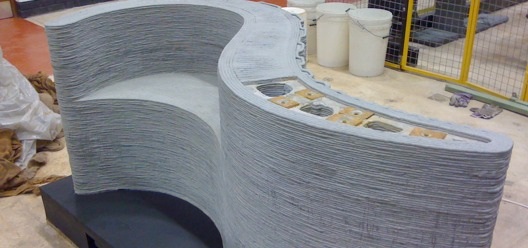
This crazy idea is now possible, using 3-D concrete printers. Following computer instructions based on a translated BIM model, a robotic arm precisely drizzles layer upon layer of concrete to produce walls, decks and other structural shapes. At the U.K.'s Loughborough University Freeform Construction project -- and at a smaller scale at MIT's Mediated Matter lab -- 3-D printing is a reality, and could usher in a new era of mast customization in homebuilding and large-scale construction.
2. Not your father's concrete mix. Everyone's heard of replacing Portland cement in concrete with widely available waste products like fly ash (from coal-burning power plants) and silica fume (from silicon furnaces). But new concrete mixes have ingredients never heard of a few years ago, and much less of the traditional cement, sand, aggregate and water.
The practice is so common now that the acronym SCM, for supplementary cementitious materials, is synonymous with concrete substitute. Today's mixes include viscosity-modifying admixtures (VMAs) like the Rheomac line from BASF and corrosion inhibitors like DCI from Grace Construction Products.
Crystalline admixtures work well for waterproofing, such as the "Krystol Internal Membranes" from Kryton International in Vancouver. Another category is pervious admixtures, also known as no-fines or low-fines concrete, which allows air and water to pass through -- thus letting storm water drain through a parking lot as LEED and EPA prefer.
3. Active concrete. I just invented this category, I think, so please credit me if you use it: Not to be confused with the slabjacking contractor in Ontario, the term describes concrete that does more than just sit and bear loads. (We could even call it "functional concrete," like the novel foodstuffs.)
The concept describes concrete like the pervious mixes -- or their opposite, the water-blocking impervious or hydrophobic concretes using Hycrete's formulas, for example, which don't need waterproofing membranes. Another example is high-density, radioactivity shielding concrete, ideal for X-ray facilities and nuclear reactors alike.
Other novel concrete products prevent rusting of the steel rebars within -- why didn't they think of this before? -- or make it super-flowable or super-stiff, so you can pour it from a distance or just dump it and immediately pull off the formwork. In every case, Active Concrete saves the day!
4. Elementary particles. A new, simple product with big implications is called Elemix, from Syntheon Inc., which are essentially little polystyrene foam pearls that can be mixed in with concrete.
This additive -- called an LSP because it's a lightweight synthetic particle -- is a partial replacement for aggregate that reduces the weight of concrete. That means less steel is needed, and less energy for moving materials like precast concrete panels. Materials costs go down, too, improving ROI. Elemix is ideal for green roofs, and it resists fire and freeze-thaw, too.
5. CNC-generated concrete formwork. Architecture firms are getting in the act, too. One is UN Studio in Amsterdam, which like some other cutting-edge practices are creating their own custom concrete formwork using computer-numeric controlled (CNC) milled materials.
For projects like their Mercedes Benz Museum, the firm is able to produce double-curvature surfaces in concrete -- difficulty level of 12, I'd say -- by ignoring existing formwork systems and cutting their own. They worked with the company designtoproduction to precisely pre-cut the forms with a CNC-router, using the firm's own design files as the starting point.
This post was originally published on Smartplanet.com